Published, reproducible, and explicit about what it cannot establish. If you disagree with a recommendation here, you should be able to point at the step.
The claim we refuse to make
Everyone in this category says they tested twenty sets of panels. We have not tested any, and we say so. We own none of these products. We have no sound meter, no treated room, no test rig and no lab. No amount of confident writing changes that, and a site that borrowed the costume would lose more trust when the gap was noticed than it ever gained.
What we did instead, and it is real work: read every manufacturer's published documentation across six product categories, compile what is actually in it, and do the arithmetic on the page so you can check it. That approach turned up something a test never would have - most of this market publishes a marketing sentence where the measurement should be.
Three acoustic panels out of eleven publish an NRC. One names the test standard behind it.
One file cabinet out of twenty-one publishes a drawer interior, which is the only way to know what a drawer actually holds.
Not one office pod publishes a figure from ISO 23351-1, the standard written specifically for office pods. They publish a building-element rating instead.
Not one acoustic partition publishes an absorption coefficient at all.
Not one desk organizer publishes a load rating.
Those five absences are findings. They came from reading documentation rather than from testing products, and they are more useful to a buyer than one more site claiming to have handled everything.
The four source classes
Every factual claim on this site traces to one of exactly four classes. Anything that fits none of them does not get published.
Named as theirs: "ATS Acoustics publishes an NRC of 1.0". Never restated as our measurement
2. Published standards
The test method a figure derives from: ASTM C423 for NRC, ASTM E84 for fire, ISO 717-1 and ISO 23351-1 for enclosures, UL and ETL for fire boxes
Named when a manufacturer cites one. We do not paraphrase a standard's contents beyond what a source states
3. Live price data
Every price and availability state
From the price layer only. No live price means the button says "Check price on Amazon" - never a stale or remembered number
4. Our own arithmetic
Coverage calculations, linear filing inches, cost per inch, paper weight, footprints
Shown line by line with the inputs visible, so you can reproduce it or dispute a specific step
What is deliberately NOT a source: aggregator figures, numbers lifted from competitor roundups, and Amazon star ratings or review counts presented as quality evidence. Those may be mentioned as popularity context and are never performance claims.
The method, by category
Acoustic panels
Which figure we use: the published NRC, and the standard it was tested to where one is named. ASTM C423 is the governing method.
How coverage is calculated: hard surface area of the room, minus doors, windows and soft furnishing, treated at 15 to 20 per cent. Worked in full on the panel calculator guide.
What we treat as disqualifying: no published absorption figure of any kind. Such a product can still rank, and it cannot score above 6 on the absorption metric.
What we weight heavily: thickness, because it determines how low in frequency a porous absorber works, and it is published far more often than NRC.
Room dividers and partitions
Which figure we use: the published core material and panel thickness, because nothing in this category publishes an NRC.
What we treat as a claim rather than a measurement: any percentage. 'Absorbs at least 85% of noise' names no frequency, no standard and no method.
What we weight: published weight, because a freestanding screen under about 15 lb across 35 sq ft of fabric will move whenever a door opens.
Office pods
Which figure we use: the published RW rating, attributed to the manufacturer, with the standard mismatch named every time it appears.
Why the mismatch matters: RW is an ISO 717-1 laboratory rating for a BUILDING ELEMENT measured between two reverberant rooms. A pod is a freestanding box with a floor, a door seal and a ventilation path. ISO 23351-1 was written for furniture-sized enclosures and reports speech level reduction. Nobody publishes it.
What we weight above the headline figure: published interior dimensions, third-party verification, and any published ventilation data.
File cabinets
Linear filing inches, the arithmetic nobody else publishes
Vertical: folders file front to back, so capacity follows the cabinet's DEPTH
Lateral: folders hang side to side, so capacity follows the cabinet's WIDTH
Usable dimension = published external dimension - 3 in shell and hardware allowance
Linear filing inches = usable dimension x number of file drawers
Cost per inch = live price / linear filing inches
The 3 in allowance is DERIVED, not assumed: the BIZOEIRON lateral is the only cabinet in our whole set that publishes a drawer interior, at 32.44 in inside a 35.43 in exterior - a 2.99 in difference. No vertical cabinet publishes a drawer interior anywhere, so applying the same figure to verticals is an assumption, and we label it as one on every page that uses it.
Storage and shelving
The weight of paper
A standard letter-size banker's box holds about 2,500 sheets
2,500 sheets of 20 lb bond weighs about 25 lb; with the box, about 30 lb
Which is roughly 1.5 lb per linear inch of upright files
So a shelf rated at 30 lb holds ONE box, not three
Our arithmetic. Every shelf-load and cabinet-load comparison on this site runs on these figures, and it is why we score published load ratings separately from capacity.
Desk organizers
Which figure we use: published external dimensions, converted into desk area consumed, against the storage provided.
What is missing across the whole category: load ratings. Not one product publishes one, and we score documentation accordingly throughout.
The scoring rubrics
Each hub has five metrics, scored 0 to 10, applied identically to every product in it. The overall figure is our editorial judgment across those metrics, not a formula - we have not pretended to a weighted average that would imply more precision than the inputs support.
capacity · footprint · build · value · documentation
`documentation` appears in every rubric and carries real weight. In these categories the gap between a published figure and a confident sentence is most of the decision, and nobody else scores it.
What this method cannot tell you
Naming the limits of a specs-only approach is part of publishing it. Here is what we genuinely cannot establish.
How a panel sounds in your specific room. Absorption varies with room geometry, existing furnishing and where the panel ends up. We can tell you what the manufacturer measured in a chamber; your room is not a chamber.
How a drawer feels after two years. Slide quality, whether a lock gets sticky, whether a particleboard drawer bottom bows under a full load. These need time and a unit, and we have neither.
Build-quality variance between production runs. A specification describes the design. Two units from the same listing can differ.
Whether a pod is comfortable to sit in. We have published dimensions and no experience of being inside one.
What a figure means when nobody published it. For the majority of products in several of our categories, there is no absorption figure, no load rating and no drawer interior. We mark that down and we cannot fill the gap.
If first-hand experience ever becomes available to us, it will be documented here with what was examined, how, for how long and by whom - and only then would the no-testing statement change. Until that happens it stands unaltered on every page.
How we are paid, and what it does not change
Felt & File is an Amazon Associate. When you buy through a link here we earn a commission at no extra cost to you. That is the whole business model.
What it does not do is move a ranking. Picks are ordered on published specifications and our own arithmetic, every one carries an explicit reason to skip it, and several of the products we rank highest are the cheapest things in their category - the best value per filing inch on this site is a 40-dollar cabinet, and the single best-value purchase anywhere here is a 17-dollar door sweep.
Where a product has no live price, the button reads Check price on Amazon rather than showing a number we cannot stand behind. Prices are refreshed daily and carry the date they were verified; anything older than 48 hours stops displaying automatically rather than going stale.
The numbers where zero is the good number
Our disclosures
Units we claim to have tested
0
Sponsored placements
0
Free products accepted
0
Products ranked for commission rather than specification
0
These are the only honesty metrics we publish, because zero is the good number in each. A count of something we lack, sitting among positive statistics, would read as a deficiency rather than as a position - which is why the stance above is written as prose with the method beside it.
Corrections
If a figure on this site does not match the manufacturer's own published specification, tell us and we will fix it. Email info@feltandfile.com with the page and the figure. A correction that changes a recommendation gets a visible note on the page and an updated date.
That is not a courtesy, it is the only quality control a method like this has. We are reading hundreds of specifications; some of them will be wrong on the listing and some of them we will read wrong. The full policy is on the editorial policy page.
A worked example
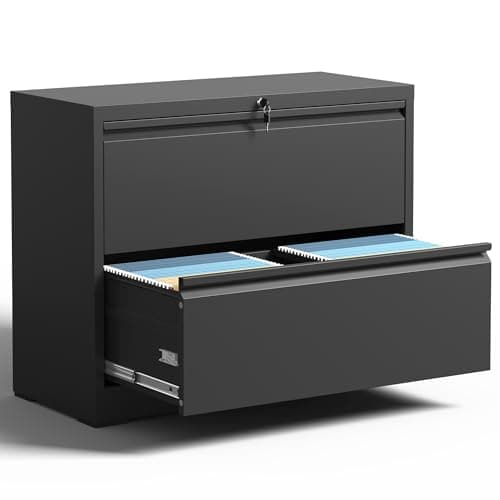
Everything above, applied to one product. This is the top pick from our lateral file cabinet ranking, and the reason it wins is visible in the specification table below: it is the only cabinet in our entire set that publishes a drawer interior, so its capacity is measured rather than estimated.
01/BIZOEIRON
2-Drawer Lateral File Cabinet, 35.43 in Wide
Best lateral cabinet
9.2/ 10
The only cabinet in this hub that publishes its drawer interior, so its capacity is measured rather than estimated. Central lock, one drawer at a time, soft-close.
The only cabinet in this hub that publishes its drawer interior, so its capacity is measured rather than estimated. Central lock, one drawer at a time, soft-close.
Published specification
Dimensions
28.5 in high x 35.43 in wide x 15.75 in deep
BIZOEIRON published specification
Drawer interior
32.44 in wide x 13.98 in deep x 9.8 in high, both drawers identical
BIZOEIRON published specification
Filing capacity
64.88 linear in (2 drawers x the published 32.44 in interior width)
Our arithmetic from BIZOEIRON's published drawer interior — measured, not estimated
Cost per linear inch
About 2.00 dollars at the price shown when written
Our arithmetic from the live price and the capacity above
Weight
40 lb
Listing published specification
Lock
Central locking system, one lock for all drawers
BIZOEIRON published specification
Anti-tip
Only one drawer can open at a time
BIZOEIRON published specification
Slides
Ball-bearing, soft-close
BIZOEIRON published specification
Capacity
Letter and legal hanging files
BIZOEIRON published specification
What the specs are good for
Publishes the drawer interior. It is the only cabinet here whose capacity we did not have to estimate, and that alone earns it the top spot
64.88 measured filing inches from two drawers, more than double the 2-drawer verticals
A true interlock: only one drawer opens at a time, which on a 40 lb cabinet is the thing stopping it coming over
Soft-close ball-bearing slides, specified
Takes legal as well as letter
What they are not
35.43 in wide needs a 3 ft run of clear wall, which a small room may not have
40 lb is light for a lateral, and the interlock is doing real work as a result
Only 15 units in stock at the time of writing
Assembly required
Skip this if
Skip this if you do not have 3 ft of free wall. A lateral's whole advantage is width; in a narrow space it becomes an obstruction and a vertical is the right shape.
Who it is for. Anyone with a wall and more than a couple of years of paper. This is the cabinet we would buy.
No. We own none of them, we have no meter or test room, and we say so on every page. What we do is read every manufacturer's published documentation, compile what is in it, and do the arithmetic on the page so you can check it.
How can you recommend something you have not used?+
By being specific about what the recommendation rests on. Every figure we publish is either a manufacturer's own specification, named as theirs, or our arithmetic from it with the working shown. Where a figure does not exist we say so and mark the product down, which is more information than most sites that claim to have handled everything will give you.
Do you get paid for rankings?+
No. We earn an Amazon commission when someone buys through a link, and it never affects an ordering. Several of our top picks are the cheapest products in their category, and the single best-value purchase on the site is a 17-dollar door sweep.
Where do the prices come from?+
A live price layer refreshed daily from Amazon. Every displayed price carries the date it was verified, and anything older than 48 hours stops displaying automatically - the button falls back to Check price on Amazon rather than showing a number we cannot stand behind.
Why do you score documentation?+
Because in these categories the gap between a published figure and a confident sentence is most of the decision. Three acoustic panels out of eleven publish an NRC. One file cabinet out of twenty-one publishes a drawer interior. Scoring that absence is the most useful thing we can do with it.
What do I do if a figure here is wrong?+
Tell us, with the page and the figure. We check it against the manufacturer's published specification and correct the page if you are right. A correction that changes a recommendation gets a visible note and an updated date.