Everyone says cover 20 to 30 per cent of something. Here is the actual sum, with your room dimensions as the input and a panel count as the output.
SMBy Scooter M.Published October 3, 2026Prices verified October 3, 2026
The short answer
For a typical 12 by 10 ft home office with a hard floor and bare walls, you need somewhere between 48 and 84 sq ft of panel - six to eleven 24 by 48 in panels. Most twelve-packs sold as room kits cover 15 to 30 sq ft, which is why people hang a whole box and hear almost nothing. The rest of this page shows the arithmetic so you can run it on your own room rather than taking our figure for yours.
Why this page exists
We looked at the pages ranking for this question and none of them does the sum. The standard advice is to cover 20 to 30 per cent of your wall area, which raises three immediate questions nobody answers: which walls, does the ceiling count, and 20 to 30 per cent of a room with a carpet and a sofa in it?
So this is our methodology page for the acoustics pillar. Every number below is either arithmetic you can check or a published figure we have named the source of. We have not measured a room, we have no meter, and we are not pretending otherwise - what we have done is set out the calculation properly so you can disagree with a specific step rather than with a vague recommendation.
Step 1: measure the hard surfaces, not the floor area
The thing that makes a room sound bad is reflective surface area, not volume. A 12 by 10 ft room with a thick carpet, curtains and a fabric sofa has far less reflective surface than the same room with laminate and blinds, and needs far less treatment.
Hard surface area, worked for a 12 x 10 ft room with an 8 ft ceiling
Four walls: 2 x (12 x 8) + 2 x (10 x 8) = 192 + 160 = 352 sq ft
Ceiling: 12 x 10 = 120 sq ft
Floor: 12 x 10 = 120 sq ft
Gross total = 592 sq ft
Less a door (about 21 sq ft) and a window (about 15 sq ft) = 556 sq ft
Less a carpet or large rug, if present (about 100 sq ft of it) = 456 sq ft
Less soft furnishing: a fabric sofa or bed, curtains (call it 36 sq ft) = about 420 sq ft of reflective surface
Our arithmetic. Subtract whatever is genuinely soft in your room: a hard floor, roller blinds and a leather chair subtract almost nothing, and a carpeted room with curtains and an upholstered chair starts much lower.
420 sq ft is the number the rest of this calculation runs on. Measure your own room, subtract your own soft surfaces, and carry your figure forward.
Step 2: decide the coverage fraction
The useful coverage fraction depends on what you are trying to achieve, and this is where the published advice is vaguest. Our working bands, stated as our judgment rather than as a measurement:
Coverage against outcome
Coverage of hard surface
What changes
For a 420 sq ft room
5%
Barely perceptible. The usual result of hanging one twelve-pack
21 sq ft
10%
Noticeable on calls. The echo on your own voice softens
42 sq ft
15 to 20%
Obviously different in the room, not just on a microphone. Our target band
63 to 84 sq ft
25 to 30%
A controlled room. Approaching what a treated studio feels like
105 to 126 sq ft
Over 40%
Over-absorbed. The room starts feeling unnaturally dead
Over 168 sq ft
These bands are our editorial judgment from the mechanism and from the coverage figures manufacturers themselves suggest. They are not measured results and we have not tested them in a room.
For a home office where the goal is better calls and a room that does not ring, 15 to 20 per cent is the right target. You are not building a studio. Going past 25 per cent costs money for diminishing benefit.
Step 3: turn square feet into panels
Panel count for a 420 sq ft room at 15 to 20 per cent
Target area = 420 x 0.15 = 63 sq ft (lower bound)
Target area = 420 x 0.20 = 84 sq ft (upper bound)
A 24 x 48 in panel = 2 ft x 4 ft = 8 sq ft each
63 / 8 = 7.9, call it 8 panels
84 / 8 = 10.5, call it 11 panels
So: 8 to 11 panels of 24 x 48 in
Our arithmetic. For a smaller 10 x 10 room the same method gives roughly 6 to 8 panels; for a 14 x 12 room, 10 to 14.
Now run the same target against the products people actually buy, which is where the gap becomes obvious.
What one pack of each product actually covers
Product
Published coverage
Packs needed for 63 to 84 sq ft
ATS Acoustics 24 x 48 in panel
8 sq ft each
8 to 11 panels
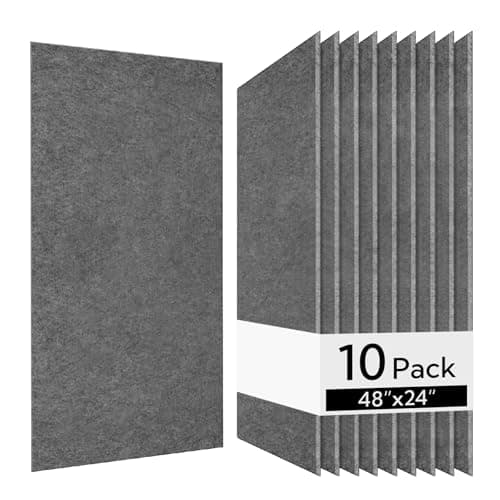
Olanglab 10-pack felt
77.35 sq ft
1 pack
TONOR 8-pack self-adhesive
About 61.9 sq ft
1 to 2 packs
Art3d wood slat 4-pack
30.8 sq ft
2 to 3 packs
NeatiEase wood slat 4-piece
About 33 sq ft
2 to 3 packs
JaneTech 6-pack squares
About 23 sq ft
3 to 4 packs
INNO STICKERS 16-pack tiles
15.5 sq ft
4 to 6 packs
TONOR hexagon 12-pack
About 10 sq ft
6 to 9 packs
Focusound foam 52-pack
52 sq ft
1 to 2 packs
Coverage figures are each manufacturer's own published specification; pack counts are our arithmetic against the 63 to 84 sq ft target for a 420 sq ft room.
Step 4: the correction nobody makes, and should
Everything above treats a square foot of panel as a square foot of absorption, which is only true if the panel absorbs essentially everything that hits it. That is what an NRC of 1.0 means.
A panel at NRC 0.9 absorbs about 90 per cent of the energy reaching it, so 8 sq ft of it does the work of 7.2 sq ft of perfect absorber. A panel with no published NRC at all cannot be corrected for, because there is no number.
The same room, corrected for published NRC
Target: 63 to 84 sq ft of EFFECTIVE absorption
ATS Acoustics at NRC 1.0: 63 / 1.0 = 63 sq ft of panel = 8 panels
TONOR at a published NRC 0.9: 63 / 0.9 = 70 sq ft = about 1.2 packs
INNO STICKERS at a published 0.6 to 0.85: 63 / 0.7 = 90 sq ft = about 6 packs
Any panel with no published NRC: not computable
Our arithmetic, treating NRC as a simple efficiency multiplier. That is a simplification: NRC is an average across four frequency bands and real absorption varies with frequency and with how the panel is mounted. It is a better approximation than ignoring the figure, and it is the reason we weight published NRC so heavily in the acoustic panel rankings.
Step 5: what the calculation cannot tell you
Being specific about the limits is part of publishing a method rather than a rule of thumb.
Frequency. This whole calculation treats absorption as a single number. In reality a 0.3 in felt panel does good work above 1,000 Hz and very little below 500, while a 2 in mineral wool panel reaches meaningfully lower. Two installations with identical square footage can sound completely different.
Placement. A panel at a first reflection point does far more than the same panel in a corner behind a bookcase. Where to place acoustic panels covers this, and it is free.
Room geometry. Parallel hard walls produce flutter echo that is disproportionately annoying and disproportionately easy to fix with a small amount of material in the right place.
What your room already has. Our 420 sq ft figure subtracts a carpet and some soft furnishing. A room with a thick rug, full curtains and a fabric sofa may need half what this suggests.
Whether absorption is your problem at all. If the complaint is a neighbor rather than an echo, none of this applies. Acoustic panels vs soundproofing is the page you want.
The practical version
01Measure your room and compute the hard surface area using the method in step 1. Subtract what is genuinely soft.
02Multiply by 0.15 and by 0.20. That is your target range in square feet.
03Divide by the published coverage of the product you are considering. Use the pack coverage, not the panel count.
04If the product publishes an NRC, divide again by that figure. If it does not, know that you are estimating.
05Start at the bottom of the range and add more if it is not enough. Absorption is additive and you can always hang another panel; you cannot easily un-hang eleven.
#
Product
Best for
Score
Price
01
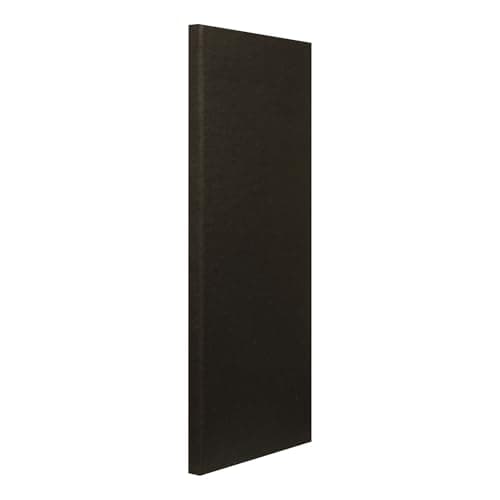
ATS Acoustics Beveled Edge Panel, 24 x 48 x 2 inThe same NRC 1.0 mineral-wool build as the Sona panel in jute burlap with a beveled edge, for about 16 dollars less.
Olanglab PET Felt Wall Panels, 10-Pack 48 x 24 in77 sq ft of recycled PET felt for about 150 dollars, which is the cheapest real coverage on this page. Thin, so it works on voices and not on rumble.
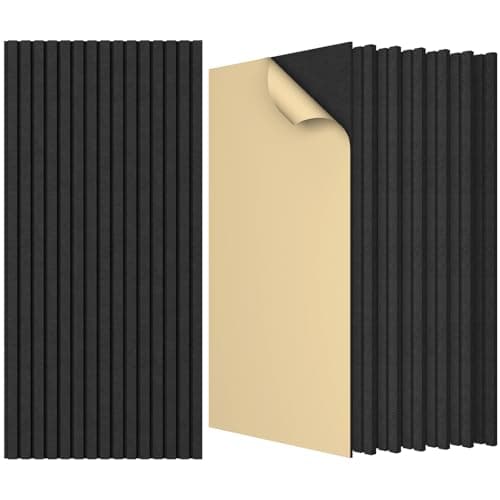
TONOR Self-Adhesive Acoustic Panels, 8-Pack 47.2 x 23.6 inPublishes both an NRC of 0.9 and a material density, which almost nothing else at this price does, and sticks on without a single screw.
Scores are ours, from the published rubric on our methodology page. They are editorial judgments about published specifications, not test results — we have not handled these units.
01/ATS Acoustics
Beveled Edge Panel, 24 x 48 x 2 in
Best measured panel under 80 dollars
8.4/ 10
The same NRC 1.0 mineral-wool build as the Sona panel in jute burlap with a beveled edge, for about 16 dollars less.
The same NRC 1.0 mineral-wool build as the Sona panel in jute burlap with a beveled edge, for about 16 dollars less.
Published specification
Panel size
24 x 48 x 2 in
ATS Acoustics published specification
Coverage per panel
8 sq ft
Our arithmetic from the published panel size
NRC
1.0 (publisher states out of 1)
ATS Acoustics published specification
Core
Mineral wool, solid wood internal frame, full wood back
ATS Acoustics published specification
Fabric
100% jute burlap
ATS Acoustics published specification
Weight
8.25 lb
Listing published specification
What the specs are good for
Same published NRC 1.0 and same mineral wool core as the Sona panel, for less money
Beveled edge reads as a deliberate architectural element rather than a studio accessory
Full wood back means it sits flat against drywall without bowing
What they are not
Burlap is a coarser, more rustic texture than the Sona fabric and shows dust
The listing does not restate the ASTM E84 fire rating that the Sona panel carries
Still a single panel per purchase
Skip this if
Skip this if the room is a living space where the panel has to look soft and finished. Burlap looks like what it is, and in a shared room that reads as equipment.
Who it is for. Anyone who wants the measured build and does not care that the fabric is agricultural.
77 sq ft of recycled PET felt for about 150 dollars, which is the cheapest real coverage on this page. Thin, so it works on voices and not on rumble.
77 sq ft of recycled PET felt for about 150 dollars, which is the cheapest real coverage on this page. Thin, so it works on voices and not on rumble.
Published specification
Panel size
47 x 23 x 0.31 in, 10 panels
Olanglab published specification
Coverage
77.35 sq ft total
Olanglab published specification
Cost per sq ft
About 1.94 dollars at the list price shown
Our arithmetic from the live price and the published coverage
Material
Recycled PET felt
Olanglab published specification
Absorption
Manufacturer states "absorbing up to 85% of sound"; no NRC and no test standard published
Olanglab published specification
Thickness
0.31 in
Olanglab published specification
What the specs are good for
77 sq ft in one box, enough to treat a whole small office rather than one wall
Under 2 dollars per square foot, roughly a sixth of the measured 2 in panels
Cuts with a knife, so awkward walls and sockets are not a problem
Slot pattern reads as deliberate wall decor in a shared room
What they are not
The "85% of sound" claim is a marketing sentence, not a measurement: no NRC, no frequency range, no standard
At 0.31 in thick it works on speech reflections and does essentially nothing below about 500 Hz
Ten thin panels is a long install compared with two thick ones
Skip this if
Skip this if your problem is a neighbor, traffic, or a washing machine. Thin felt does not touch low frequency and no quantity of it will. That is a blocking problem and panels are an absorbing product.
Who it is for. The person whose calls sound echoey in a hard room and who wants the whole room treated this month.
Self-Adhesive Acoustic Panels, 8-Pack 47.2 x 23.6 in
Best for walls you cannot drill
8.0/ 10
Publishes both an NRC of 0.9 and a material density, which almost nothing else at this price does, and sticks on without a single screw.
Publishes both an NRC of 0.9 and a material density, which almost nothing else at this price does, and sticks on without a single screw.
Published specification
Panel size
47.2 x 23.6 x 0.35 in, 8 panels
TONOR published specification
Coverage
About 61.9 sq ft total
Our arithmetic from the published panel size
NRC
0.9 (manufacturer's published figure; no test standard named)
TONOR published specification
Density
212.2 kg/m3
TONOR published specification
Material
100% polyester fiber
TONOR published specification
Mounting
Self-adhesive backing
TONOR published specification
What the specs are good for
An NRC figure AND a density figure, which together are the most spec data anyone publishes in the peel-and-stick tier
212.2 kg/m3 is a genuinely high density for polyester felt and it is why the NRC claim is plausible
No fixings at all, which makes this the rental answer
About 62 sq ft, enough for two walls of a small room
What they are not
Names no test standard for the NRC, so the figure is unaudited
0.35 in thick: same low-frequency limitation as every felt panel
Adhesive needs a smooth, clean, dry wall and can lift paint on removal
Skip this if
Skip this if your walls are textured, freshly painted, or anything other than smooth and sound. Adhesive panels on a rough or chalky surface fall off, usually about three weeks later.
Who it is for. A renter with smooth walls and a landlord, who still wants a density figure behind the purchase.
How many acoustic panels do I need for a 12 by 10 ft room?+
Eight to eleven 24 by 48 in panels, which is 64 to 88 sq ft, assuming a hard floor and bare walls. That comes from about 420 sq ft of reflective surface after subtracting a door, a window and some soft furnishing, treated at 15 to 20 per cent coverage. The full working is on this page.
Is 20 per cent coverage enough for acoustic panels?+
For a home office, yes. Fifteen to twenty per cent of the hard surface area is where the change becomes obvious in the room rather than only on a microphone. Past 25 per cent you get diminishing returns, and past about 40 per cent the room starts to feel unnaturally dead.
Why did one pack of acoustic panels make no difference?+
Because most packs are far smaller than people assume. A 12-pack of hexagon tiles is about 10 sq ft, which in a normal room is under 3 per cent coverage - a quarter of the way to merely noticeable. The product works; one pack is a sample rather than a treatment.
Does the ceiling count toward acoustic panel coverage?+
Yes, and the floor does too. Reflections come off every hard surface. A hard ceiling is one of the most reflective surfaces in a room and one of the least treated, which is why suspended panels do well per square foot: they absorb on both faces.
Do I need more panels if they have a lower NRC?+
Yes, roughly in proportion. A panel at NRC 0.9 does about 90 per cent of the work of a perfect absorber, so you need about 11 per cent more area. A panel with no published NRC cannot be corrected for at all, which is why we weight the published figure so heavily.
Can I have too many acoustic panels?+
Yes. Past about 40 per cent coverage a room starts to feel unnaturally dead, which most people find uncomfortable rather than pleasant. That takes far more treatment than anyone buying from a normal budget is likely to install.
Sources
Where these numbers came from
We have not handled any of these products. Every figure on this page is either the manufacturer's own published specification, named as such, or our arithmetic from those figures, shown so you can check it. Prices come from Amazon through our price layer and carry the date they were verified.
Amazon product listings, retrieved 2026-10-03
Published specifications, dimensions, materials and manufacturer claims were read from each product's own listing data. Prices and availability refresh daily and carry their verification date on the page.
The full published method, and an explicit statement of what a specs-only approach cannot tell you.
ASTM C423 — Standard Test Method for Sound Absorption and Sound Absorption Coefficients by the Reverberation Room Method
The governing test method behind any NRC figure. We name it where a manufacturer publishes an NRC so you know what the number is a result of. We have not performed this test and we do not restate anyone's NRC as our own measurement.