Buying containers first is why the tidy lasts a fortnight. The order matters more than the products.
SMBy Scooter M.Published October 3, 2026Prices verified October 3, 2026
The short answer
Decide what leaves the room before you decide where anything goes, and buy containers last. Almost every home office organizing failure is the same: someone buys a set of attractive boxes, fills them with things they should have thrown away, and discovers in three weeks that they now have tidy clutter. Sorting first costs an afternoon and nothing else, and it changes what you need to buy - usually downward.
Step 1: empty it
Everything off the desk and out of its drawers, onto the floor. This feels destructive and it is the only step that reliably works, because you cannot assess what you have while it is distributed into the places it accumulated.
Do the desk first and the cabinets later. The desk is where the daily friction is, it is the smallest surface, and finishing it in one session gives you something to protect.
Step 2: four piles, not categories
Do not sort by topic. Sort by how often you touch it, because that is what determines where it should live.
The four piles
Pile
What goes in it
Where it ends up
Live work
Projects currently in progress. Usually three to six things
On the desk, vertically, in slots with visible labels
Reference
Things you might need: records, manuals, contracts, past tax years
In a filing cabinet, out of sight
Supplies stock
Spare pens, paper, cables, batteries, the dongle
Under the desk or in a cabinet. NOT on the desk
Leaves the room
Expired, duplicated, superseded, unidentifiable
Today. Shred, recycle, return, bin
The fourth pile is the point of the whole exercise. In most home offices it is the largest, and every item in it is something you would otherwise have bought a container for.
Step 3: assign homes by frequency
Three zones, and the rule for each is about frequency rather than importance.
01On the desk: hourly. The pen, the notebook, the live projects. Three to six things and a tray. Everything else on a desk is being stored rather than used, and storage does not need to be on a desk.
02Under the desk: weekly. Supplies stock, the printer paper, the cables. Reachable without leaving the chair, invisible when you are not reaching. An 11-dollar mounted drawer is the cheapest storage you own.
03In the cabinet: monthly or less. Reference, records, archive. Out of sight, behind a lock if it is sensitive, and you should be happy never to open it.
Test it against the pile. If your live-work pile is twelve projects, you do not have a storage problem, you have a commitment problem, and no container fixes that. If your reference pile is 40 inches of paper, you need a 3-drawer lateral and not another desk tray.
Step 4: now buy things
And only now, because the piles tell you the sizes.
What to buy, by pile size
If your pile is
Buy
Roughly
Live work: 3 to 6 projects
A desk organizer with vertical slots and trays
17 to 34 dollars
Supplies stock: a drawer's worth
An under-desk mounted drawer, or drawer inserts
11 to 19 dollars
Supplies stock: more than a drawer
A rolling cart with a published load rating
42 to 66 dollars
Reference: under 30 linear inches
A 2-drawer cabinet
40 to 130 dollars
Reference: 30 to 70 linear inches
A 2-drawer lateral
100 to 130 dollars
Reference: over 70 linear inches
A 3-drawer lateral
160 to 180 dollars
Boxes and bulk, not folders
A steel storage cabinet with a published shelf load
84 to 160 dollars
Anything irreplaceable
A certified fire box, alongside the cabinet
68 to 100 dollars
Measure your reference pile standing upright, in inches. That figure compares directly to the linear filing inch numbers we publish for every cabinet, and it is the only measurement that tells you what to buy.
Step 5: the part that makes it last
Everything above is a one-day project. What keeps the room organized is one scheduled habit, and it has to be scheduled rather than aspirational.
Fifteen minutes, weekly, to run one physical inbox back down to empty. Not a filing habit at the moment paper arrives - that requires attention exactly when you have none. One tray that everything lands in, processed once a week when you can think.
That is the whole system. The reason it works is that it only has to happen once, and the reason the daily version fails is that it has to happen every time.
#
Product
Best for
Score
Price
01
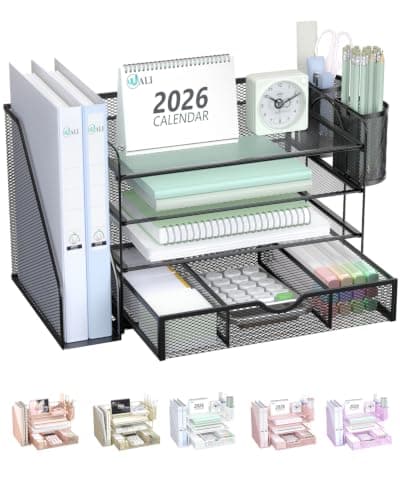
WALI 4-Tier Desk File Organizer with DrawerFour letter trays, a vertical file section, two pen holders and a sliding drawer in a 13.58 by 9.84 in footprint. Seventeen dollars.
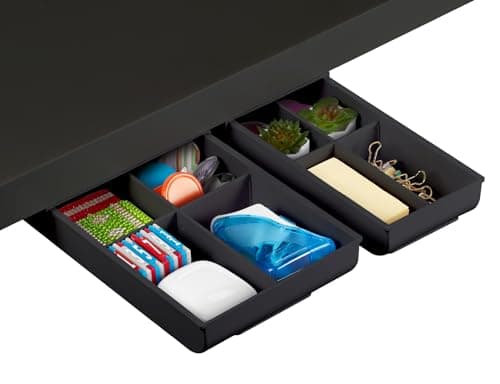
Bostitch Konnect Under-Desk Drawer, 2-PackTwo self-adhesive slide-out drawers with four dividers for 11 dollars. The cheapest storage on the whole site and the one we would buy first.
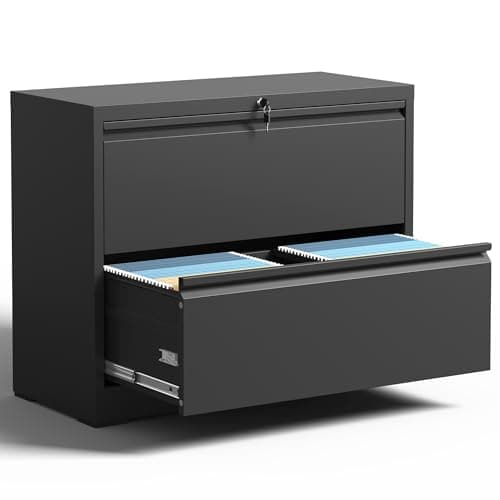
BIZOEIRON 2-Drawer Lateral File Cabinet, 35.43 in WideThe only cabinet in this hub that publishes its drawer interior, so its capacity is measured rather than estimated. Central lock, one drawer at a time, soft-close.
Scores are ours, from the published rubric on our methodology page. They are editorial judgments about published specifications, not test results — we have not handled these units.
01/WALI
4-Tier Desk File Organizer with Drawer
Best desk organizer
8.4/ 10
Four letter trays, a vertical file section, two pen holders and a sliding drawer in a 13.58 by 9.84 in footprint. Seventeen dollars.
Four letter trays, a vertical file section, two pen holders and a sliding drawer in a 13.58 by 9.84 in footprint. Seventeen dollars.
Published specification
Dimensions
13.58 in wide x 9.84 in deep x 5.71 in high
Listing published specification
Sections
4 letter trays, 1 vertical file section, 2 metal pen holders, 1 sliding divided drawer
WALI published specification
Material
Thickened steel wire mesh with dense small aperture
WALI published specification
Assembly
Required; no tools
WALI published specification
Load rating
Not published
Absence confirmed against the published specification
What the specs are good for
Four trays AND vertical filing AND a drawer AND pen holders, in under one square foot of desk, for 17 dollars
The vertical section is the part most organizers at this price leave out, and it is where live folders go
Dense small mesh rather than wide wire, so paper clips do not fall through
The sliding drawer is divided, so it does not become a single tray of chaos
What they are not
No published load rating, and four loaded letter trays is real weight on a wire frame
5.71 in tall means the trays are shallow; each holds a modest stack, not a ream
Mesh collects dust and is awkward to clean
Assembly required, which at this price means thin fixings
Skip this if
Skip this if your paper arrives in stacks rather than sheets. Four shallow trays overflow fast, and at that point you need a desktop drawer unit or a filing cabinet, not more trays.
Who it is for. Any desk with a paper problem and a square foot to spare. This is the default pick for the hub.
Two self-adhesive slide-out drawers with four dividers for 11 dollars. The cheapest storage on the whole site and the one we would buy first.
Two self-adhesive slide-out drawers with four dividers for 11 dollars. The cheapest storage on the whole site and the one we would buy first.
Published specification
Drawer size
9.06 x 5.61 x 1.91 in
Listing published specification
Pack
2 drawers, 4 customizable dividers
Bostitch published specification
Weight
0.9 lb
Listing published specification
Mounting
Self-adhesive to the underside of the desktop
Bostitch published specification
Load rating
Not published
Absence confirmed against the published specification
What the specs are good for
Eleven dollars for two drawers, which is the best value on the site by a distance
Four removable dividers across two drawers, so pens, cables and sticky notes each get a compartment
Mounts entirely under the desktop, so it costs zero desk surface and zero floor
Bostitch is an actual office-products brand with a product line behind it
What they are not
No published load rating, and adhesive mounting under a desk is exactly where you want one
1.91 in deep: this holds stationery, not notebooks or anything with a spine
Self-adhesive only, no screw option, so removal will take finish with it
Needs a smooth flat underside, which a desk with a frame rail or a cable tray may not have
Skip this if
Skip this if your desk underside is textured, has a visible frame, or is anything other than a flat smooth panel. Adhesive drawers come off, and they come off full.
Who it is for. Every desk. This is the first eleven dollars we would spend on a cluttered one.
The only cabinet in this hub that publishes its drawer interior, so its capacity is measured rather than estimated. Central lock, one drawer at a time, soft-close.
The only cabinet in this hub that publishes its drawer interior, so its capacity is measured rather than estimated. Central lock, one drawer at a time, soft-close.
Published specification
Dimensions
28.5 in high x 35.43 in wide x 15.75 in deep
BIZOEIRON published specification
Drawer interior
32.44 in wide x 13.98 in deep x 9.8 in high, both drawers identical
BIZOEIRON published specification
Filing capacity
64.88 linear in (2 drawers x the published 32.44 in interior width)
Our arithmetic from BIZOEIRON's published drawer interior — measured, not estimated
Cost per linear inch
About 2.00 dollars at the price shown when written
Our arithmetic from the live price and the capacity above
Weight
40 lb
Listing published specification
Lock
Central locking system, one lock for all drawers
BIZOEIRON published specification
Anti-tip
Only one drawer can open at a time
BIZOEIRON published specification
Slides
Ball-bearing, soft-close
BIZOEIRON published specification
Capacity
Letter and legal hanging files
BIZOEIRON published specification
What the specs are good for
Publishes the drawer interior. It is the only cabinet here whose capacity we did not have to estimate, and that alone earns it the top spot
64.88 measured filing inches from two drawers, more than double the 2-drawer verticals
A true interlock: only one drawer opens at a time, which on a 40 lb cabinet is the thing stopping it coming over
Soft-close ball-bearing slides, specified
Takes legal as well as letter
What they are not
35.43 in wide needs a 3 ft run of clear wall, which a small room may not have
40 lb is light for a lateral, and the interlock is doing real work as a result
Only 15 units in stock at the time of writing
Assembly required
Skip this if
Skip this if you do not have 3 ft of free wall. A lateral's whole advantage is width; in a narrow space it becomes an obstruction and a vertical is the right shape.
Who it is for. Anyone with a wall and more than a couple of years of paper. This is the cabinet we would buy.
Empty it, sort by how often you touch things rather than by topic, deal with the leaves-the-room pile today, assign homes by frequency, and buy containers last once you know the sizes. Then book fifteen minutes weekly to run one inbox back to empty.
What should I buy to organize my home office?+
Nothing, until you have sorted. Then: a desk organizer with vertical slots at 17 to 34 dollars, an under-desk drawer at 11, and a file cabinet sized to your reference pile measured in linear inches. That is about 60 dollars plus the cabinet.
Why does my office get messy again?+
Usually two reasons: supplies are stored on the desk rather than under it, and there is no scheduled reset. Fifteen minutes a week processing one physical inbox is what makes a one-day tidy last, because it only has to happen once rather than at every moment paper arrives.
How much paper should I keep?+
Far less than most people do. Scan anything you might need and keep the scans off-site; keep originals only where the original matters, which for most households is under twenty sheets. A document filing system for a home has the keep-and-shred list.
What goes on the desk and what goes under it?+
On: things you touch hourly - a pen, a notebook, live projects in vertical slots. Under: supplies stock, spare cables, paper, anything weekly. The test is whether forgetting it exists for a day would cause a problem.
Sources
Where these numbers came from
We have not handled any of these products. Every figure on this page is either the manufacturer's own published specification, named as such, or our arithmetic from those figures, shown so you can check it. Prices come from Amazon through our price layer and carry the date they were verified.
Amazon product listings, retrieved 2026-10-03
Published specifications, dimensions, materials and manufacturer claims were read from each product's own listing data. Prices and availability refresh daily and carry their verification date on the page.
The full published method, and an explicit statement of what a specs-only approach cannot tell you.
Our arithmetic: the weight of office paper
A standard letter-size banker's box holds about 2,500 sheets; 2,500 sheets of 20 lb bond weighs about 25 lb, so a full box is roughly 30 lb including the box. That works out at about 1.5 lb per linear inch of upright files. Every shelf-load and cabinet-load comparison on this site uses those figures and shows the sum.