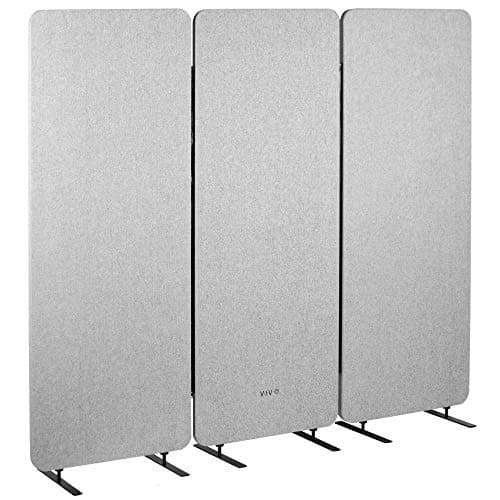
Half of this category is fabric on a steel frame and half has an absorbing core. They look identical in a photograph and do completely different jobs.
Which divider, in one paragraph
If the problem is what appears behind you on video calls, buy a 50-dollar folding screen. If the problem is noise in a shared room, you need a partition with a published core material, and that is a 320 to 450 dollar purchase. Those are two different products that photograph identically. The gap between them is roughly 330 dollars and the most useful thing this page can do is make sure you buy the one that matches your actual complaint.
The split that runs through this whole category
Half of what gets sold as a room divider is fabric stretched over a steel or iron frame: no core, no absorbing mass, and - to the credit of most of the sellers - no acoustic claim either. It blocks a sightline completely, which is what it is for, and it will not change what a microphone hears.
The other half is an acoustic partition: a panel with a PET or polyester fiber core, usually on a weighted or castered base, weighing 47 to 67 lb rather than 9 to 21. It absorbs reflections and interrupts the direct path between two people, which in a shared room is a real and noticeable change.
Telling them apart from a listing
What the listing says
What it means
Names PET, polyester fiber or acoustic felt
There is an absorber inside. The real signal
Publishes a panel thickness
Best available evidence. Nothing else predicts absorption as well
Describes only Oxford fabric and an iron frame
No core. A visual screen, and usually an honest one
States "absorbs at least 85% of noise"
A sentence, not a measurement. No frequency, no standard
Weighs 9 to 21 lb across 30-plus sq ft
Fabric on a frame. No absorbing mass exists at that weight
Not one acoustic partition we examined publishes an NRC or names a test standard, so core material and thickness are the only evidence available in this category.
What even the good ones cannot do
No divider at any price makes a conversation private. A partition does not reach the ceiling, does not reach the floor, and has essentially no mass. Sound travels over, under and around it regardless of what the core is made of.
That is not a flaw. A divider that sealed to the ceiling and floor and weighed enough to block sound would be a wall. If genuine privacy is the requirement, the honest answer is an enclosure, which is what office pods are and why they start at 3,200 dollars.
Three things decide a divider
Coverage is height times width. A 66 in screen hides a seated person completely and a standing person from the shoulders down; 75 in covers a standing adult. Width matters more than people expect because of the camera - a 24 in panel looks fine in the preview and reveals the whole room the moment you lean.
Stability is weight and base geometry, and it is where the cheap end genuinely fails. Nine pounds carrying 37 sq ft of fabric is a sail: in a room with a ceiling fan, an air vent or a door that opens, it will move. Two products in this category do not publish a weight at all, and for a freestanding screen that is the specification.
Mobility, if the room has two jobs. A dining room that becomes an office at nine wants wheels or a screen that folds flat. If the divider will stand in one place forever, do not pay for either.
The desk-sized version
If the problem is one workstation rather than a room, a desk screen costs 30 to 160 dollars and takes no floor at all. It clamps to the desk edge or stands on the surface, and a felt or polyester one does genuinely useful work on call quality because it sits a foot from your mouth, which is the best position a small amount of material can occupy.
The one compatibility question is the thickness of your desktop's front edge - VIVO publishes 0.4 to 1.4 in, Yaomiao publishes 3/4 to 2 in, and several sellers publish nothing. Best desk privacy panels has the full table, and do desk privacy panels reduce noise is the honest assessment.
#
Product
Best for
Score
Price
01
VIVO Freestanding Privacy Panel, 72 x 66 in (PP-3-T072G)Three zip-linked 23.8 in panels on flexible feet, 51.4 lb, tackable surface. The only partition here with a model number and a consistent spec sheet.
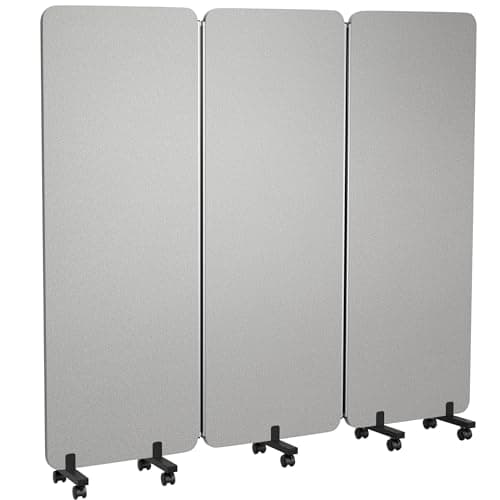
KERRAM 3-Panel Foldable Office Partition with WheelsNames its core material as 100% high-density polyester fiber, states a 1.13 in panel thickness, folds flat, and runs on 10 self-locking casters.
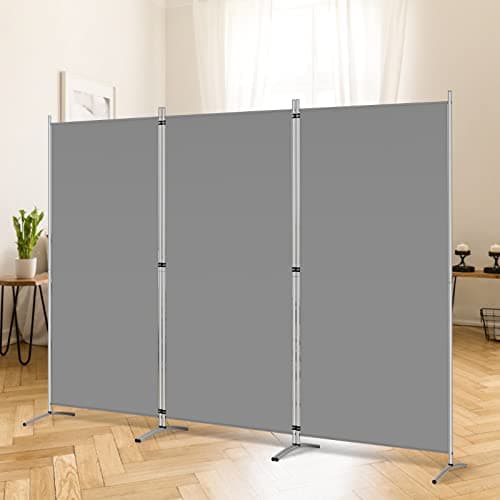
RANTILA 3-Panel Folding Privacy Screen, 102 x 71 in102 inches of sightline for 50 dollars. Fabric on a steel frame, 13.3 lb, no acoustic material and no claim of any.
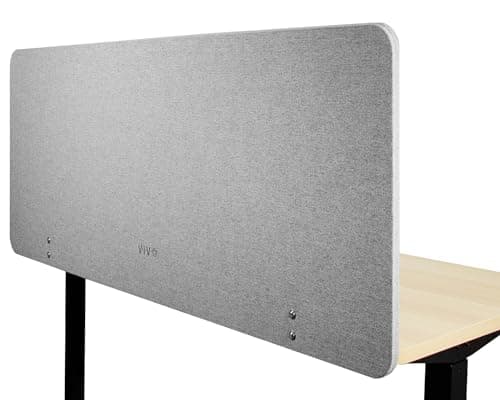
VIVO Clamp-On Desk Privacy Panel, 60 x 24 in (PP-1-V060G)Clamps to a 0.4 to 1.4 in desktop, mounts above or below the surface, and ships with cable spacers. The only desk panel here with a real model line.
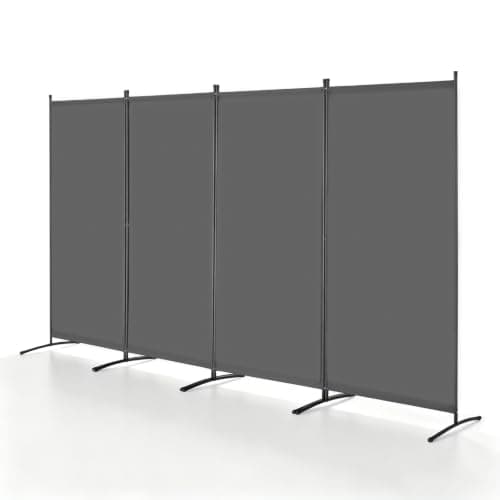
VEVOR 4-Panel Room Divider, 136 in Wide136 inches across four panels for 61 dollars, on an iron frame at 21.4 lb. The most sightline per dollar on the site.
Scores are ours, from the published rubric on our methodology page. They are editorial judgments about published specifications, not test results — we have not handled these units.
01/VIVO
Freestanding Privacy Panel, 72 x 66 in (PP-3-T072G)
Best office partition
7.6/ 10
Three zip-linked 23.8 in panels on flexible feet, 51.4 lb, tackable surface. The only partition here with a model number and a consistent spec sheet.
Three zip-linked 23.8 in panels on flexible feet, 51.4 lb, tackable surface. The only partition here with a model number and a consistent spec sheet.
Published specification
Overall size
72.4 in wide x 65.8 in high
VIVO published specification
Panel size
23.8 in wide x 65.8 in high, 3 panels
VIVO published specification
Weight
51.4 lb
Listing published specification
Model
PP-3-T072G
VIVO published specification
Surface
Tackable
VIVO published specification
Configuration
Zipper connections; straight wall or curve; usable singly
VIVO published specification
Absorption
Not published for this model. VIVO states sound-reducing material on its clamp-on panels but publishes no figure for any of them
Absence confirmed against the published specification
What the specs are good for
A real model number and dimensions that match across the listing, which is rarer in this category than it should be
51.4 lb across three panels on flexible feet, so it stands where you put it and does not walk
Zip connections mean you can use one panel at a desk and three to wall off a corner, from the same purchase
Tackable surface turns the partition into usable wall, which a small room does not otherwise have
What they are not
No published absorption figure, at 400 dollars. That is the main thing to understand before buying it
Flexible feet take up about 2 ft of floor depth at the base
No wheels on this model; the mobile version is a separate 450-dollar product
Skip this if
Skip this if you are buying it to make calls quieter. It is a sightline and a pinboard, and a good one. For noise, our acoustic-partition picks below publish a core material and this does not.
Who it is for. Someone carving a work corner out of a shared room who wants a partition that looks deliberate and survives being moved.
Names its core material as 100% high-density polyester fiber, states a 1.13 in panel thickness, folds flat, and runs on 10 self-locking casters.
Names its core material as 100% high-density polyester fiber, states a 1.13 in panel thickness, folds flat, and runs on 10 self-locking casters.
Published specification
Overall size
71 in wide x 66 in high
KERRAM published specification
Panel thickness
1.13 in
KERRAM published specification
Core
100% high-density polyester fiber, fabric outer
KERRAM published specification
Frame
Aluminum
KERRAM published specification
Casters
10 self-locking swivel casters
KERRAM published specification
Assembly
3 to 5 minutes; casters only, no panel assembly
KERRAM published specification
Absorption
Not published as a figure. The core material and thickness are published, the NRC is not
Absence confirmed against the published specification
What the specs are good for
States a panel thickness AND a core material, which together are the two facts that decide whether a partition does anything acoustically
1.13 in of high-density polyester is a genuine absorber, unlike fabric on a steel frame
Folds completely flat for storage, which no other acoustic partition here does
Aluminum frame keeps the weight down without the flex of a thin steel tube
Ten self-locking casters and a 3 to 5 minute setup
What they are not
No NRC or absorption coefficient published, so the thickness and material are the only evidence
380 dollars for 32 sq ft of partition
Only 20 units showed in stock at the time of writing, so availability is thin
Skip this if
Skip this if you need the partition to block sound rather than absorb it. 1.13 in of polyester fiber reduces reflections and speech spill; it is not a wall and it will not stop a conversation being audible on the other side.
Who it is for. Someone in a shared room who needs the calls to stop bouncing and the partition to disappear into a cupboard at weekends.
102 inches of sightline for 50 dollars. Fabric on a steel frame, 13.3 lb, no acoustic material and no claim of any.
102 inches of sightline for 50 dollars. Fabric on a steel frame, 13.3 lb, no acoustic material and no claim of any.
Published specification
Overall size
102 in wide x 20 in deep x 71 in high
RANTILA published specification
Panel size
34 in wide x 71 in high, 3 panels
RANTILA published specification
Weight
13.3 lb
Listing published specification
Frame
Steel
RANTILA published specification
Fabric
UV protected, waterproof
RANTILA published specification
Hinges
Double hinged, folds either direction
RANTILA published specification
Acoustic material
None. RANTILA makes no acoustic claim for this product, which is to its credit
Absence confirmed against the published specification
What the specs are good for
102 in of coverage for 50 dollars, which is about a fifth of the cost per inch of any acoustic partition here
Double hinges fold both ways, so it makes an L, a Z or a straight run
13.3 lb: one person carries it with one hand
Makes no acoustic claim at all, which is more honest than most of this category
What they are not
No acoustic material whatsoever. It changes what people see and nothing about what they hear
13.3 lb across 50 sq ft of fabric is a sail: it will move if a door opens or a fan points at it
Needs 20 in of floor depth folded into a zigzag to stand up at all
Skip this if
Skip this if you are trying to make calls quieter. We have scored its acoustic metric a 2 rather than a 1 only because any solid object between two people blocks a little high-frequency sound. That is physics, not a feature.
Who it is for. Someone whose actual problem is a bed, a laundry pile or a kitchen appearing on every video call.
Clamp-On Desk Privacy Panel, 60 x 24 in (PP-1-V060G)
Best desk privacy panel
7.4/ 10
Clamps to a 0.4 to 1.4 in desktop, mounts above or below the surface, and ships with cable spacers. The only desk panel here with a real model line.
Clamps to a 0.4 to 1.4 in desktop, mounts above or below the surface, and ships with cable spacers. The only desk panel here with a real model line.
Published specification
Panel size
59.1 in wide x 23.8 in high
Listing published specification
Model
PP-1-V060G
VIVO published specification
Desk thickness
Fits 0.4 to 1.4 in
VIVO published specification
Mounting
Clamp-on or screw-in; above or below the desk
VIVO published specification
Surface
Tackable
VIVO published specification
Supplied with
Spacers for cable routing
VIVO published specification
Absorption
VIVO describes "sound-reducing material" but publishes no NRC or coefficient
Absence confirmed against the published specification
What the specs are good for
Publishes the desk-thickness range it fits, which is the one spec that decides whether a clamp-on panel is usable at all
Mounts below the desk as a modesty panel as well as above it as a screen
Cable spacers in the box, so the clamp does not fight your cable tray
Tackable surface at eye level is genuinely useful desk real estate
What they are not
150 dollars for 10 sq ft of panel: the most expensive desk screen per square foot here
No published absorption figure despite a sound-reducing claim
Clamp-on only works on a desk with a free front edge; a desk against a wall on three sides limits placement
Skip this if
Skip this if your desktop is thicker than 1.4 in or has a bullnose or beveled front edge. VIVO publishes the range precisely so you can check, and a clamp that does not seat properly is a panel on the floor.
Who it is for. A desk in a shared room, where the screen has to look like office equipment rather than a craft project.
136 inches across four panels for 61 dollars, on an iron frame at 21.4 lb. The most sightline per dollar on the site.
136 inches across four panels for 61 dollars, on an iron frame at 21.4 lb. The most sightline per dollar on the site.
Published specification
Overall size
136.4 in wide x 20.4 in deep x 72.4 in high
VEVOR published specification
Panel size
34 in wide x 72.4 in high, 4 panels
VEVOR published specification
Weight
21.38 lb
Listing published specification
Frame
Iron
VEVOR published specification
Fabric
Oxford, waterproof
VEVOR published specification
Assembly
About 15 minutes; two people recommended
VEVOR published specification
Acoustic material
None, and none claimed
Absence confirmed against the published specification
What the specs are good for
136 in is enough to wall off a whole corner of a bedroom, for 61 dollars
21.4 lb on an iron frame is noticeably more substantial than the lighter screens here
Oxford fabric is heavier and less translucent than the thin polyester screens at this price
VEVOR's own instruction to fold it into a W for stability is the right advice and they print it
What they are not
No acoustic material and no claim of any
Fifteen minutes and two people to assemble, which is slower than any other screen here
Needs 20.4 in of floor depth, and more if you fold it tighter for stability
Skip this if
Skip this if you have under about 8 ft of wall to work with. At 136 in the panels have to be heavily zigzagged to fit a small room, which costs you most of the span you paid for.
Who it is for. Someone dividing a large open room rather than screening a desk.
The cheap ones do essentially nothing. Partitions with a PET or polyester core absorb reflections and interrupt the direct path between two people, which makes a shared room noticeably calmer. Neither stops a conversation being heard, because sound travels over, under and around any divider.
How tall should a room divider be?+
At least 66 in to hide a seated person completely, and 72 in or more for a standing adult. Taller screens get less stable, so a 75 in screen on a 9 lb frame is a worse purchase than a 66 in screen on a 50 lb one.
What is the difference between a room divider and an office partition?+
Usually the core and the weight. A divider is fabric on a frame at 9 to 21 lb for 30 to 70 dollars; a partition has an absorbing core on a weighted base at 47 to 67 lb for 320 to 650. The words are used interchangeably in listings, so read the specification.
Will a room divider fall over?+
A multi-panel screen folded into a zigzag is stable. The same screen stood in a straight line is not, and neither is a lightweight single panel in a room with moving air. Check the published weight: under about 15 lb across 35 sq ft of fabric and it will move.
Are room dividers good for rentals?+
They are among the best products on this site for renters: no fixings, no marks, and the whole thing moves out with you. That applies to the acoustic partitions as well as the cheap screens.
Sources
Where these numbers came from
We have not handled any of these products. Every figure on this page is either the manufacturer's own published specification, named as such, or our arithmetic from those figures, shown so you can check it. Prices come from Amazon through our price layer and carry the date they were verified.
Amazon product listings, retrieved 2026-10-03
Published specifications, dimensions, materials and manufacturer claims were read from each product's own listing data. Prices and availability refresh daily and carry their verification date on the page.
The full published method, and an explicit statement of what a specs-only approach cannot tell you.
ASTM C423 — Standard Test Method for Sound Absorption and Sound Absorption Coefficients by the Reverberation Room Method
The governing test method behind any NRC figure. We name it where a manufacturer publishes an NRC so you know what the number is a result of. We have not performed this test and we do not restate anyone's NRC as our own measurement.