Three formats, three different problems. Buying the wrong one is why half of these end up in a cupboard.
SMBy Scooter M.Published October 3, 2026Prices verified October 3, 2026
The short answer
Flat trays for paper that arrives and leaves. Vertical slots for projects that live on your desk for weeks. Drawers for small objects. Drawer inserts if the mess is already inside a drawer. Most desks need two of the four, and the WALI 4-tier is on this page because it is the one product that combines flat trays, a vertical section and a drawer in under a square foot.
Match the format to the mess
Four formats against what they are for
Format
Right for
Wrong for
Typical cost
Flat letter tray
Paper flowing through: an inbox, an outbox, to-file
Live projects. Only the top sheet of each tier is visible
12 to 20 dollars
Vertical file slots
Several live projects at once, upright and labeled
A single stream of incoming paper
17 to 34 dollars
Surface drawers
Small objects you want out of sight
Paper. Most are too shallow and too small
10 to 46 dollars
Drawer inserts
An existing drawer that is one layer of chaos
Anything that needs to be on the surface
13 to 21 dollars
Why flat trays disappoint people
Flat letter trays are the most-bought desk organizer and the most-abandoned, and the reason is structural rather than a failure of discipline.
A six-tier tray looks like six categories and behaves like one pile with five hidden layers. You can see the top sheet of each tier and nothing else. Within a fortnight the bottom tier is a geological record and the top one is everything.
Trays work brilliantly for flow: an inbox everything lands in, an outbox for things going elsewhere, a to-file tray for the weekly pass. Two or three trays with those jobs is a system. Six trays with six topics is not.
Why drawers are not for paper
Surface drawer units are typically 4 to 7 in wide and 2 to 3 in deep. Letter paper is 8.5 by 11 in. Only one product in our whole set - the STORi STAX at 12.5 by 9.25 in - publishes letter-size compatibility.
So a drawer organizer is a small-object product: pens, clips, cables, charger ends, batteries, the dongle. That is a real and common problem, and drawers are the right answer to it. They are simply not an answer to the paper problem, which is what a lot of people buy them hoping for.
The format that costs no desk at all
Drawer inserts sit inside a drawer you already have, so they consume zero desk surface. If the mess is already in a drawer, this is the cheapest and most efficient format available: five mesh trays with non-skid feet for 13 dollars.
Two things decide which insert to buy. Stackable trays use a deep drawer's full height, which a single expandable tray cannot. Expandable trays fit an odd-sized drawer that nothing standard matches, which is common in built-in furniture and old bureaus. Buy stackable for a deep drawer and expandable for a strange one.
What most desks actually need
In practice, two things:
01One combined unit on the surface handling paper, with both flat trays for flow and a vertical section for live work. Roughly a square foot of desk and 17 to 34 dollars.
02One drawer solution for small objects: either inserts in a drawer you have, or an 11-dollar drawer mounted under the desk which takes no surface at all.
That is about 30 dollars and it covers both kinds of mess. Everything beyond it is refinement, and the common failure is buying three surface units that each solve a third of the problem while consuming most of the desk.
#
Product
Best for
Score
Price
01
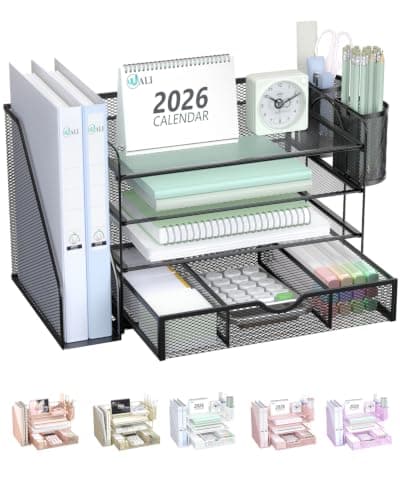
WALI 4-Tier Desk File Organizer with DrawerFour letter trays, a vertical file section, two pen holders and a sliding drawer in a 13.58 by 9.84 in footprint. Seventeen dollars.
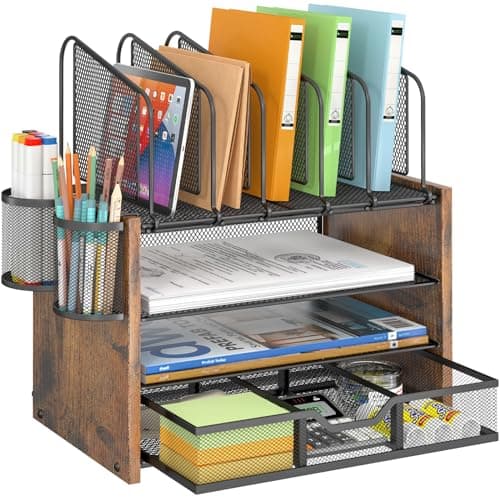
DAOUTIME 4-Tier Mesh Desk Organizer with 5 Vertical File HoldersFive vertical file classifiers plus a three-compartment sliding drawer, on a wood-and-metal frame at 13 in tall.
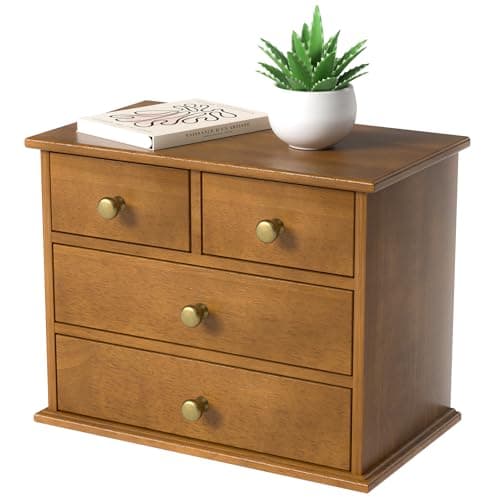
JNFUZ Solid Oak Desk Organizer with 4 DrawersSolid oak rather than bamboo or MDF, with metal handles and non-slip silicone pads, in a 13 by 7.5 in footprint.
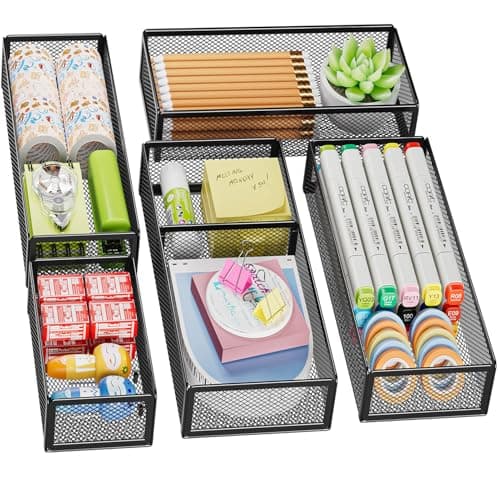
Marbrasse Desk Drawer Organizer Set, 5-PackFive stackable mesh trays with an adjustable divider and non-skid feet, for 13 dollars. The cheapest real fix for a drawer.
Scores are ours, from the published rubric on our methodology page. They are editorial judgments about published specifications, not test results — we have not handled these units.
01/WALI
4-Tier Desk File Organizer with Drawer
Best desk organizer
8.4/ 10
Four letter trays, a vertical file section, two pen holders and a sliding drawer in a 13.58 by 9.84 in footprint. Seventeen dollars.
Four letter trays, a vertical file section, two pen holders and a sliding drawer in a 13.58 by 9.84 in footprint. Seventeen dollars.
Published specification
Dimensions
13.58 in wide x 9.84 in deep x 5.71 in high
Listing published specification
Sections
4 letter trays, 1 vertical file section, 2 metal pen holders, 1 sliding divided drawer
WALI published specification
Material
Thickened steel wire mesh with dense small aperture
WALI published specification
Assembly
Required; no tools
WALI published specification
Load rating
Not published
Absence confirmed against the published specification
What the specs are good for
Four trays AND vertical filing AND a drawer AND pen holders, in under one square foot of desk, for 17 dollars
The vertical section is the part most organizers at this price leave out, and it is where live folders go
Dense small mesh rather than wide wire, so paper clips do not fall through
The sliding drawer is divided, so it does not become a single tray of chaos
What they are not
No published load rating, and four loaded letter trays is real weight on a wire frame
5.71 in tall means the trays are shallow; each holds a modest stack, not a ream
Mesh collects dust and is awkward to clean
Assembly required, which at this price means thin fixings
Skip this if
Skip this if your paper arrives in stacks rather than sheets. Four shallow trays overflow fast, and at that point you need a desktop drawer unit or a filing cabinet, not more trays.
Who it is for. Any desk with a paper problem and a square foot to spare. This is the default pick for the hub.
Solid oak rather than bamboo or MDF, with metal handles and non-slip silicone pads, in a 13 by 7.5 in footprint.
Solid oak rather than bamboo or MDF, with metal handles and non-slip silicone pads, in a 13 by 7.5 in footprint.
Published specification
Dimensions
13 in wide x 7.5 in deep x 10.2 in high
JNFUZ published specification
Weight
8.02 lb
Listing published specification
Drawers
4: 2 large, 2 small
JNFUZ published specification
Material
Solid oak
JNFUZ published specification
Handles
Metal; supplied separately with a screwdriver
JNFUZ published specification
Feet
Non-slip silicone pads
JNFUZ published specification
Load rating
Not published
Absence confirmed against the published specification
What the specs are good for
Solid oak, stated, and JNFUZ explicitly contrasts it with bamboo and MDF rather than hiding behind the word wood
13 by 7.5 in is 3 in less desk depth than the DEAYOU for the same four drawers
Metal handles and silicone pads: two details that separate furniture from a box
Screwdriver included for the handles, which ship separately to protect the finish
What they are not
No published load rating
10.2 in tall is the tallest organizer in this hub and will sit in front of a monitor
Handles need fitting before use
Forty-six dollars
Skip this if
Skip this if the organizer will sit beside a monitor. At 10.2 in it is taller than the bottom bezel of most screens on a standard stand, and that is an annoyance you notice every day.
Who it is for. A visible desk where the organizer should be the nicest object on it.
Five stackable mesh trays with an adjustable divider and non-skid feet, for 13 dollars. The cheapest real fix for a drawer.
Five stackable mesh trays with an adjustable divider and non-skid feet, for 13 dollars. The cheapest real fix for a drawer.
Published specification
Tray size
10.8 x 2.3 x 5.5 in as listed
Listing published specification
Pack
5 trays, 1 removable adjustable divider
Marbrasse published specification
Material
Powder-coated black wire mesh
Marbrasse published specification
Feet
Non-skid
Marbrasse published specification
Stacking
Stackable to save space
Marbrasse published specification
Load rating
Not published
Absence confirmed against the published specification
What the specs are good for
Five trays for 13 dollars, which is 2.60 dollars per compartment and the best value in the hub
Non-skid feet, which is the detail that stops drawer organizers migrating into one corner every time the drawer closes
Stackable, so a deep drawer uses its full height instead of one layer
Powder-coated rather than bare wire, so it will not mark a drawer bottom
What they are not
No published load rating
Only one divider across five trays, so four of them are single compartments
The listed dimensions are inconsistent in their ordering, so the actual tray proportions are unclear
Wire mesh lets the smallest items through
Skip this if
Skip this if your drawer is shallow. Stackability is the selling point, and in a 2 in desk drawer you can only ever use one layer, which makes the expandable tray below a better object.
Who it is for. Any desk drawer that is currently one undifferentiated layer of objects.
Trays for paper flowing through - an inbox, an outbox, a to-file tray. Vertical slots for live projects, because every label stays visible rather than only the top sheet. Most desks want two or three trays for flow and three vertical slots for work in progress.
Can I keep paper in a desk organizer drawer?+
Usually not. Surface drawer units are typically 4 to 7 in wide where letter paper is 8.5 by 11. Only one product in our set publishes letter-size compatibility. Drawers are for small objects; trays and slots are for paper.
What is the most space-efficient desk organizer?+
A drawer insert, because it takes no desk surface at all. After that, an under-desk mounted drawer at 11 dollars. Among surface units, the ones that combine trays, vertical slots and a drawer give the most capacity per square inch.
Should I buy stackable or expandable drawer organizers?+
Stackable for a deep drawer, because it uses the full height. Expandable for an odd-sized drawer that nothing standard fits, which is common in built-in furniture. In a standard shallow drawer the stackable set is better value at five trays for 13 dollars.
How many desk organizers do I need?+
Two: one combined surface unit for paper with both flat trays and vertical slots, and one drawer solution for small objects. About 30 dollars total. Buying three separate surface units that each solve a third of the problem is the common and expensive mistake.
Sources
Where these numbers came from
We have not handled any of these products. Every figure on this page is either the manufacturer's own published specification, named as such, or our arithmetic from those figures, shown so you can check it. Prices come from Amazon through our price layer and carry the date they were verified.
Amazon product listings, retrieved 2026-10-03
Published specifications, dimensions, materials and manufacturer claims were read from each product's own listing data. Prices and availability refresh daily and carry their verification date on the page.