Most filing systems fail for the same reason: too many categories, decided at the wrong moment, by someone with no attention to spare.
SMBy Scooter M.Published October 3, 2026Prices verified October 3, 2026
The short answer
Use eight categories, not forty. Have exactly one physical inbox. Process it once a week, not as paper arrives. A filing system fails when it asks you to make a classification decision at the moment a letter lands, which is precisely when you have no attention for it. Eight broad folders you can name without thinking, plus a weekly fifteen minutes, beats any taxonomy however elegant.
Why alphabetical filing fails at home
Alphabetical works in an office where the categories are stable, the volume is high and somebody's job includes filing. At home it fails for a specific reason: you have to remember what you called a thing.
Is the boiler service record under B for boiler, H for heating, S for service, or the engineer's company name? Any of those is defensible, which is the problem. Six months later you look under the wrong one, conclude you have lost it, and the system has failed you at the only moment it mattered.
Broad categories remove the recall problem. A HOUSE folder answers the question without you having to remember a decision you made in March.
The eight categories
A filing system for a household
Folder
What goes in it
Typical volume
House
Mortgage or lease, deeds, surveys, boiler and appliance records, warranties, work done
The largest. 6 to 12 in
Money
Bank, savings, pension, investments, loans
3 to 6 in
Tax
Returns and supporting records, one folder per year
2 to 4 in per year
Insurance
Home, car, life, health. Policies and claims
2 to 4 in
Vehicle
Title, servicing, MOT or inspection, insurance claims
2 to 4 in
Medical
Records, prescriptions, test results, one folder per person
2 to 6 in
Work
Contracts, payslips, qualifications, professional records
Volumes are our estimate for a typical household over a few years. Total is roughly 22 to 48 linear inches, which is a 2-drawer lateral or a 3-drawer vertical.
Eight is the number because it is the number you can hold in your head. If you find yourself wanting a ninth, ask whether it belongs inside one of the eight. A SCHOOL folder goes inside Admin. A PETS folder goes inside Admin. Resist the fifteenth folder, because the fifteenth is where the system starts requiring you to remember rules.
One inbox, and what it is for
Everything that arrives goes in one tray. Not sorted, not opened necessarily, not decided about. One tray.
This is the single most important part of the system, and it is the part people skip because it looks like procrastination. It is not: it is batching. Classifying a document takes ten seconds when you are in filing mode and feels impossible when you are mid-task with a letter in one hand.
A tray with a week of unopened post in it is not disorder. It is a queue, and a queue with a scheduled processing time is a system.
The weekly fifteen minutes
01Open everything in the inbox. All of it, in one pass.
02Bin or shred anything that is not needed. This is most of it. Marketing, duplicate statements, anything available online.
03Act on anything that needs acting on, or move it to a live-work slot if it needs more than two minutes.
04File the rest into one of the eight folders. No sub-decisions, no new categories.
05Empty the tray. The point is that it reaches zero, weekly.
Fifteen minutes is genuinely enough for a household once the backlog is cleared. The first session after a year of accumulation will take two hours, and that is a one-off.
The scan-first rule
Most paper does not need to exist. Your phone scans a document in four seconds and the scan is searchable, backed up and in two places at once, which the paper is not.
Scan and shred: utility bills, statements, receipts you might need for a warranty, correspondence.
Scan and keep the paper: anything with a signature, anything a government department issued, anything you would need to produce in original form.
Keep the paper in a certified fire box: passports, birth and marriage certificates, deeds, wills, vehicle titles. Usually under twenty sheets. Fireproof file cabinet vs safe.
Applied properly, scan-first cuts a household's paper volume by more than half, which frequently turns a 3-drawer cabinet purchase into a 2-drawer one.
Retention, briefly and with a caveat
We are not accountants or lawyers and this is not advice. Retention requirements vary by jurisdiction and by circumstance, and the only sensible instruction is to check your own tax authority's published guidance and your own professional advisers.
What we can say usefully is structural: retention is what keeps a filing system from growing without limit. Decide a rule for each of the eight categories, write it on the folder, and apply it at the annual review. Without a retirement rule, every filing system eventually outgrows every cabinet.
#
Product
Best for
Score
Price
01
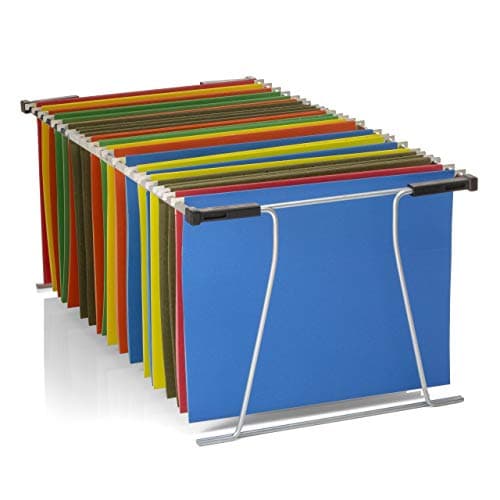
Officemate Universal Hanging File Frame (91966)Thirteen dollars of coated steel frame that turns any 24 to 27 in drawer or banker's box into hanging-file storage.
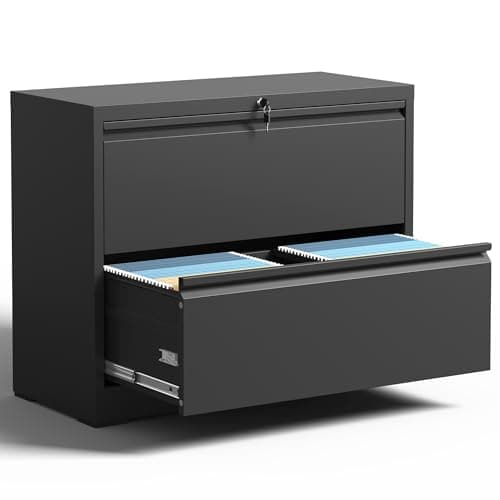
BIZOEIRON 2-Drawer Lateral File Cabinet, 35.43 in WideThe only cabinet in this hub that publishes its drawer interior, so its capacity is measured rather than estimated. Central lock, one drawer at a time, soft-close.
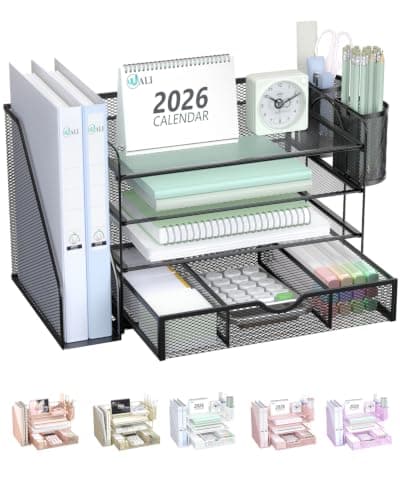
WALI 4-Tier Desk File Organizer with DrawerFour letter trays, a vertical file section, two pen holders and a sliding drawer in a 13.58 by 9.84 in footprint. Seventeen dollars.
Scores are ours, from the published rubric on our methodology page. They are editorial judgments about published specifications, not test results — we have not handled these units.
01/Officemate
Universal Hanging File Frame (91966)
Best cheap fix for a rodless drawer
6.2/ 10
Thirteen dollars of coated steel frame that turns any 24 to 27 in drawer or banker's box into hanging-file storage.
Thirteen dollars of coated steel frame that turns any 24 to 27 in drawer or banker's box into hanging-file storage.
Published specification
Fits
24 to 27 in deep cabinets and drawers; also banker's boxes
Officemate published specification
Adjustment
Breakable notches every 1/2 in
Officemate published specification
Dimensions
15.75 in deep x 24 to 27 in wide x 9.75 in high assembled
Officemate published specification
Capacity
Letter and legal
Officemate published specification
Material
Heavy-duty coated steel
Officemate published specification
Weight
1 lb
Listing published specification
What the specs are good for
Thirteen dollars turns a drawer you already own into a filing drawer, which is the cheapest filing capacity available anywhere
Breakable notches every half inch means it adjusts to a real drawer rather than a nominal one
Works in a banker's box as well as a cabinet
Takes legal as well as letter
What they are not
Only fits 24 to 27 in drawers. Most home-office cabinets here are 15 to 19 in deep, so it will not fit them
A frame sitting inside a drawer costs you about an inch of depth either side
Breakable notches are one-way: cut too short and the frame is scrap
Skip this if
Skip this if your drawer is under 24 in deep. Measure first. Almost every cabinet on this site is shallower than this frame's minimum, and it is designed for deep commercial drawers and file boxes.
Who it is for. A deep desk drawer, an old commercial cabinet with no rails, or a stack of banker's boxes you want to file properly.
The only cabinet in this hub that publishes its drawer interior, so its capacity is measured rather than estimated. Central lock, one drawer at a time, soft-close.
The only cabinet in this hub that publishes its drawer interior, so its capacity is measured rather than estimated. Central lock, one drawer at a time, soft-close.
Published specification
Dimensions
28.5 in high x 35.43 in wide x 15.75 in deep
BIZOEIRON published specification
Drawer interior
32.44 in wide x 13.98 in deep x 9.8 in high, both drawers identical
BIZOEIRON published specification
Filing capacity
64.88 linear in (2 drawers x the published 32.44 in interior width)
Our arithmetic from BIZOEIRON's published drawer interior — measured, not estimated
Cost per linear inch
About 2.00 dollars at the price shown when written
Our arithmetic from the live price and the capacity above
Weight
40 lb
Listing published specification
Lock
Central locking system, one lock for all drawers
BIZOEIRON published specification
Anti-tip
Only one drawer can open at a time
BIZOEIRON published specification
Slides
Ball-bearing, soft-close
BIZOEIRON published specification
Capacity
Letter and legal hanging files
BIZOEIRON published specification
What the specs are good for
Publishes the drawer interior. It is the only cabinet here whose capacity we did not have to estimate, and that alone earns it the top spot
64.88 measured filing inches from two drawers, more than double the 2-drawer verticals
A true interlock: only one drawer opens at a time, which on a 40 lb cabinet is the thing stopping it coming over
Soft-close ball-bearing slides, specified
Takes legal as well as letter
What they are not
35.43 in wide needs a 3 ft run of clear wall, which a small room may not have
40 lb is light for a lateral, and the interlock is doing real work as a result
Only 15 units in stock at the time of writing
Assembly required
Skip this if
Skip this if you do not have 3 ft of free wall. A lateral's whole advantage is width; in a narrow space it becomes an obstruction and a vertical is the right shape.
Who it is for. Anyone with a wall and more than a couple of years of paper. This is the cabinet we would buy.
Four letter trays, a vertical file section, two pen holders and a sliding drawer in a 13.58 by 9.84 in footprint. Seventeen dollars.
Four letter trays, a vertical file section, two pen holders and a sliding drawer in a 13.58 by 9.84 in footprint. Seventeen dollars.
Published specification
Dimensions
13.58 in wide x 9.84 in deep x 5.71 in high
Listing published specification
Sections
4 letter trays, 1 vertical file section, 2 metal pen holders, 1 sliding divided drawer
WALI published specification
Material
Thickened steel wire mesh with dense small aperture
WALI published specification
Assembly
Required; no tools
WALI published specification
Load rating
Not published
Absence confirmed against the published specification
What the specs are good for
Four trays AND vertical filing AND a drawer AND pen holders, in under one square foot of desk, for 17 dollars
The vertical section is the part most organizers at this price leave out, and it is where live folders go
Dense small mesh rather than wide wire, so paper clips do not fall through
The sliding drawer is divided, so it does not become a single tray of chaos
What they are not
No published load rating, and four loaded letter trays is real weight on a wire frame
5.71 in tall means the trays are shallow; each holds a modest stack, not a ream
Mesh collects dust and is awkward to clean
Assembly required, which at this price means thin fixings
Skip this if
Skip this if your paper arrives in stacks rather than sheets. Four shallow trays overflow fast, and at that point you need a desktop drawer unit or a filing cabinet, not more trays.
Who it is for. Any desk with a paper problem and a square foot to spare. This is the default pick for the hub.
Less than people expect. Eight hanging folders, a cabinet sized to your measured pile, and one tray.
Measure your existing paper standing upright, in inches. Under 30 is a 2-drawer; 30 to 70 is a 2-drawer lateral; over 70 is a 3-drawer lateral. Those figures compare directly to the linear filing inch numbers we publish for every cabinet on best file cabinets for a home office.
One useful cheap item: if you have a deep drawer or banker's boxes with no rails, a universal hanging file frame is about 13 dollars and turns either into proper filing. It fits 24 to 27 in drawers, which rules out most home-office cabinets, so measure first.
For paper and filing supplies beyond cabinets, inkandindent.com covers the stationery side.
FAQ
Questions people ask about this
How do I set up a paper filing system at home?+
Eight broad categories - House, Money, Tax, Insurance, Vehicle, Medical, Work, Admin - one physical inbox that everything lands in, and fifteen minutes weekly to process the inbox to empty. The broad categories are what stop you having to remember what you called something.
Why does alphabetical filing not work at home?+
Because you have to remember what you called a thing. A boiler record could be under B, H, S or the engineer's company name, all defensible. Six months later you look in the wrong place and conclude you lost it. Broad categories remove the recall problem entirely.
How many filing categories should I have?+
Eight. It is the number you can hold in your head without a reference. If you want a ninth, it almost always belongs inside one of the eight. Subdivide within a category - one folder per tax year - never across categories.
Should I scan documents instead of filing them?+
Scan almost everything and shred what the scan replaces: bills, statements, receipts, correspondence. Keep the paper where a signature or an official issuer matters, and keep the genuinely irreplaceable originals in a certified fire box. Applied properly this cuts household paper by more than half.
How long should I keep documents?+
That depends on your jurisdiction and circumstances, and we are not qualified to advise on it. Check your tax authority's published guidance. What we can say structurally is that every category needs a retirement rule written on the folder, or the system grows until it outgrows any cabinet.
How big a file cabinet do I need?+
Measure your paper standing upright in inches. Under 30 inches is a 2-drawer vertical; 30 to 70 is a 2-drawer lateral; over 70 is a 3-drawer lateral. That measurement compares directly to the linear filing inch figures we publish for every cabinet.
Sources
Where these numbers came from
We have not handled any of these products. Every figure on this page is either the manufacturer's own published specification, named as such, or our arithmetic from those figures, shown so you can check it. Prices come from Amazon through our price layer and carry the date they were verified.
Amazon product listings, retrieved 2026-10-03
Published specifications, dimensions, materials and manufacturer claims were read from each product's own listing data. Prices and availability refresh daily and carry their verification date on the page.
The full published method, and an explicit statement of what a specs-only approach cannot tell you.
Our arithmetic: the weight of office paper
A standard letter-size banker's box holds about 2,500 sheets; 2,500 sheets of 20 lb bond weighs about 25 lb, so a full box is roughly 30 lb including the box. That works out at about 1.5 lb per linear inch of upright files. Every shelf-load and cabinet-load comparison on this site uses those figures and shows the sum.
Our arithmetic: the 3 in shell allowance for filing capacity
Only one cabinet in our set publishes a drawer interior — the BIZOEIRON lateral, at 32.44 in interior inside a 35.43 in exterior, a 2.99 in difference. We round that to 3 in and apply it to every other cabinet's published external figure. It is derived from one lateral cabinet, so applying it to verticals is an assumption and we label it as one every time.