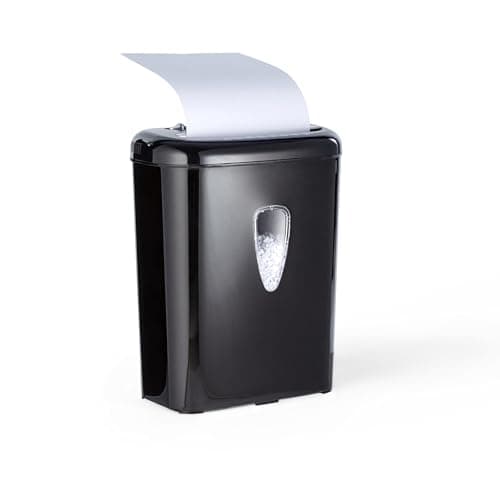
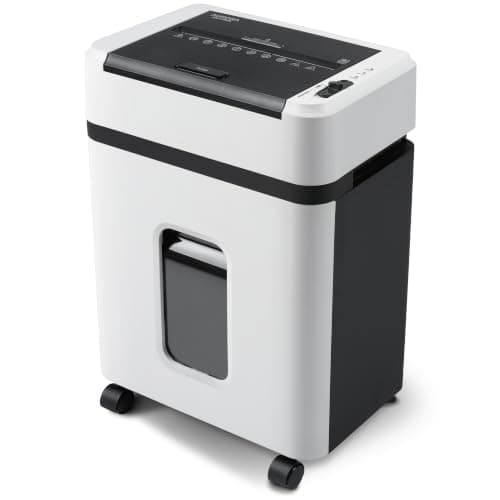
Every listing leads with sheets per pass. The number that decides how long a real job takes is the one four of these five leave out.
SMBy Scooter M.Published November 2, 2026Prices verified November 22, 2026
The short answer
If you have a backlog - a drawer or a box of old statements - buy the Aurora AU110MB. It takes 110 sheets in an auto-feed tray and runs for a published 30 minutes, which is the only combination here that lets you load it and walk away. If you shred a folder most weeks, buy the Bonsaii C266-B: 12 sheets at micro-cut with 20 minutes of run time, on casters. If you shred the week's junk mail and nothing else, the Amazon Basics is under fifty dollars and is the only machine on this page honest enough to print its cooldown - three minutes on, thirty minutes off. That ratio is the whole reason this page is ranked on run time rather than sheets per pass.
Sheets per pass is the number you are sold. It is not the number that matters.
Every shredder listing leads with a sheet count, because it is the easiest number to compare and the easiest to feel good about. Fourteen sounds twice as good as six. In practice the sheet rating tells you how thick a handful you can feed without jamming, and almost nothing about how long the job takes.
What decides that is the duty cycle: how many minutes the motor will run, and how many minutes it then has to sit cooling before it will run again. A home shredder is a small motor in a plastic case with no fan to speak of, and the cooldown is not a formality - run past it and these machines shut themselves off.
Here is the problem with the category. Four of these five publish a run time. Exactly one publishes the cooldown that goes with it.
What each listing publishes about the two halves of the duty cycle
Shredder
Sheets per pass
Cut and level
Run time
Cooldown
Aurora AU110MB
110 auto / 10 manual
Micro-cut, P-4
30 min
Not published
Aurora AU830MA
8
Micro-cut, P-5
20 min
Not published
Bonsaii C266-B
12
Micro-cut, P-4
20 min
Not published
Fellowes 14C10
14
Cross-cut, P-4
10 min
Not published
Amazon Basics AU600MA
6
Micro-cut, P-4
3 min
30 min, published
Compiled from each listing's own published specification, 2026-11-02. The Bonsaii listing states 20 minutes in its feature text and 60 minutes in its size field; we have published the figure that appears in a sentence.
How long a box of paper actually takes
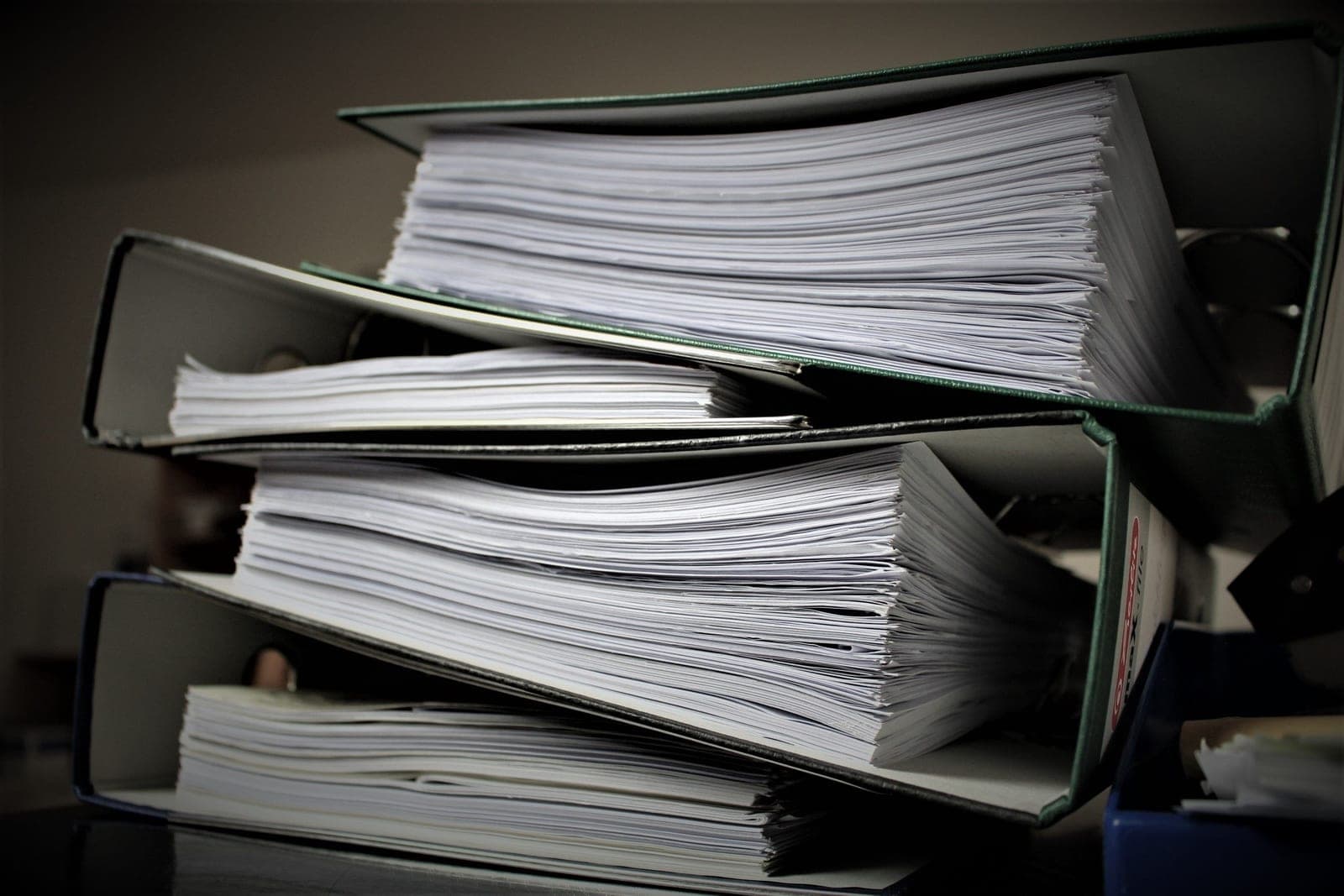
This site's storage pages use a standard figure for paper: a letter-size banker's box holds about 2,500 sheets. That is roughly what a full filing drawer holds too, and it is the unit most people are actually trying to get rid of. So run it through the sheet ratings.
Passes needed to shred one banker's box, 2,500 sheets
Amazon Basics, 6 sheets per pass: 2,500 / 6 = about 417 passes
Aurora AU830MA, 8 per pass: 2,500 / 8 = about 313 passes
Bonsaii C266-B, 12 per pass: 2,500 / 12 = about 209 passes
Fellowes 14C10, 14 per pass: 2,500 / 14 = about 179 passes
Aurora AU110MB, 110 per auto load: 2,500 / 110 = about 23 loads
Our arithmetic, from each listing's published sheet rating and the banker's-box figure used across this site's storage pages. No listing publishes a feed rate in sheets per minute, so this counts handfuls rather than minutes - which is exactly why the duty cycle below matters more than the count.
Now apply the one published duty cycle. The Amazon Basics gives you three minutes of shredding, then thirty minutes of nothing. Over a full hour that is about six minutes of actual work. Four hundred and seventeen handfuls at that rate is not an afternoon - it is a project you come back to across several days, and the sheet rating never hinted at it.
That is the entire argument for auto-feed. Twenty-three loads against four hundred passes is a different kind of task: you are opening a lid twenty-three times rather than squaring up a handful of paper four hundred times. The Aurora AU110MB costs about 120 dollars more than the Amazon Basics, and if you have a cabinet to empty it is the only machine here that makes that job finish.
What the security levels mean, and where the band is wide
Shredders are rated on a P-scale, and four of the five here are P-4. That sounds like parity and is not, because a band covers a range of particle sizes and these listings publish where in the band they sit.
Published particle size, which is the figure behind the level
Shredder
Level
Published particle size
Aurora AU830MA
P-5
3/32 x 15/32 in, stated as about 2,592 particles per sheet
Amazon Basics AU600MA
P-4
5/32 x 15/32 in (4 x 12 mm)
Aurora AU110MB
P-4
5/32 x 9/16 in
Bonsaii C266-B
P-4
13/64 x 15/32 in (5 x 12 mm)
Fellowes 14C10
P-4
5/32 x 1-9/16 in
Every figure is published by the listing itself. We have not measured any of them and have no way to verify a cut size from a photograph.
Read the last column rather than the level. The Fellowes particle is 1-9/16 in long; the Amazon Basics particle is 15/32 in, about a third of that, for a third of the price. Both are P-4. If you came to this category because you read that micro-cut beats cross-cut, that difference is what the phrase is pointing at, and it survives inside a single security band.
Whether you need P-5 is a question about what you shred, not about how careful you are. Household statements that could be downloaded again do not need it. Client records, medical paperwork or anything you hold under a duty of confidence reasonably might, and the AU830MA is the only machine here that provides it.
How we ranked these
Capacity, value, security, throughput and documentation. Throughput is the metric doing the real work on this page: it reads the published run time and cooldown together rather than the sheet rating alone, which is why the cheapest machine scores lowest on it despite being the easiest to recommend on price. Documentation scores what each maker was willing to put in writing, and it is the reason a 47-dollar shredder outscores a 142-dollar one on that metric. Full rubric on how we pick.
#
Product
Best for
Score
Price
01
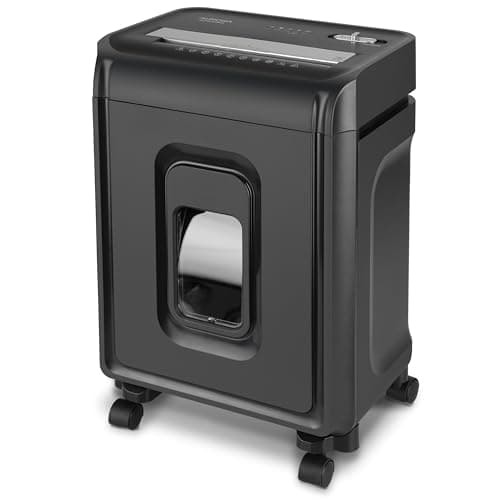
Aurora AU110MB 110-Sheet Auto-Feed Micro-Cut ShredderLoad 110 sheets, shut the lid and leave. Thirty minutes of continuous run time and an auto-feed tray turn a box of old statements from an afternoon into an errand.
Aurora AU830MA 8-Sheet Micro-Cut Shredder, P-5The only P-5 machine here, and the only listing anywhere in this set that publishes how many particles a sheet becomes: about 2,592.
Bonsaii C266-B 12-Sheet Micro-Cut ShredderTwelve sheets a pass, micro-cut, twenty minutes of run time and a published noise figure, on casters. The sensible middle of this page.
Fellowes 14C10 14-Sheet Cross-Cut ShredderFourteen sheets at a time, the most here, and the only machine that names staples, paper clips and unopened junk mail among what it will eat.
Amazon Basics AU600MA 6-Sheet Micro-Cut ShredderUnder fifty dollars, micro-cut at P-4, and the only listing in this category that publishes the number everyone else leaves out: three minutes on, thirty minutes off.
Scores are ours, from the published rubric on our methodology page. They are editorial judgments about published specifications, not test results — we have not handled these units.
01/Aurora
AU110MB 110-Sheet Auto-Feed Micro-Cut Shredder
Best for a paper backlog
8.6/ 10
Load 110 sheets, shut the lid and leave. Thirty minutes of continuous run time and an auto-feed tray turn a box of old statements from an afternoon into an errand.
Load 110 sheets, shut the lid and leave. Thirty minutes of continuous run time and an auto-feed tray turn a box of old statements from an afternoon into an errand.
Published specification
Capacity
110 sheets auto-feed; 10 sheets manual
Aurora published specification
Security level
P-4 micro-cut, 5/32 x 9/16 in particles
Aurora published specification
Continuous run time
30 minutes
Aurora published specification
Cooldown period
Not published
Absence confirmed against the published specification
Bin
4.0 gallon pullout basket
Aurora published specification
Dimensions
13.4 in wide x 8.7 in deep x 18.8 in high
Listing published specification
Weight
17.4 lb
Listing published specification
Model
AU110MB
Aurora published specification
Also shreds
Credit cards
Aurora published specification
Protection
Auto start/stop, jam-prevention auto reverse, overload protection; LED indicators for feed error, bin full, door open, overload, overheat
Aurora published specification
Mobility
Casters included
Aurora published specification
What the specs are good for
The only machine here you can walk away from. 110 sheets a load against 6 to 14 for everything else is the difference between feeding a shredder and loading one
Thirty minutes of published continuous run time, the longest on this page
Publishes its particle size as well as its P-level, so the security claim is checkable rather than asserted
17.4 lb on casters, which is the lightest of the three heavier machines here and the only one that moves without being carried
What they are not
P-4, not P-5. The AU830MA on this page cuts finer for about 27 dollars less
Publishes no cooldown period, so the 30-minute figure is the on half of a fraction whose denominator is missing
The most expensive machine here by a clear margin
A 4.0 gallon bin behind a 110-sheet tray fills fast; the auto-feed makes emptying the bottleneck
Skip this if
Skip this if your shredding is a few sheets a week. Auto-feed earns its price against a backlog, and for the daily junk-mail habit you are paying about 120 dollars more than the Amazon Basics for a tray you will not fill.
Who it is for. Anyone with a filing cabinet to empty. If the job is boxes rather than sheets, this is the only machine on the page built for it.
The only P-5 machine here, and the only listing anywhere in this set that publishes how many particles a sheet becomes: about 2,592.
The only P-5 machine here, and the only listing anywhere in this set that publishes how many particles a sheet becomes: about 2,592.
Published specification
Capacity
8 sheets per pass
Aurora published specification
Security level
P-5 micro-cut, 3/32 x 15/32 in particles
Aurora published specification
Particles per sheet
About 2,592 per letter-size sheet; stated as 10 times smaller than standard cross-cut
Aurora published specification
Continuous run time
20 minutes
Aurora published specification
Cooldown period
Not published
Absence confirmed against the published specification
Bin
4.0 gallon pullout wastebasket
Aurora published specification
Dimensions
12.95 in wide x 8.9 in deep x 19.49 in high
Listing published specification
Weight
24.5 lb
Listing published specification
Model
AU830MA
Aurora published specification
Protection
Thermal and overload protection with auto shut-off; auto start, manual reverse; LED indicators for power, overheat, overload, door open and bin full
Aurora published specification
What the specs are good for
P-5 is a genuine step up from the P-4 everything else here manages, and the published particle size - 3/32 by 15/32 in - lets you confirm it rather than take it on trust
Publishes a particle count per sheet. Nothing else in this category we examined publishes anything comparable
Twenty minutes of continuous run time on a machine aimed at security rather than volume
Thermal AND overload protection with auto shut-off, stated separately
What they are not
Eight sheets a pass. A box of paper through this is a long evening, and the AU110MB on this page exists for exactly that reason
24.5 lb and no casters mentioned, which makes it the least movable machine here
No published cooldown, so the 20-minute run time cannot be turned into a real hourly rate
Costs about three times the Amazon Basics for the same P-4 bin size and two more sheets a pass
Skip this if
Skip this if the documents are household statements rather than client records. P-5 is a meaningful upgrade over P-4 and it costs you six sheets a pass against the Fellowes; if nothing you shred would matter reconstructed, you are paying for a threat model you do not have.
Who it is for. Someone shredding client files, medical records or anything with a legal duty attached, where the cut size is the point and the volume is not.
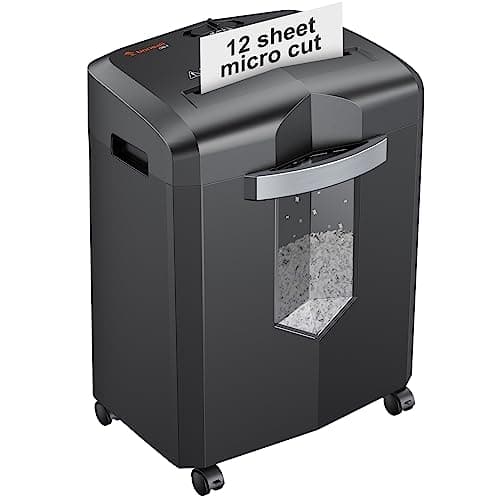
Twelve sheets a pass, micro-cut, twenty minutes of run time and a published noise figure, on casters. The sensible middle of this page.
Twelve sheets a pass, micro-cut, twenty minutes of run time and a published noise figure, on casters. The sensible middle of this page.
Published specification
Capacity
12 sheets per pass
Bonsaii published specification
Security level
P-4 micro-cut, 13/64 x 15/32 in (5 x 12 mm) particles
Bonsaii published specification
Continuous run time
20 minutes, with a stated cooling system
Bonsaii published specification
Cooldown period
Not published
Absence confirmed against the published specification
Noise
70 dB
Bonsaii published specification
Bin
4.2 gallon pullout with a visible level window
Bonsaii published specification
Dimensions
13.15 in wide x 9.57 in deep x 18.03 in high
Listing published specification
Model
C266-B
Bonsaii published specification
Also shreds
Credit cards, staples, paper clips and CDs
Bonsaii published specification
Warranty
1 year
Bonsaii published specification
Weight
Not published
Absence confirmed against the published specification
What the specs are good for
Twelve sheets at micro-cut is the best capacity-to-cut-size trade on this page; the Fellowes takes two more but cuts coarser
Publishes a noise figure, which only this machine does, and 70 dB is a real consideration in a room you take calls in
Four casters and a visible bin window, so it moves and you can see when it is full without opening it
States a 1-year warranty, which two machines here do not mention at all
What they are not
The listing contradicts itself on run time: the size field reads 60 minutes and the feature text says 20. We have published the 20-minute figure because it is the one stated in a sentence
No published cooldown, so the run time is again half a fraction
Publishes no weight at all, which on a machine sold partly on its casters is an odd omission
P-4 at a price where the Aurora AU830MA gives you P-5
Skip this if
Skip this if you need to trust the specification sheet without cross-checking it. A listing that publishes two different run times in two different fields has not been proofread, and that is the one number this category is bought on.
Who it is for. A household that shreds a folder most weeks rather than a box twice a year, and wants micro-cut without the Aurora's price.
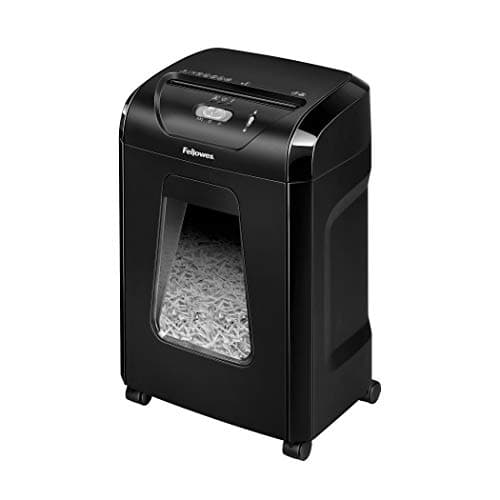
Fourteen sheets at a time, the most here, and the only machine that names staples, paper clips and unopened junk mail among what it will eat.
Fourteen sheets at a time, the most here, and the only machine that names staples, paper clips and unopened junk mail among what it will eat.
Published specification
Capacity
14 sheets per pass
Fellowes published specification
Security level
P-4 cross-cut, 5/32 x 1-9/16 in particles
Fellowes published specification
Continuous run time
10 minutes before a cooldown is needed
Fellowes published specification
Cooldown period
Not published; stated only as a cool down period
Absence confirmed against the published specification
Bin
5 gallon pullout, stated to hold over 250 shredded sheets
Fellowes published specification
Dimensions
13.44 in wide x 9.69 in deep x 19.69 in high
Listing published specification
Weight
11.4 lb
Listing published specification
Model
14C10
Fellowes published specification
Also shreds
Credit cards, paper clips, staples and unopened junk mail
Fellowes published specification
Safety
Patented Safety Lock that disables the machine
Fellowes published specification
What the specs are good for
Fourteen sheets a pass, the highest manual capacity here, which is the number that matters if you are feeding it by hand
Explicitly rated for staples, paper clips and unopened junk mail - the one machine here that tells you not to bother opening the envelope
A safety lock that disables the machine, which is the only child and pet provision published on this page
The largest bin here at 5 gallons, with a published sheet figure rather than only a volume
What they are not
Cross-cut, not micro-cut: the particle is 5/32 by 1-9/16 in, which is about three times the length of the micro-cut machines here at the same P-4 rating
Ten minutes of run time, the shortest of the four machines that publish a continuous figure
Publishes no cooldown duration, only that one is needed
11.4 lb with no casters mentioned, so it lives where you put it
Skip this if
Skip this if the particle size matters to you. P-4 is a band, not a number, and a 1-9/16 in strip is at the coarse end of it while the micro-cut machines here sit at the fine end for similar money.
Who it is for. Someone shredding junk mail and statements by the handful, who would rather not open envelopes or pull staples.
Under fifty dollars, micro-cut at P-4, and the only listing in this category that publishes the number everyone else leaves out: three minutes on, thirty minutes off.
Under fifty dollars, micro-cut at P-4, and the only listing in this category that publishes the number everyone else leaves out: three minutes on, thirty minutes off.
Published specification
Capacity
6 sheets of 20 lb bond per pass
Amazon Basics published specification
Security level
P-4 micro-cut, 5/32 x 15/32 in (4 x 12 mm) particles
Amazon Basics published specification
Continuous run time
3 minutes
Amazon Basics published specification
Cooldown period
30 minutes, published. Runs beyond the maximum trigger an automatic shut-off to protect the motor
Amazon Basics published specification
Bin
4.1 gallon, easy-empty
Amazon Basics published specification
Paper entry width
8.7 in
Amazon Basics published specification
Dimensions
12.76 in wide x 7.32 in deep x 15.94 in high
Listing published specification
Weight
9.9 lb
Listing published specification
Model
AU600MA
Amazon Basics published specification
Also shreds
Credit cards one at a time through a dedicated slot, staples and small paper clips. Explicitly NOT metallic cards
Amazon Basics published specification
What the specs are good for
The only machine on this page that publishes its cooldown. Three on and thirty off is not a flattering number and they printed it anyway, which is worth more than the four longer run times published without a denominator
Micro-cut P-4 at under fifty dollars, the same security band as machines here costing two and three times as much
9.9 lb and under 16 in tall, the smallest footprint here, which matters because a shredder lives on the floor of a room you work in
Publishes the paper entry width and names what it will not take, including metallic cards
What they are not
Three minutes on, thirty off is a duty cycle of about one part in eleven. Over an hour that is roughly six minutes of shredding, whatever the sheet rating says
Six sheets a pass, the lowest here, which compounds the duty cycle rather than offsetting it
Credit cards go through a separate slot one at a time, so a stack of old cards is a chore
No casters, no warranty statement and no noise figure
Skip this if
Skip this if you have a backlog. The duty cycle makes a banker's box a multi-day project no matter how patient you are, and that is arithmetic rather than opinion - the auto-feed Aurora exists for this exact job.
Who it is for. A household that shreds the week's junk mail on a Sunday, where three minutes is genuinely enough and the price is the point.
Worth saying before anyone spends 170 dollars: a shredder is the disposal end of a filing system, and most households are feeding theirs far more paper than they need to.
The approach that works is to sort by consequence of loss rather than by subject - a certified fire box for documents whose originals matter, a cabinet for records that are reconstructable but inconvenient, and the shredder for everything a scan replaces. Done properly that is more than half of what is currently in most filing cabinets, which means the backlog is real and finite rather than endless. A document filing system for a home walks the whole sort, and how to set up a paper filing system covers what happens to the paper that stays.
And some of it should not be shredded at all. Documents whose originals matter - deeds, certificates, passports - belong in a certified fire box, not a cabinet and certainly not a bin. Best fireproof file cabinets and boxes covers what certification actually means there, because the claims in that category are far less honest than the ones on this page.
FAQ
Questions people ask about this
How many sheets should a home office shredder take?+
Fewer than you think, because the sheet rating is not what limits you. The machines here take 6 to 14 sheets by hand, and the difference between them matters far less than how long each will run before it needs to cool down. If you are shredding a backlog rather than a handful, the number to look for is an auto-feed tray, not a higher sheet rating.
What does P-4 mean on a paper shredder?+
It is a security band describing how small the particles are, and it is wide. Four of the five shredders here are P-4, with published particle lengths ranging from 15/32 in to 1-9/16 in - a factor of more than three inside one rating. Read the published particle size rather than the level. P-5, which one machine here provides, cuts finer again.
How long does it take to shred a box of paper?+
Longer than the sheet rating suggests, because of the cooldown. A banker's box holds about 2,500 sheets, which is roughly 417 handfuls through a 6-sheet machine or 23 loads through a 110-sheet auto-feed. The one machine here that publishes its duty cycle gives three minutes of shredding for every thirty minutes of rest, so on that machine a box is a job you return to over several days.
Is micro-cut worth it over cross-cut?+
Usually yes, and the reason is particle length rather than the marketing. The cross-cut machine here produces a 1-9/16 in strip; the micro-cut machines produce particles between 15/32 and 9/16 in long at the same P-4 rating. Micro-cut also fills the bin faster for the same volume of paper, which is the honest trade.
Can a shredder handle staples and credit cards?+
Some say so explicitly and some do not, and that is the distinction worth checking. One machine here is rated for staples, paper clips and unopened junk mail, which saves the worst part of the job. Credit cards are usually accepted but often through a separate slot, one at a time, and at least one listing specifically excludes metallic cards.
Sources
Where these numbers came from
We have not handled any of these products. Every figure on this page is either the manufacturer's own published specification, named as such, or our arithmetic from those figures, shown so you can check it. Prices come from Amazon through our price layer and carry the date they were verified.
Amazon product listings, retrieved 2026-10-03
Published specifications, dimensions, materials and manufacturer claims were read from each product's own listing data. Prices and availability refresh daily and carry their verification date on the page.
The full published method, and an explicit statement of what a specs-only approach cannot tell you.
Our arithmetic: the weight of office paper
A standard letter-size banker's box holds about 2,500 sheets; 2,500 sheets of 20 lb bond weighs about 25 lb, so a full box is roughly 30 lb including the box. That works out at about 1.5 lb per linear inch of upright files. Every shelf-load and cabinet-load comparison on this site uses those figures and shows the sum.