Sort by what happens if you lose it, not by what it is about. That one change decides where everything goes.
SMBy Scooter M.Published October 3, 2026Prices verified October 3, 2026
The short answer
Sort by consequence of loss, not by subject. Three destinations: a certified fire box for documents whose ORIGINALS matter and whose replacement means an institution and a wait; a filing cabinet for records that are reconstructable but inconvenient; and the shredder for everything a scan replaces. For most households the fire box holds under twenty sheets and the shredder takes more than half of what is currently in the cabinet.
The sorting question
For each document, ask: if this burned tonight, what would happen?
01Nothing, I can download it again. Shred it. Bank statements, utility bills, most correspondence.
02An inconvenience. I would have to ask someone for a copy. Filing cabinet. Medical records, past tax returns, warranties.
03A government office and a six-week wait. Fire box. Passports, certificates, deeds, titles.
That is the whole system. It cuts across subject entirely, which is why it works: a single House folder contains documents from all three destinations and the deeds leave it for the fire box while the utility bills leave it for the shredder.
The three destinations in detail
Where each document belongs
Document
Destination
Why
Passport
Fire box
Replacement requires an application and a wait
Birth, marriage, death certificates
Fire box
Issuing authority only, slow
Property deeds, mortgage completion documents
Fire box
Institution-held replacement, significant effort
Will, power of attorney, trust documents
Fire box
Original signatures may be required
Insurance policies and the home inventory
Fire box
You need these specifically after a fire
Vehicle title
Fire box
Replaceable but slow, and needed when you least want delay
Social security card, immigration papers
Fire box
Painful to replace
A USB or drive with scans of everything
Fire box
Both SentrySafe boxes are rated for USBs and DVDs
Tax returns and supporting records
Filing cabinet
Reconstructable and bulky
Medical records
Filing cabinet
Obtainable again, though inconvenient
Employment contracts, qualifications
Filing cabinet
Issuer can usually reissue
Warranties and appliance manuals
Filing cabinet
Most are online now; keep the proof of purchase
Bank and credit card statements
Scan and shred
Available from the institution
Utility bills
Scan and shred
Available online, and rarely needed
Receipts without a warranty attached
Shred
No purpose after the return window
Marketing, catalogs, anything unsolicited
Shred or recycle today
It is not a document
A practical sorting, not legal advice. Retention requirements vary by jurisdiction, and your own tax authority's published guidance is the thing to check.
Why the fire box is a separate product
A locking file cabinet offers no fire protection whatsoever. A key lock and 0.8 mm cold-rolled steel do nothing against heat, and a standard cabinet in a house fire loses everything in it.
A certified box is a genuinely different object: UL Classified for fire endurance and ETL Verified for water submersion, with stated durations and temperatures. SentrySafe publishes half an hour at 1550F and 72 hours submerged for the 0.66 cubic foot box.
It costs about 8.62 dollars per linear filing inch against a cabinet's 2.00, which is why you put twenty sheets in it rather than your filing. The full comparison is on fireproof file cabinet vs safe.
The off-site copy
A fire box protects originals in your house. It does not protect against the house being inaccessible, which after a serious incident it will be for some time.
Scan everything in the fire box and keep the scans somewhere else. Encrypted cloud storage, a drive at a relative's house, or both. The scans are not a substitute for the originals in any legal sense, and they are what lets you start an insurance claim from a hotel room.
A sensible belt-and-braces arrangement: originals in the fire box, a drive with the scans ALSO in the fire box, and a copy of the same scans off-site. Both SentrySafe boxes here publish that they are rated for USBs and DVDs.
What goes in the cabinet, and how much of it
After the fire box takes its twenty sheets and the shredder takes everything a scan replaces, what remains is usually far less than people expect.
A typical household, after sorting
Starting volume, unsorted: 40 to 70 linear inches is common
Less scan-and-shred (bills, statements, correspondence): minus 50 to 60 per cent
Less the fire box (under 20 sheets, call it 1 inch): minus 1 inch
Remaining for the cabinet: about 15 to 30 linear inches
Which is a 2-drawer cabinet, not the 3-drawer most people assume
Our estimate from the category volumes on setting up a paper filing system. The point is directional rather than precise: sorting usually reduces the cabinet you need by one size.
That is a genuine saving - roughly 50 dollars of cabinet and about a third of the floor space - and it is the practical argument for doing the sort before the purchase rather than after.
#
Product
Best for
Score
Price
01
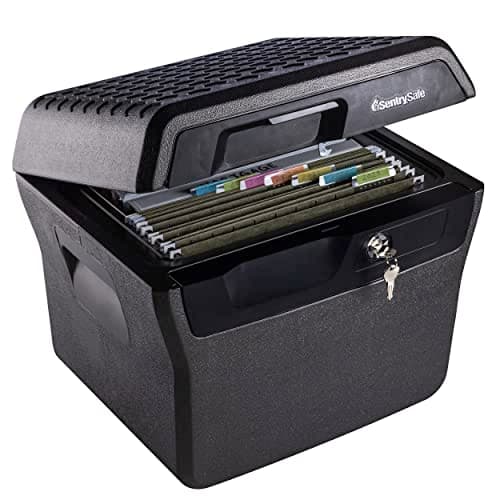
SentrySafe Fireproof and Waterproof Lock Box, 0.66 cu ftUL Classified for 1/2 hour at 1550F and ETL Verified for 72 hours submerged. The only product on this site with third-party certified protection.
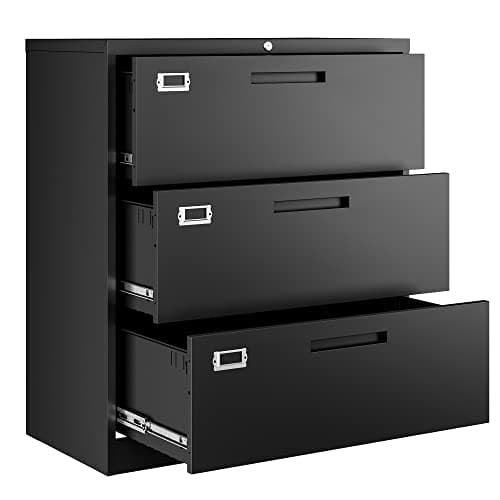
Letaya 3-Drawer Lateral File Cabinet, 36 in Wide (AA1)Three 36 in drawers, about 99 filing inches, at about 1.82 dollars per inch. The largest and best-value capacity we found.
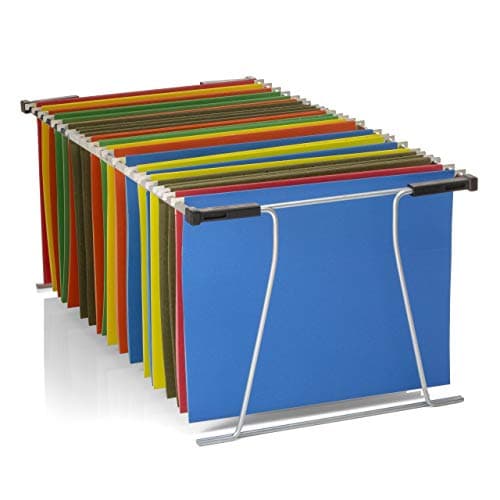
Officemate Universal Hanging File Frame (91966)Thirteen dollars of coated steel frame that turns any 24 to 27 in drawer or banker's box into hanging-file storage.
Scores are ours, from the published rubric on our methodology page. They are editorial judgments about published specifications, not test results — we have not handled these units.
01/SentrySafe
Fireproof and Waterproof Lock Box, 0.66 cu ft
Best fire protection
6.6/ 10
UL Classified for 1/2 hour at 1550F and ETL Verified for 72 hours submerged. The only product on this site with third-party certified protection.
UL Classified for 1/2 hour at 1550F and ETL Verified for 72 hours submerged. The only product on this site with third-party certified protection.
About 11.6 linear in, from the published interior depth
Our arithmetic from SentrySafe's published interior dimensions
Weight
41 lb
SentrySafe published specification
Lock
Flat key lock designed to stay shut in a fire; 2 keys
SentrySafe published specification
Extra
Built-in carrying handles
SentrySafe published specification
What the specs are good for
UL Classified AND ETL Verified: two named third-party certifications with stated durations and a stated temperature. Nothing else on this site is certified by anyone
Publishes interior dimensions as well as exterior, so you know what fits
Takes letter-size hanging files, so the papers stay organized rather than loose
Carrying handles, which matters because the point of a fire box is that you can also take it with you
41 lb in a box this size is the fire lining doing its job
What they are not
About 11.6 filing inches for 100 dollars, which is 8.62 dollars per inch and the most expensive storage on this site by a factor of four
Half an hour at 1550F is the entry-level fire rating; 1-hour and 2-hour ratings exist at higher prices
41 lb for 0.66 cubic feet is heavy to move, handles notwithstanding
It is a box, not a cabinet. It does not replace a filing cabinet and should not be bought as one
Skip this if
Skip this if you are trying to store your filing. This holds a passport, birth certificates, the deeds and the insurance policy. Everything else belongs in a cabinet that costs a tenth as much per inch, which is the entire point of our fireproof-versus-safe comparison.
Who it is for. Everyone, alongside a filing cabinet. The documents that cannot be replaced belong in something certified, and the rest do not.
Three 36 in drawers, about 99 filing inches, at about 1.82 dollars per inch. The largest and best-value capacity we found.
Three 36 in drawers, about 99 filing inches, at about 1.82 dollars per inch. The largest and best-value capacity we found.
Published specification
Dimensions
40 in high x 36 in wide x 16 in deep
Letaya published specification
Weight
56 lb
Listing published specification
Filing capacity
About 99 linear in (3 drawers x about 33 in usable width)
Our arithmetic: published 36 in width minus the 3 in shell allowance, x 3 drawers
Cost per linear inch
About 1.82 dollars at the price shown when written
Our arithmetic from the live price and the capacity above
Slides
Ball-bearing full suspension
Letaya published specification
Lock
Built-in interlock securing all drawers; folding key
Letaya published specification
Hanging bar
Adjustable, takes A4, letter or legal
Letaya published specification
What the specs are good for
About 99 filing inches: more than three times a standard 2-drawer vertical, in roughly the same floor area as the 2-drawer lateral
About 1.82 dollars per inch, the best value on the whole site
Interlock across all three drawers
40 in high puts the top drawer at a comfortable standing height rather than a crouch
What they are not
56 lb across three drawers is LESS weight than the 2-drawer model's 67 lb, which is an odd combination on a taller cabinet and makes the interlock essential
40 in high means it will not fit under a desk
No drawer interior and no load rating published
Three loaded lateral drawers is well over 200 lb of paper on a 56 lb shell
Skip this if
Skip this if you cannot anchor it to a wall. A 40 in cabinet weighing 56 lb that can hold 200-plus lb of paper is top-heavy by construction, and Letaya does not supply an anti-tip kit.
Who it is for. A household archive: tax years, property papers, medical records, all of it, in one cabinet.
Thirteen dollars of coated steel frame that turns any 24 to 27 in drawer or banker's box into hanging-file storage.
Thirteen dollars of coated steel frame that turns any 24 to 27 in drawer or banker's box into hanging-file storage.
Published specification
Fits
24 to 27 in deep cabinets and drawers; also banker's boxes
Officemate published specification
Adjustment
Breakable notches every 1/2 in
Officemate published specification
Dimensions
15.75 in deep x 24 to 27 in wide x 9.75 in high assembled
Officemate published specification
Capacity
Letter and legal
Officemate published specification
Material
Heavy-duty coated steel
Officemate published specification
Weight
1 lb
Listing published specification
What the specs are good for
Thirteen dollars turns a drawer you already own into a filing drawer, which is the cheapest filing capacity available anywhere
Breakable notches every half inch means it adjusts to a real drawer rather than a nominal one
Works in a banker's box as well as a cabinet
Takes legal as well as letter
What they are not
Only fits 24 to 27 in drawers. Most home-office cabinets here are 15 to 19 in deep, so it will not fit them
A frame sitting inside a drawer costs you about an inch of depth either side
Breakable notches are one-way: cut too short and the frame is scrap
Skip this if
Skip this if your drawer is under 24 in deep. Measure first. Almost every cabinet on this site is shallower than this frame's minimum, and it is designed for deep commercial drawers and file boxes.
Who it is for. A deep desk drawer, an old commercial cabinet with no rails, or a stack of banker's boxes you want to file properly.
Once a year, ideally when you do your tax, run three passes:
01Retire a tax year if your retention rule says it is past. One folder out, one folder in, and the Tax category never grows.
02Check the fire box. Passports expire, policies get replaced, a will gets updated. The box is the one place where a superseded document is actively dangerous, because someone might rely on it.
03Refresh the off-site scans. A two-year-old backup of your documents is most of a backup and not all of one.
Twenty minutes a year, and it is the thing that stops a filing system growing until it outgrows the cabinet. For the week-to-week version, setting up a paper filing system has the eight categories and the weekly reset.
FAQ
Questions people ask about this
What documents should I keep in a fireproof box?+
Documents whose originals matter and whose replacement means an institution and a wait: passports, birth and marriage certificates, property deeds, wills, insurance policies, vehicle titles, and a drive with scans of everything. For most households that is under twenty sheets.
Does a locking file cabinet protect documents from fire?+
No, not at all. A key lock and thin steel offer no fire resistance, and a standard cabinet in a house fire loses everything in it. Fire protection needs an insulated enclosure with third-party certification, which is a different product at about four times the cost per filing inch.
How should I sort household documents?+
By consequence of loss rather than subject. Ask what would happen if each document burned tonight: nothing means shred it, an inconvenience means the filing cabinet, and a government office with a six-week wait means the fire box.
Should I keep paper copies if I scan everything?+
Keep paper where a signature or an official issuer matters, and where you might need to produce an original. Shred what the scan genuinely replaces: bills, statements, routine correspondence. That typically removes more than half of a household's paper.
Where should I keep backup scans of my documents?+
Two places: a drive inside the fire box, and an encrypted copy off-site. A fire box protects originals in your house, and after a serious incident the house is inaccessible for a while. The off-site copy is what lets you start an insurance claim from somewhere else.
How long should I keep tax records?+
That depends on your jurisdiction and your circumstances, and we are not qualified to advise on it. Check your tax authority's published guidance and write the rule on the folder so the annual review can apply it.
Sources
Where these numbers came from
We have not handled any of these products. Every figure on this page is either the manufacturer's own published specification, named as such, or our arithmetic from those figures, shown so you can check it. Prices come from Amazon through our price layer and carry the date they were verified.
Amazon product listings, retrieved 2026-10-03
Published specifications, dimensions, materials and manufacturer claims were read from each product's own listing data. Prices and availability refresh daily and carry their verification date on the page.
The full published method, and an explicit statement of what a specs-only approach cannot tell you.
UL Classification and ETL Verification, as cited by SentrySafe
SentrySafe publishes a UL Classification for fire endurance and an ETL Verification for water submersion, each with a stated duration. We quote their published durations and temperatures and have verified nothing ourselves.
Our arithmetic: the weight of office paper
A standard letter-size banker's box holds about 2,500 sheets; 2,500 sheets of 20 lb bond weighs about 25 lb, so a full box is roughly 30 lb including the box. That works out at about 1.5 lb per linear inch of upright files. Every shelf-load and cabinet-load comparison on this site uses those figures and shows the sum.