Thirty dollars or three hundred and eighty. The photographs look the same, the products are not, and the listings are not much help.
SMBy Scooter M.Published October 3, 2026Prices verified October 3, 2026
The short answer
If you need to hide something, buy the 50-dollar screen. If you need the room to sound calmer, buy the 380-dollar partition. If you need a conversation to be private, buy neither, because neither does that. A room divider is fabric on a steel frame and blocks sightlines. An acoustic partition has a PET or polyester core and absorbs reflections. The gap between them is about 330 dollars and it buys absorption, mass and a tackable surface - not privacy, which is a different product at a different price entirely.
The honest comparison table
Room divider against acoustic partition
Room divider
Acoustic partition
Typical price
30 to 70 dollars
320 to 650 dollars
What is inside
Nothing. Fabric stretched on a steel or iron frame
PET or polyester fiber, sometimes with a published thickness
Typical weight
9 to 21 lb
47 to 67 lb
Blocks sightlines
Yes, completely. This is what it is for
Yes, completely
Reduces reflections
Negligibly. Any solid object blocks a little high frequency
Yes, measurably in effect though not in published figures
Reduces speech spill
Barely
Noticeably in a shared room, by interrupting the direct path and absorbing the first reflections
Makes a conversation private
No
No. Sound goes over, under and around it
Doubles as a pinboard
No
Usually yes, tackable surface
Stable in moving air
Not at the light end
Yes
Stores flat
Yes, folds
Only the KERRAM
Compiled from the published specifications of the products in our set, 2026-10-03.
What 330 dollars actually buys
A core, and sometimes a number for it
The RANTILA 3-panel has no acoustic material and makes no acoustic claim, which is to its credit. The KERRAM has 1.13 in of 100% high-density polyester fiber and says so. That inch of fiber is the product difference.
It is worth saying what you do NOT get: an NRC. Not one acoustic partition we examined publishes an absorption coefficient or names a test standard. YASRKML publishes a percentage - at least 85% of noise - which is a sentence, not a measurement. So you are buying material and thickness on inference. That is a reasonable basis and it is not the same as evidence, which is why best acoustic room dividers scores KERRAM above YASRKML for publishing the thickness.
Mass, which is stability
A 51 lb VIVO partition stays where you put it. A 9 lb MAYOLIAH screen does not, in any room with a ceiling fan, an air vent or a door that opens. This is the least glamorous difference and the one people notice daily.
A tackable surface
In a small home office, 33 sq ft of pinnable surface that arrived anyway is a genuine second function. A fabric screen gives you nothing to pin to.
The escalation path, and where each step stops
Most people arrive at this question somewhere on a ladder. Here is the whole ladder with honest prices and honest limits.
From screen to enclosure
Step
Cost
What it fixes
Where it stops
Rearrange the room
Free
Camera angle, direct line of sight, distance from the noise
Does nothing if the room has one usable layout
Room divider
30 to 70 dollars
Sightlines, completely
Does nothing for noise
Desk privacy panel
30 to 160 dollars
Sightlines at the desk, plus the first reflections near your microphone
Only covers one workstation
Wall acoustic panels
150 to 600 dollars
Room reflections, echo, how your calls sound
Needs usable wall; does nothing for sound entering the room
Acoustic partition
320 to 650 dollars
Reflections and speech spill in a shared room, movably
Not private. No mass, no seal, no ceiling
Office pod
3,200 to 5,400 dollars
Genuine isolation. The only consumer product that blocks
Costs as much as a car and needs 11 to 20 sq ft of floor
Build a wall
Several thousand
Everything
Not reversible, and not available to renters
Three situations, three answers
The bed is behind you on every call
Buy the 50-dollar screen. This is purely a sightline problem and a sightline product solves it completely. Spending 380 dollars here buys you absorption you did not need. The RANTILA 3-panel at 102 in is the one we would get.
Two people working in one room, both on calls
Buy the acoustic partition, and get the one that publishes a thickness. You will not stop hearing each other - nothing short of a wall does - but interrupting the direct path and absorbing the first reflections takes the room from chaotic to workable. Combine it with desk screens if the desks are close.
You need a call nobody can overhear
Buy neither. This is the case where the honest answer is unwelcome. A partition does not reach the ceiling, does not reach the floor, and has no mass. Speech is audible around it. The only consumer product that genuinely delivers this is an enclosure, which starts at about 3,200 dollars and which we have priced out properly on office pods. Everything cheaper is a compromise and it is better to know that before spending 400 dollars finding out.
#
Product
Best for
Score
Price
01
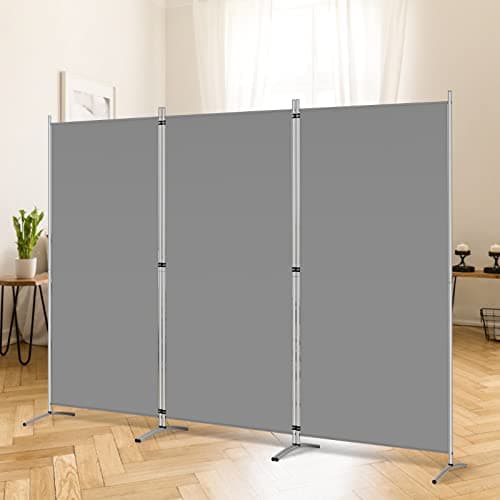
RANTILA 3-Panel Folding Privacy Screen, 102 x 71 in102 inches of sightline for 50 dollars. Fabric on a steel frame, 13.3 lb, no acoustic material and no claim of any.
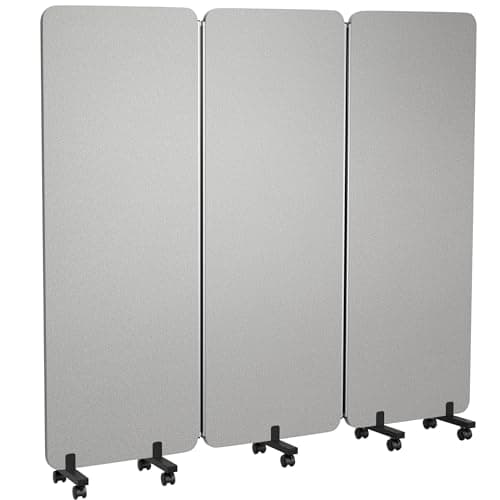
KERRAM 3-Panel Foldable Office Partition with WheelsNames its core material as 100% high-density polyester fiber, states a 1.13 in panel thickness, folds flat, and runs on 10 self-locking casters.
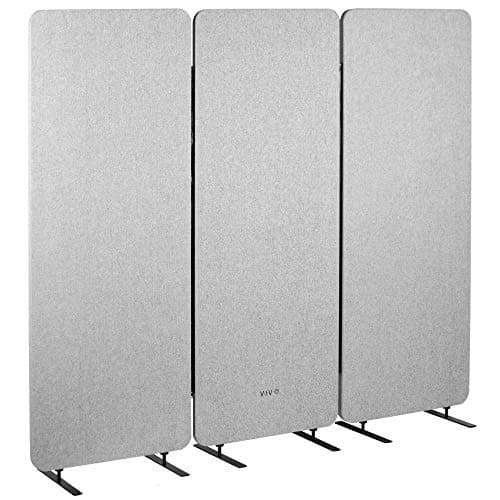
VIVO Freestanding Privacy Panel, 72 x 66 in (PP-3-T072G)Three zip-linked 23.8 in panels on flexible feet, 51.4 lb, tackable surface. The only partition here with a model number and a consistent spec sheet.
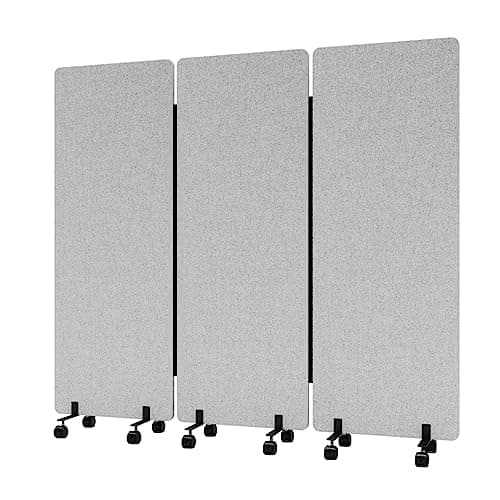
YASRKML 3-Panel Soundproof Room Divider, Portable AcousticFlame-retardant PET with a fabric wrap, 12 self-locking wheels and a reinforced metal base, at about 60 dollars less than the KERRAM.
Scores are ours, from the published rubric on our methodology page. They are editorial judgments about published specifications, not test results — we have not handled these units.
01/RANTILA
3-Panel Folding Privacy Screen, 102 x 71 in
Best wide screen under 50 dollars
6.0/ 10
102 inches of sightline for 50 dollars. Fabric on a steel frame, 13.3 lb, no acoustic material and no claim of any.
102 inches of sightline for 50 dollars. Fabric on a steel frame, 13.3 lb, no acoustic material and no claim of any.
Published specification
Overall size
102 in wide x 20 in deep x 71 in high
RANTILA published specification
Panel size
34 in wide x 71 in high, 3 panels
RANTILA published specification
Weight
13.3 lb
Listing published specification
Frame
Steel
RANTILA published specification
Fabric
UV protected, waterproof
RANTILA published specification
Hinges
Double hinged, folds either direction
RANTILA published specification
Acoustic material
None. RANTILA makes no acoustic claim for this product, which is to its credit
Absence confirmed against the published specification
What the specs are good for
102 in of coverage for 50 dollars, which is about a fifth of the cost per inch of any acoustic partition here
Double hinges fold both ways, so it makes an L, a Z or a straight run
13.3 lb: one person carries it with one hand
Makes no acoustic claim at all, which is more honest than most of this category
What they are not
No acoustic material whatsoever. It changes what people see and nothing about what they hear
13.3 lb across 50 sq ft of fabric is a sail: it will move if a door opens or a fan points at it
Needs 20 in of floor depth folded into a zigzag to stand up at all
Skip this if
Skip this if you are trying to make calls quieter. We have scored its acoustic metric a 2 rather than a 1 only because any solid object between two people blocks a little high-frequency sound. That is physics, not a feature.
Who it is for. Someone whose actual problem is a bed, a laundry pile or a kitchen appearing on every video call.
Names its core material as 100% high-density polyester fiber, states a 1.13 in panel thickness, folds flat, and runs on 10 self-locking casters.
Names its core material as 100% high-density polyester fiber, states a 1.13 in panel thickness, folds flat, and runs on 10 self-locking casters.
Published specification
Overall size
71 in wide x 66 in high
KERRAM published specification
Panel thickness
1.13 in
KERRAM published specification
Core
100% high-density polyester fiber, fabric outer
KERRAM published specification
Frame
Aluminum
KERRAM published specification
Casters
10 self-locking swivel casters
KERRAM published specification
Assembly
3 to 5 minutes; casters only, no panel assembly
KERRAM published specification
Absorption
Not published as a figure. The core material and thickness are published, the NRC is not
Absence confirmed against the published specification
What the specs are good for
States a panel thickness AND a core material, which together are the two facts that decide whether a partition does anything acoustically
1.13 in of high-density polyester is a genuine absorber, unlike fabric on a steel frame
Folds completely flat for storage, which no other acoustic partition here does
Aluminum frame keeps the weight down without the flex of a thin steel tube
Ten self-locking casters and a 3 to 5 minute setup
What they are not
No NRC or absorption coefficient published, so the thickness and material are the only evidence
380 dollars for 32 sq ft of partition
Only 20 units showed in stock at the time of writing, so availability is thin
Skip this if
Skip this if you need the partition to block sound rather than absorb it. 1.13 in of polyester fiber reduces reflections and speech spill; it is not a wall and it will not stop a conversation being audible on the other side.
Who it is for. Someone in a shared room who needs the calls to stop bouncing and the partition to disappear into a cupboard at weekends.
Freestanding Privacy Panel, 72 x 66 in (PP-3-T072G)
Best office partition
7.6/ 10
Three zip-linked 23.8 in panels on flexible feet, 51.4 lb, tackable surface. The only partition here with a model number and a consistent spec sheet.
Three zip-linked 23.8 in panels on flexible feet, 51.4 lb, tackable surface. The only partition here with a model number and a consistent spec sheet.
Published specification
Overall size
72.4 in wide x 65.8 in high
VIVO published specification
Panel size
23.8 in wide x 65.8 in high, 3 panels
VIVO published specification
Weight
51.4 lb
Listing published specification
Model
PP-3-T072G
VIVO published specification
Surface
Tackable
VIVO published specification
Configuration
Zipper connections; straight wall or curve; usable singly
VIVO published specification
Absorption
Not published for this model. VIVO states sound-reducing material on its clamp-on panels but publishes no figure for any of them
Absence confirmed against the published specification
What the specs are good for
A real model number and dimensions that match across the listing, which is rarer in this category than it should be
51.4 lb across three panels on flexible feet, so it stands where you put it and does not walk
Zip connections mean you can use one panel at a desk and three to wall off a corner, from the same purchase
Tackable surface turns the partition into usable wall, which a small room does not otherwise have
What they are not
No published absorption figure, at 400 dollars. That is the main thing to understand before buying it
Flexible feet take up about 2 ft of floor depth at the base
No wheels on this model; the mobile version is a separate 450-dollar product
Skip this if
Skip this if you are buying it to make calls quieter. It is a sightline and a pinboard, and a good one. For noise, our acoustic-partition picks below publish a core material and this does not.
Who it is for. Someone carving a work corner out of a shared room who wants a partition that looks deliberate and survives being moved.
Flame-retardant PET with a fabric wrap, 12 self-locking wheels and a reinforced metal base, at about 60 dollars less than the KERRAM.
Flame-retardant PET with a fabric wrap, 12 self-locking wheels and a reinforced metal base, at about 60 dollars less than the KERRAM.
Published specification
Overall size
72 in wide x 66 in high maximum
YASRKML published specification
Panel size
24 in wide x 66 in high, 3 panels
YASRKML published specification
Core
Flame-retardant PET with fabric wrapping
YASRKML published specification
Casters
12 self-lockable universal wheels with brakes
YASRKML published specification
Base
Reinforced rust-proof metal
YASRKML published specification
Surface
Tackable
YASRKML published specification
Absorption
Manufacturer states it "absorbs at least 85% of noise". No NRC, no frequency range, no standard
YASRKML published specification
What the specs are good for
Flame-retardant PET core named explicitly, which puts it in the acoustic tier rather than the visual-screen tier
Twelve braked casters on a reinforced metal base: the most caster-and-base hardware of any partition here
Zip-linked and usable as one, two or three panels
Tackable surface, so it doubles as pinboard
What they are not
The "85% of noise" figure is a marketing sentence, not a measurement. No NRC, no frequency band, no test standard
Does not publish a panel thickness, which is the single most useful number for an absorber
Only 13 units in stock at the time of writing
Skip this if
Skip this if you want to compare absorbers on thickness, because YASRKML does not publish one. The KERRAM at 1.13 in tells you what you are buying; this tells you a percentage with nothing behind it.
Who it is for. Someone who wants a PET-cored partition on good casters and will accept less spec data to save 60 dollars.
If your complaint is noise, yes: an inch of polyester fiber between you and a reflection genuinely changes a shared room. If your complaint is that people can see your bedroom on calls, no: a 50-dollar screen solves that completely and the extra 330 dollars buys you nothing you asked for.
Will an acoustic partition make my calls private?+
No. A partition does not reach the ceiling or the floor and has essentially no mass, so speech travels over, under and around it. It makes a room sound calmer and reduces spill. Genuine privacy needs an enclosure, which starts around 3,200 dollars.
How can I tell if a divider has an acoustic core?+
Look for a named material in the specification: PET, polyester fiber, acoustic felt. If the listing only describes the outer fabric and the frame, there is no core. Also look for a published thickness, which almost nothing in the category gives you and which is the best single predictor of performance.
Does a thicker partition absorb more?+
Yes, and specifically it absorbs lower in frequency. A porous absorber works best where the quarter-wavelength of the sound fits inside its depth, which is why 1.13 in of polyester does meaningfully more at speech frequencies than a thin felt screen.
Can I combine a partition with wall panels?+
Yes, and it is usually the right approach in a room where you have some usable wall but not enough. Treat the walls you have, then put the partition where the wall is not. The absorbers do not interfere with each other.
Sources
Where these numbers came from
We have not handled any of these products. Every figure on this page is either the manufacturer's own published specification, named as such, or our arithmetic from those figures, shown so you can check it. Prices come from Amazon through our price layer and carry the date they were verified.
Amazon product listings, retrieved 2026-10-03
Published specifications, dimensions, materials and manufacturer claims were read from each product's own listing data. Prices and availability refresh daily and carry their verification date on the page.
The full published method, and an explicit statement of what a specs-only approach cannot tell you.
ASTM C423 — Standard Test Method for Sound Absorption and Sound Absorption Coefficients by the Reverberation Room Method
The governing test method behind any NRC figure. We name it where a manufacturer publishes an NRC so you know what the number is a result of. We have not performed this test and we do not restate anyone's NRC as our own measurement.