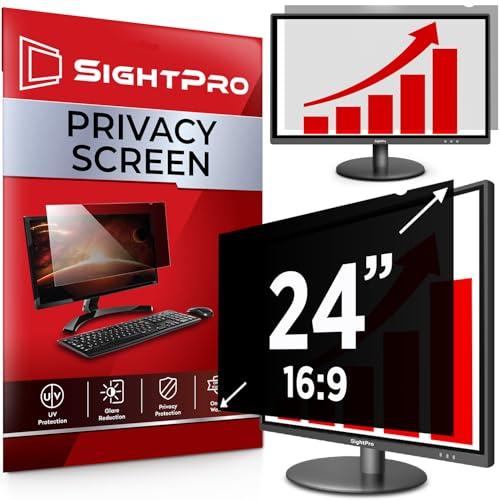
Two monitors sold as 24 inch can need filters that differ by more than an inch. The diagonal is the marketing number; the width and height are the specification.
SMBy Scooter M.Published November 16, 2026Prices verified November 22, 2026
The short answer
Measure your panel before you buy anything. Two of the makers here say so on their own listings, and it is the only mistake in this category that cannot be worked around. For a 16:9 24-inch monitor, buy the SightPro - it publishes the panel size in millimeters and inches, ships both mounting systems, and is the only filter here honest enough to print that a side filter does nothing about someone standing behind you. If you want the privacy angle as a number, buy the Peslv two-pack: 30 degrees with the matte face out, 26 with the glossy face out, published. If the monitor is shared, the JEEETINTX attaches on magnets and comes off in a second instead of peeling tape.
The diagonal is the marketing number
A privacy filter is a sheet of micro-louvered film cut to the exact rectangle of your screen. It is sold by the diagonal, because that is how monitors are sold - and the diagonal does not determine the rectangle. Aspect ratio does.
Two of the five listings here say this themselves, in almost the same words: verify your screen's width and height before ordering, and do not select on the diagonal alone. When a seller argues against the number on its own box, it is worth listening.
What a 24-inch diagonal actually measures, by aspect ratio
16:9 -> width = 24 x 16 / sqrt(16^2 + 9^2) = 20.9 in (532 mm), height = 11.8 in (299 mm)
16:10 -> width = 24 x 16 / sqrt(16^2 + 10^2) = 20.4 in (519 mm), height = 12.8 in (325 mm)
Difference on the same 24 in diagonal: 13 mm narrower and 26 mm taller
Published check: Peslv's 16:9 filter is 532 x 299 mm; its 16:10 filter is 519 x 325 mm
The first two rows are our arithmetic from the aspect ratios. The last row is Peslv's own published figures for the two filters, which match the arithmetic to within rounding - which is why we are confident telling you to measure rather than trust the label.
A 16:9 filter on a 16:10 panel overhangs the bezel by about 13 mm across and leaves roughly a 26 mm strip of screen uncovered down the bottom. It is not a tight fit; it is the wrong part. And the two are sold a few dollars apart on the same search page under the same headline number.
What each listing publishes
Panel size, angle and mounting, as published
Filter
Panel size
Ratio
Viewing angle
Mounting
SightPro 24 in
532 x 299 mm
16:9
Not published
Adhesive or slide tabs
Peslv 24 in 2-pack
532 x 299 mm
16:9
30 deg matte / 26 deg glossy
Adhesive or slide tabs
Peslv 24 in 16:10
519 x 325 mm
16:10
Plus or minus 30 deg
Adhesive or slide tabs
Protescreen 27 in 2-pack
598 x 337 mm
16:9
Plus or minus 28 deg
Adhesive or slide tabs
JEEETINTX magnetic 24 in
Not published alone
16:9
60 deg total
Magnetic bracket
Each figure is that listing's own published specification. Four of the five publish a panel size in millimeters; the magnetic one publishes only an overall size including its bracket, which is the one number you cannot check against a screen.
Note what is NOT in that table: a test standard, anywhere. Every optical claim in this category - 92 per cent blue light, 98 per cent UV, German anti-glare coatings - is published as a bare percentage with nothing behind it. We have repeated the figures because they are what the makers state, and we would not weight them against anything.
The viewing angle is a trade, not a score
A tighter angle is more private and less comfortable, and the listings here span a real range: 26, 28 and 30 degrees either side of straight-on.
Peslv quantifies the trade better than anyone, because its film is dual-sided and the angle depends which face you fit outward: matte out gives 30 degrees and better anti-glare, glossy out gives 26 degrees and stronger privacy. Same product, two settings, both published. That is the clearest statement of the compromise in this entire category.
The practical read: 30 degrees is forgiving enough that you can shift in your chair; 26 to 28 starts to dim the far edge of a wide screen when you are not square to it. On a 27 in panel that matters more than on a 24, because the outer corners sit further off-axis from where you sit.
Adhesive, tabs or magnets
Three mounting systems, and the right one depends on whether the filter ever comes off.
Adhesive strips stick to the screen bezel and hold the filter permanently. Slide mount tabs stick to the frame and let the filter slide out, but they need a raised bezel to grip - Peslv states plainly that a flush-bezel monitor can only use the adhesive option, which is the detail most buyers discover after opening the box. Magnets on a bracket are the newest answer and the only one designed for frameless monitors, where there is no bezel for a tab to hold.
If the filter goes on once and stays, any of the three works and the cheapest is fine. If it comes off daily - a shared monitor, a desk someone else uses, confidential work in blocks - the magnetic bracket is the difference between a habit you keep and one you abandon in a fortnight.
How we ranked these
Fit, privacy, optics, mounting and documentation. Fit scores whether the listing publishes real panel dimensions and says what it does NOT fit, because that is the only failure mode here that wastes the whole purchase. Privacy scores the published viewing angle, and three of five state one. Documentation rewards a model number you can reorder against, which two of these do not provide. Full rubric on how we pick.
#
Product
Best for
Score
Price
01
SightPro SP-PSB24169 Privacy Filter, 24 in 16:9Publishes its panel size in millimeters and inches, ships both mounting systems, and is the only filter here that prints the limitation everyone discovers later: it does nothing about the person standing behind you.
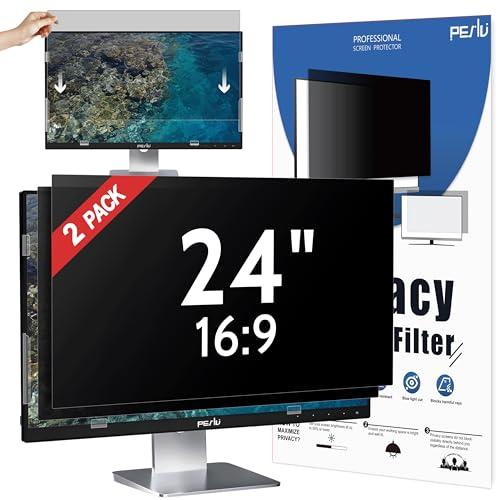
Peslv Privacy Filter 2-Pack, 24 in 16:9Two filters for less than most singles, and the only listing here that quantifies the trade it is asking you to make: matte out for 30 degrees and anti-glare, glossy out for 26 and more privacy.
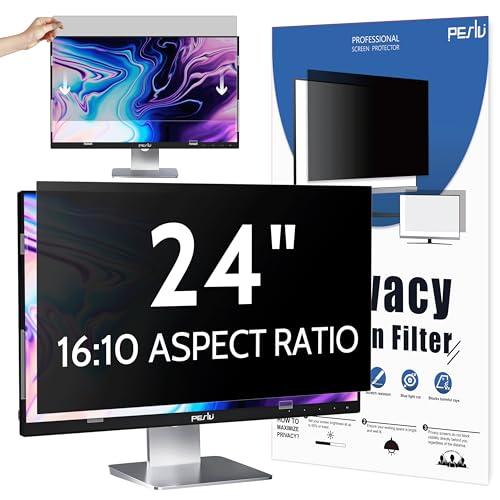
Peslv Privacy Filter, 24 in 16:10The same film cut for a 16:10 panel: 519 x 325 mm against the 16:9 version's 532 x 299. Same 24-inch monitor on the box, 13 mm narrower and 26 mm taller in reality.
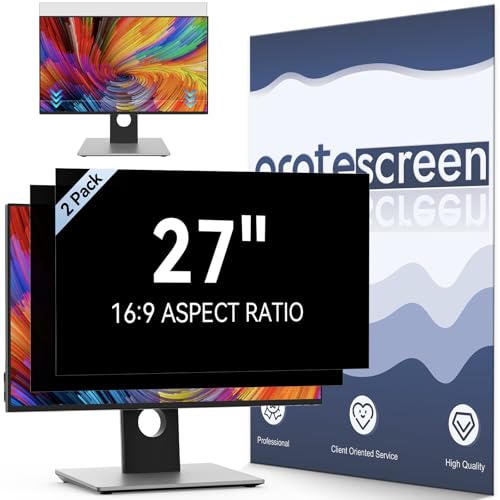
Protescreen 6400 Privacy Filter 2-Pack, 27 in 16:9Two 27-inch filters with the panel size published at 598 x 337 mm and the tightest stated viewing angle here at plus or minus 28 degrees.
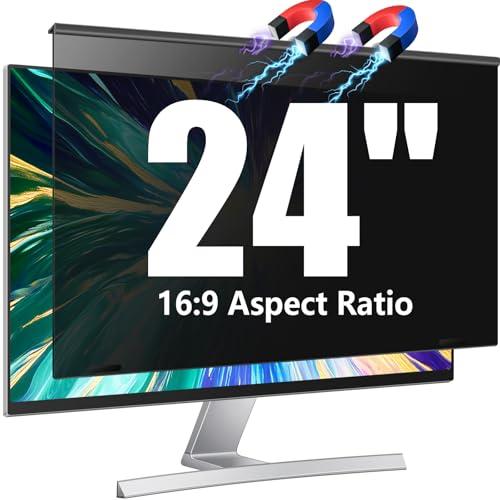
JEEETINTX Magnetic Privacy Filter, 24 in 16:9 FramelessAn aluminum bracket and magnets instead of adhesive, so the filter comes off in a second. Built for frameless and thin-bezel monitors, and explicit about what it will not fit.
Ranked on whether the listing tells you enough to buy the right size, then on the published viewing angle. Prices are live.
01/SightPro
SP-PSB24169 Privacy Filter, 24 in 16:9
Best documented
8.6/ 10
Publishes its panel size in millimeters and inches, ships both mounting systems, and is the only filter here that prints the limitation everyone discovers later: it does nothing about the person standing behind you.
Publishes its panel size in millimeters and inches, ships both mounting systems, and is the only filter here that prints the limitation everyone discovers later: it does nothing about the person standing behind you.
Published specification
Panel size
532 x 299 mm (20 15/16 x 11 13/16 in); 24 in diagonal (609.6 mm)
SightPro published specification
Aspect ratio
16:9
SightPro published specification
Thickness
0.018 in
Listing published specification
Model
SP-PSB24169 / PF240W9B
SightPro published specification
Mounting
Two options: clear adhesive strips, or slide mount tabs for monitors with a raised bezel so the filter slides on and off
SightPro published specification
In the box
Filter, 2 sets of adhesive strips, 2 sets of slide mount tabs, microfiber cloth
SightPro published specification
Optics
Multi-layered film; blacks out from the side, stated to protect from glare, UV and blue light
SightPro published specification
Stated limitation
Published: "It does not block visibility directly behind you, regardless of the distance"
SightPro published specification
Compliance
Stated Section 889 and TAA compliant
SightPro published specification
Viewing angle
Not published as a figure
Absence confirmed against the published specification
What the specs are good for
Publishes the panel size in millimeters AND inches AND the diagonal, then tells you in the same breath not to buy on the diagonal alone. That is the single most useful sentence in this category
Both mounting systems in the box, so a raised-bezel monitor and a flush one are the same purchase
Prints the honest limitation - a side filter does nothing about someone behind you - which no other listing here admits
A real model number from a named US company, with Section 889 and TAA compliance stated
What they are not
Publishes no viewing angle. Two cheaper filters here state theirs to the degree, and the angle is what you are actually buying
Single filter at a price where two of the picks here are two-packs
No figures behind the glare, UV and blue light claims
16:9 only, as every filter here is - check your panel before ordering
Skip this if
Skip this if you want the privacy angle quantified. SightPro publishes more about the physical fit than anyone here and less about the optics, and if the number that matters to you is degrees rather than millimeters the Peslv filters state theirs.
Who it is for. A permanent install on a known monitor, where getting the size right first time matters more than saving ten dollars.
Two filters for less than most singles, and the only listing here that quantifies the trade it is asking you to make: matte out for 30 degrees and anti-glare, glossy out for 26 and more privacy.
Two filters for less than most singles, and the only listing here that quantifies the trade it is asking you to make: matte out for 30 degrees and anti-glare, glossy out for 26 and more privacy.
Published specification
Panel size
532 x 299 mm (20 15/16 x 11 13/16 in); 24 in diagonal
Peslv published specification
Aspect ratio
16:9 only, stated explicitly
Peslv published specification
Count
2 filters
Peslv published specification
Viewing angle
Matte side out: 30 degrees. Glossy side out: 26 degrees
Peslv published specification
Dual-sided
Matte face for anti-glare, glossy face for stronger anti-peep; the user chooses which faces out
Peslv published specification
Optics
Stated 92% blue light and 98% UV reduction; German AG anti-glare coating
Peslv published specification
Mounting
Two options; monitors without a raised bezel can only use option 2
Peslv published specification
In the box
2 filters, 4 sets of adhesive strips, 4 sets of slide mount tabs, 2 cleaning kits, cloth
Peslv published specification
Model number
Not published; the listing carries a part code only
Absence confirmed against the published specification
What the specs are good for
Quantifies the dual-side trade - 30 degrees matte against 26 glossy - which turns a marketing feature into a decision you can actually make
Two filters at well under twenty dollars each, the cheapest per filter on this page
States the mounting restriction plainly: a flush-bezel monitor can only use the adhesive option, which is the thing most buyers find out after unboxing
Four sets of each mounting part, so re-siting a filter later does not need new adhesive
What they are not
No model number, only a part code, so reordering the identical item in two years is guesswork
The listing's dimension fields are placeholder 1 x 1 in values - the real size is in the text, which is a documentation failure on the one spec that matters
Two filters are only a saving if you have two monitors or expect to replace one
The 92% and 98% optical figures carry no test standard
Skip this if
Skip the two-pack if you have one monitor and no plan for a second. The single Peslv filter is the same film and the same published angles, and paying for a spare you will not fit is not a saving.
Who it is for. A two-monitor desk, or anyone who wants the privacy angle stated as a number rather than implied.
The same film cut for a 16:10 panel: 519 x 325 mm against the 16:9 version's 532 x 299. Same 24-inch monitor on the box, 13 mm narrower and 26 mm taller in reality.
The same film cut for a 16:10 panel: 519 x 325 mm against the 16:9 version's 532 x 299. Same 24-inch monitor on the box, 13 mm narrower and 26 mm taller in reality.
Published specification
Panel size
519 x 325 mm (20 7/16 x 12 3/4 in); 24 in diagonal (609.6 mm)
Peslv published specification
Aspect ratio
16:10 only, stated explicitly
Peslv published specification
Viewing angle
Beyond plus or minus 30 degrees the screen is shielded
Peslv published specification
Dual-sided
Matte face for anti-glare, glossy face for stronger anti-peep
Peslv published specification
Optics
Stated 92% blue light and 98% UV reduction
Peslv published specification
Mounting
Two options; a flush-bezel monitor can use option 2 only
Peslv published specification
In the box
Filter, adhesive strips, slide mount tabs, cleaning kit, cloth
Peslv published specification
Model number
Not published
Absence confirmed against the published specification
What the specs are good for
A 16:10 filter at all. Most of this category is 16:9 only, and a 16:10 panel wearing a 16:9 filter is 13 mm over on width and 26 mm short on height
Publishes the exact panel size in millimeters and repeats the warning against buying on the diagonal
Same quantified dual-side construction as the 16:9 Peslv filters
Under thirty dollars for the harder size to find
What they are not
No model number at all
16:10 only. The same caution that makes this pick useful also makes it useless on a 16:9 panel
Single filter, where the 16:9 line offers a cheaper-per-unit two-pack
The optical percentages carry no test standard, same as the rest of the Peslv range
Skip this if
Skip this if you have not measured. A 16:10 monitor is far less common than it was, and the penalty for guessing is a filter that overhangs the bezel on one axis and leaves a strip of screen uncovered on the other.
Who it is for. An older or business-class 24 in monitor - a lot of Dell and HP office panels are 16:10 - where the common filters simply do not fit.
Plus or minus 28 degrees is the tightest published angle on this page, which is the direction you want for a screen anyone walks past
Publishes the panel size in millimeters, which on a 27 in monitor is the difference between a fit and a 10 mm overhang
Two filters at under twenty-five dollars each, for the size where singles usually cost more than that
A model number, which two picks here do not provide
What they are not
A tighter angle cuts both ways: at 28 degrees you have less room to shift in your own chair before the screen dims on you
27 in 16:9 only
One set of mounting parts per filter, against four sets in the Peslv two-pack
The optical percentages are stated without a standard, as everywhere in this category
Skip this if
Skip this if you move around while you work. Twenty-eight degrees is a narrow cone, and on a 27 in panel the edges of your own screen start to dim before the middle does if you are not square to it.
Who it is for. A 27 in monitor in a room other people cross - the size where a passer-by reads your screen from the doorway without trying.
An aluminum bracket and magnets instead of adhesive, so the filter comes off in a second. Built for frameless and thin-bezel monitors, and explicit about what it will not fit.
An aluminum bracket and magnets instead of adhesive, so the filter comes off in a second. Built for frameless and thin-bezel monitors, and explicit about what it will not fit.
Published specification
Fits
23.6, 23.8 and 24 in frameless or thin-bezel monitors, 16:9
JEEETINTX published specification
Does NOT fit
Published exclusions: 23 in monitors, and curved monitors. Dimensions exclude the bezel
JEEETINTX published specification
Mounting
Magnetic base on an aluminum alloy bracket; stated one-second attach, removable
JEEETINTX published specification
Viewing angle
60 degrees of privacy protection
JEEETINTX published specification
Material
High-performance composite, stated over 30 per cent stronger than acrylic
JEEETINTX published specification
Optics
Stated to block harmful rays and blue light
JEEETINTX published specification
Overall size
21.53 x 13.03 in including the bracket
Listing published specification
Panel size
Not published separately from the bracket
Absence confirmed against the published specification
Model number
Not published
Absence confirmed against the published specification
What the specs are good for
Magnets, not adhesive. On a monitor that is shared, or that you only need private some of the day, taking a filter off in a second rather than peeling tape is the whole product
Publishes what it does NOT fit - 23 in panels and curved monitors - which is rarer and more useful than another compatibility list
An aluminum bracket rather than tape means no residue and nothing to re-stick when it loosens
Composite rather than acrylic, published as over 30 per cent stronger, on a part that gets handled daily
What they are not
Does not publish the panel size on its own, only the 21.53 x 13.03 in overall including bracket, so you cannot check it against your screen the way you can the others
The narrowest fit window here: three monitor sizes, frameless or thin bezel only, nothing curved
No model number, so there is nothing to reorder against
The most expensive single filter on this page, and the bracket is most of why
Skip this if
Skip this if your monitor has a conventional raised bezel. The magnetic bracket is designed around a frameless edge, and on a thick-bezel monitor you are paying for a mounting system that has nothing to grip.
Who it is for. A monitor someone else also uses, or a desk in a shared room where the filter goes on for the confidential hour and off for the rest.
When the problem is the room, not the screen. A filter protects one monitor from one angle. If you are taking confidential calls in a shared room, or the issue is being overlooked generally rather than read specifically, a physical screen does more: best desk privacy panels ranks the clamp-on and freestanding options, and how to divide a home office in a shared room covers the free layout changes that usually come first.
When the problem is being overheard rather than seen. A filter does nothing for audio. The honest options there are absorption, a partition, or masking - sound masking for office privacy covers the last one, which is the only product that works on a conversation leaving the room.
When the documents are the exposure. A screen filter protects what is on the monitor. Paper on the desk and in the drawer is the other half, and that is a lock rather than a film: best locking file cabinets.
FAQ
Questions people ask about this
How do I know what size privacy filter to buy?+
Measure the lit area of your screen, width and height, with the monitor on - not the diagonal and not the bezel. Then match those figures to a filter's published millimeters. A 24 in 16:9 panel is about 532 x 299 mm and a 24 in 16:10 panel is about 519 x 325 mm, so the same headline size needs filters that differ by 13 mm across and 26 mm down.
What viewing angle should a privacy filter have?+
The filters here publish 26, 28 and 30 degrees either side of center. Tighter is more private and less comfortable: at 26 to 28 degrees the far edge of a wide screen starts to dim when you are not square to it, and at 30 you can shift in your chair. One maker here lets you choose, because its film is dual-sided and gives 30 degrees one way round and 26 the other.
Do privacy filters stop someone behind you seeing the screen?+
No, and only one listing here says so. The film narrows the cone from which the screen is readable to either side; a person standing behind you is looking straight on, which is exactly the angle the filter is designed to keep clear. For that problem you want something physically between you and the room.
Can a privacy filter be removed and put back?+
It depends entirely on the mounting. Adhesive strips are effectively permanent. Slide mount tabs let the filter slide out, but they need a raised bezel to grip - a flush-bezel monitor can only use the adhesive. A magnetic bracket is the one designed for on and off daily, and it is the one to buy for a monitor somebody else also uses.
Do privacy filters reduce blue light?+
Every listing here claims so, usually at 92 per cent blue light and 98 per cent UV, and not one of them names a test standard or a measurement method. We have reported the figures because they are what the makers publish, and we would buy a filter for the privacy angle and the fit rather than for the optical claims.
Sources
Where these numbers came from
We have not handled any of these products. Every figure on this page is either the manufacturer's own published specification, named as such, or our arithmetic from those figures, shown so you can check it. Prices come from Amazon through our price layer and carry the date they were verified.
Amazon product listings, retrieved 2026-10-03
Published specifications, dimensions, materials and manufacturer claims were read from each product's own listing data. Prices and availability refresh daily and carry their verification date on the page.