Acoustic ceiling baffles vs clouds: which should you hang?
They are the same absorber at two points on one continuum, and the thing that separates them is not the material. It is how far from the ceiling you are willing to hang it.
SMBy Scooter M.Published November 19, 2026Prices verified November 22, 2026
The short answer
In a home office with a standard 8 ft ceiling, hang clouds. A baffle has to drop 12 to 24 in into the room to be a baffle, and in a room you stand up in that is head height you do not have. Hang baffles if the ceiling is high, sloped, or an exposed joist bay - that is the room baffles were designed for and the room where their one real advantage, unlimited depth behind the panel, actually exists. And whichever you hang, spacing is not a detail: the one published dataset that measures the same baffle at two hang depths says going from 12 in to 24 in of depth and spacing roughly doubles what each unit absorbs, which means half as many, hung twice as far apart, measures slightly better than twice as many crowded together.
They are the same product, turned ninety degrees
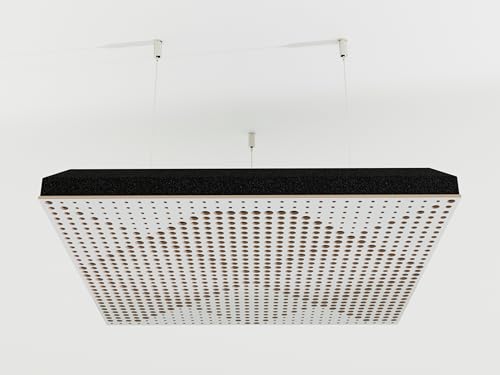
A baffle is a rigid rectangle hung vertically, like a fin, usually in a row of parallel fins. A cloud is a panel hung horizontally, flat, a few inches below the ceiling. That is the entire difference in form, and both share the property that makes ceiling treatment efficient in the first place: the panel hangs in open air, so both faces are exposed to the room instead of one. The arithmetic that falls out of that is on the best sound absorbing panels for a ceiling, and it applies equally to both formats here.
What the two formats do not share is the space behind the panel. A cloud has a defined gap between its back and the ceiling - four inches, twelve inches, whatever the cables are set to. A baffle has no behind: it is edge-on to the ceiling and the air is on both sides of it all the way up. That one geometric difference is the whole of this comparison, and it is worth more than any material difference between the products.
The mounting is part of the number, and the standard says so
Any NRC you read came out of ASTM C423, in which a sample is placed in a reverberation chamber and the increase in sound decay is measured. What far fewer listings mention is that C423 has a companion practice, ASTM E795, which defines how the sample is held while that happens. The mounting is not a footnote to the result. It is part of the result.
Type A is the specimen laid directly against the test surface. This is the wall panel and the glued-up ceiling tile: no gap, one face in the room.
Type E leaves an airspace behind the specimen, and the number after the letter is that airspace in millimeters. Type E-400 is a 400 mm plenum, about 15.75 in, and it is the common case for a suspended ceiling. This is the cloud condition.
Free-hanging units that are not butted together into a continuous plane get their own mounting type, and here is the part that matters for shopping: the result is reported as an absorption area per unit - sabins per baffle - rather than as a coefficient. This is the baffle condition.
So a baffle and a cloud are not measured on the same scale, and the industry knows it. A cloud's figure can honestly be a coefficient, because there is a defined area of panel facing a room. A baffle's cannot, cleanly, because the unit is an object hanging in air rather than a surface covering an area - which is why manufacturers of real commercial baffles publish sabins per baffle and not NRC.
The gap behind the panel is the lever nobody sells you
A porous absorber works on moving air, and air is moving fastest a quarter of a wavelength away from a hard surface. Right at the surface it is barely moving at all, which is why a thin panel glued flat to a ceiling does so little at low frequencies and why spacing the same panel away from the surface does so much. The mounting convention above is built on this: deepening the airspace moves the useful absorption downward in frequency.
Where an air gap starts doing work, by depth
The sum: frequency = speed of sound / (4 x gap), with the speed of sound taken as 343 m/s
0.5 in gap (a panel on battens): 343 / (4 x 0.0127 m) = about 6,750 Hz - sibilance only
4 in gap (a typical decor cloud on short cables): about 844 Hz
12 in gap: about 281 Hz
15.75 in gap (the 400 mm plenum the standard names): about 214 Hz
24 in gap: about 141 Hz
Our arithmetic, and it is a first-order guide to where a gap starts helping rather than a prediction of how much. A real panel's measured curve is broader and messier than any single number. The point of the list is the shape of it: the gain is not linear, and the first few inches buy you almost nothing you did not already have.
Read that list against how clouds are actually sold. The cheap decorative sets ship short cables and get hung three or four inches down, because that is what looks tidy. At four inches the cavity is doing its best work around 844 Hz - the top of the speech range, the part a thin panel was going to absorb anyway. The gap is contributing almost nothing to the half of the problem that makes a room sound boomy rather than bright.
The ua acoustics clouds on this page are the exception that proves the point, and they prove it with the maker's own two numbers. The listing publishes a 200 Hz lower limit for the panel and ships 40 in cables. Our sum says a gap has to be about 16.9 in deep before it works at 200 Hz. So the first 17 inches of that cable are buying real low-frequency reach, and the remaining 23 inches are buying nothing the panel is able to use - they are there for ceiling height, not for acoustics. Two published figures from the same listing, and together they tell you exactly how low to hang it.
The one table in this category that measures the same baffle twice
Every consumer listing we have read gives one absorption figure, or none, for one mounting condition that is usually unstated. We went looking for a published dataset that varied the mounting and held the product constant, and found exactly one: a commercial polyester baffle whose maker publishes its Type J results at two different hang depths. It is not a product we list and we are not ranking it. We are using it because it answers a question nobody else publishes an answer to.
Published average sabins per baffle, same product, two mountings
Baffle thickness
12 in depth, 12 in spacing
24 in depth, 24 in spacing
Change
1/2 in
2.85
6.10
2.14x
1 in
3.80
8.10
2.13x
2 in
4.85
10.35
2.13x
Change from 1/2 in to 2 in
1.70x
1.70x
-
Manufacturer-published figures for the Acoustical Surfaces Poly Max baffle, in average sabins per baffle under ASTM C423 with a J mounting. The ratios in the margins are ours. Note what the published table varies: depth and spacing move TOGETHER between its two columns, so the 2.13x cannot be attributed to depth alone. It is the combined effect of hanging lower and further apart.
Two things fall out of that, and the second one is worth money. First: the mounting change is worth more than the material change. Doubling the depth and spacing multiplies each baffle's absorption by about 2.13. Quadrupling the thickness - from half an inch to two inches, four times the material - multiplies it by 1.70. Both ratios hold to two decimal places across every row, which is the sort of consistency that suggests a real effect rather than a rounding artifact.
Second, and this is the one that changes what you buy: wider spacing means fewer baffles over the same ceiling. So run the arithmetic per foot of ceiling rather than per baffle, and the conclusion inverts.
A 10 ft run of ceiling: ten baffles crowded, or five spread out
At 12 in spacing you fit about 10 baffles in a 10 ft run. At 24 in spacing, about 5
1/2 in baffles: 10 x 2.85 = 28.5 sabins vs 5 x 6.10 = 30.5 sabins
1 in baffles: 10 x 3.80 = 38.0 sabins vs 5 x 8.10 = 40.5 sabins
2 in baffles: 10 x 4.85 = 48.5 sabins vs 5 x 10.35 = 51.8 sabins
Every row: half the baffles, about 7 percent MORE total absorption
Our arithmetic on the manufacturer's published figures. The mechanism is not mysterious - baffles hung close together shade each other, and sound cannot reach the inner faces of a crowd. The practical reading is narrow and we will not stretch it: it says do not crowd baffles, and it says the money is better spent on height and spacing than on an extra row. It does not say five baffles treat a room, and it does not transfer to clouds, which are a different mounting with a different geometry.
This refines rather than contradicts the coverage targets on the best sound absorbing panels for a ceiling, which counts exposed surface area and tells you to spread the panels out. Exposed surface is a geometric count and it does not know whether two panels are shading each other. The sabin data is what puts a number on the spreading-out.
Head height decides this more often than acoustics does
Everything above is the acoustic case. In an actual home office, the format is usually chosen for you by the ceiling before any of it applies.
A standard US ceiling is 8 ft. A 24 in baffle hung with even a short cable leaves you about 5 ft 9 in of clearance, which is not a room you can stand up in. The 12 in version of the same ATS baffle exists precisely for this, and it still takes a foot out of the room - and costs about 15.37 dollars per square foot of exposed surface against about 9.75 for the wide one, because the aluminum frame is a far larger share of a narrow panel. You pay a premium of roughly half again, per square foot, for the head height.
A cloud at 12 in is doing the same thing to your head height, of course. The difference is that a cloud can sit over the desk, where nobody stands, and a row of baffles usually has to cross the room. A cloud is a patch of treatment above one spot. A row of baffles is a treatment of the ceiling plane. Those are different jobs and the room decides which one is available to you.
8 ft flat ceiling, desk under it: a cloud over the desk. A baffle row is not realistic at this height.
9 to 10 ft ceiling: either. Baffles become genuinely practical and can be hung at a depth that earns their keep.
Sloped, vaulted or double height: baffles, or a cloud on a long chain. This is the room the format was designed for, and the one where the depth is free.
Exposed joists, basement or garage conversion: baffles between the joists, where the structure gives you fixing points and the depth costs nothing.
Existing suspended grid: neither - replace the grid tiles instead, which is cheaper than both and the subject of the ceiling roundup.
The formats side by side
Baffles and clouds compared on what each format can and cannot do
Baffles
Clouds
Orientation
Vertical fin, usually in parallel rows
Horizontal panel, flat below the ceiling
Both faces exposed
Yes
Yes
Gap behind the panel
No back - air on both sides
Defined by the cable or chain length
How absorption is reported
Absorption area per unit (sabins per baffle)
Can honestly be a coefficient
Head height cost
12 to 24 in, across the room
4 to 12 in, usually over the desk only
Best ceiling
High, sloped, or exposed joists
Standard 8 ft flat
Treats
The ceiling plane
One spot, thoroughly
Available on Amazon
Two brands we could find
Crowded
Cheapest here, per sq ft exposed
About 4.25 dollars (Otoolling)
About 2.18 dollars (ElaraBerry rectangles)
Thickest here
2 in (ATS)
2.1 in (ua acoustics)
Dollar figures are our arithmetic from each listing's published dimensions and the price verified on 2026-11-19, dividing by exposed surface with both faces counted. They will drift; the live price is on each buy row above.
What you can actually buy, which narrows it further
There is a supply-side fact here that no amount of acoustics will get around. Searching the Amazon catalog for hanging baffles returns essentially two brands - ATS Acoustics, in two sizes and three colorways, and the Otoolling - plus a commercial range whose units run past a thousand dollars each. Clouds, by contrast, are a crowded category with dozens of sellers, because a cloud can be sold as decor and a baffle looks like something from a gymnasium.
That shapes the honest recommendation more than we would like. If you want a baffle at a home-office price you are choosing between a well-documented 2 in mineral wool panel at around 156 dollars and a 15 mm polyester one at around 68, and that is the market. If you want a cloud you have real choice, and the thing to choose on is which of them publishes anything at all - which, in this set, is two out of four.
How we ranked these
The hub's five metrics, applied here exactly as everywhere else: absorption, coverage, mounting, finish and documentation. Documentation does unusually heavy lifting on this page, because the comparison it supports is only possible where a maker publishes something. Of the seven products below, two publish an NRC, one publishes a frequency range, one publishes a material density, one names a fire standard - and one publishes two different NRC figures for the same panel in two places on the same listing. The full rubric is on how we pick.
We have not tested any of these. Everything above is published specification, named standards, and arithmetic shown in full so you can check it or disagree with it.
#
Product
Best for
Score
Price
01
ATS Acoustics Hanging Acoustic Baffle, 24 x 48 x 2 in2 in of absorber on an aluminum frame, hung so both faces work, and the only ceiling product here that publishes an absorption number at all.
ATS Acoustics Hanging Acoustic Baffle, 12 x 48 x 2 inThe same mineral wool, frame and published NRC as the 24 in baffle in half the drop. You pay a premium per square foot for the head height.
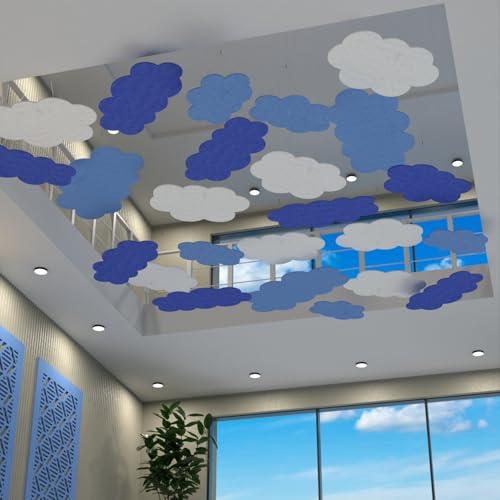
ua acoustics WILDS Acoustic Ceiling Clouds, 2-Pack 50 x 50 cmThe only cloud in this set that publishes an NRC, a frequency range and a cable length, and the only one with the thickness to use any of them.
Skutchi Designs eSCAPE Cloud Shaped Acoustic Ceiling Panel, 24 x 36 inA 10-foot adjustable chain and a named fire standard, let down by a listing that states two different NRC figures for the same panel.
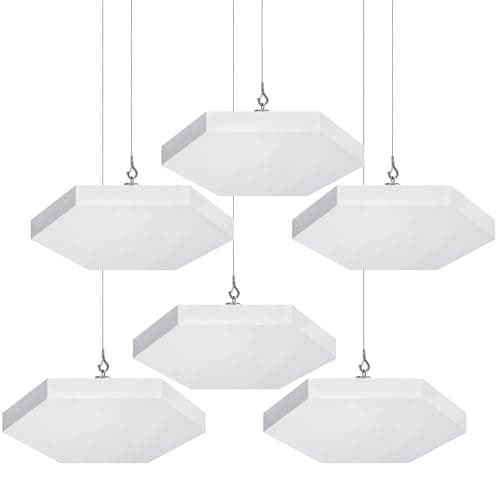
ElaraBerry Hexagon Ceiling Panels, 6-Pack Coated FiberglassCoated fiberglass at a published 120 kg/m3, hung from the ceiling so both faces work. It is the only product here that absorbs on two sides.
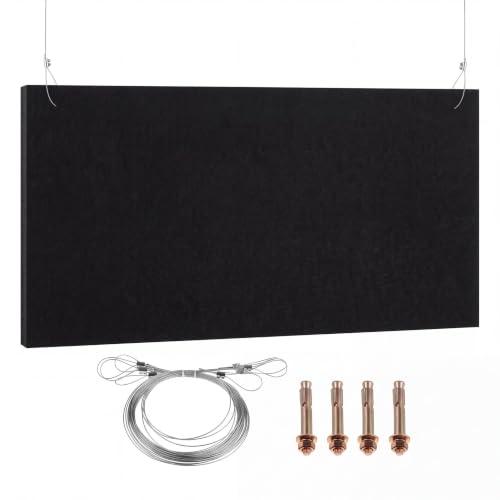
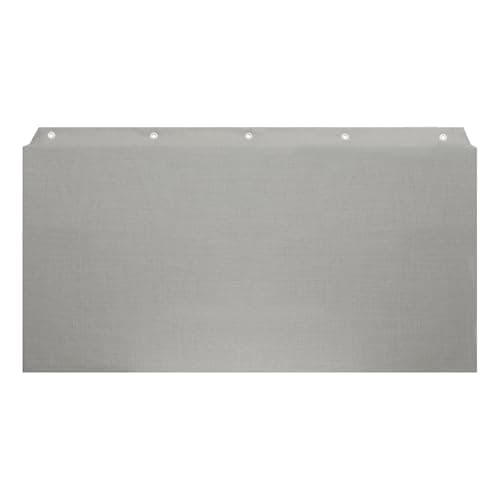
ElaraBerry Hanging Ceiling Panels, Rectangle, 8-PackEight hanging slats that work out at roughly 41 sq ft of exposed surface for under a hundred dollars. They are also 0.35 in thick, and that is the whole story.
Three baffles and four clouds, scored on the hub's usual five metrics. Every cost-per-square-foot figure in the prose below is our arithmetic from each listing's published dimensions and the price verified on 2026-11-19; the price on each buy row is live.
01/ATS Acoustics
Hanging Acoustic Baffle, 24 x 48 x 2 in
Best documented baffle
7.4/ 10
2 in of absorber on an aluminum frame, hung so both faces work, and the only ceiling product here that publishes an absorption number at all.
2 in of absorber on an aluminum frame, hung so both faces work, and the only ceiling product here that publishes an absorption number at all.
Published specification
Baffle size
24 x 48 x 2 in
ATS Acoustics published specification
Absorbing surface
16 sq ft (8 sq ft per face, both faces exposed)
Our arithmetic from the published baffle size
NRC
1.52 (publisher states out of 1); no test standard named on the listing
ATS Acoustics published specification
Frame
Aluminum frame, just inside the fabric
ATS Acoustics published specification
Core and cover
Not named on the current listing. The baffle is a fabric wrap over the frame; the fill is not stated
Absence confirmed against the published specification
Weight
8 lb, which is 0.5 lb per sq ft of exposed surface
Listing published weight; the per-square-foot figure is our arithmetic
Origin
Manufactured in the USA
ATS Acoustics published specification
What the specs are good for
2 in of depth is the only thickness here that reaches below about 500 Hz, which is where a boomy room actually lives
A published NRC in a category where seven of the nine products on this page publish nothing
Aluminum frame rather than a bare fabric sock, which is what stops a baffle sagging into a banana over a year
Hangs free, so 8 sq ft of panel does the work of 16 sq ft of wall
About 9.75 dollars per square foot of exposed surface against about 15.37 for the 12 in version of the same baffle
What they are not
The NRC of 1.52 is published without naming a test standard, and a coefficient above 1 is an artifact of how a two-sided absorber gets normalized to one-sided area, not a panel that absorbs more energy than reaches it
A 24 in drop is a lot of baffle to have hanging in a room with an 8 ft ceiling
8 lb overhead needs a joist or a proper cavity anchor; a drywall plug is not enough
The current colorway is Fog, a flat commercial gray that is fine in a studio and conspicuous in a spare bedroom
One baffle will not change a room. Four is a treatment, and that is four times this price
Skip this if
Skip this if your ceiling is under 8 ft or you sit under where it would hang. A 24 in baffle over a desk is a thing you will walk into, and the narrower 12 in version of the identical product exists for exactly this reason.
Who it is for. Someone with a high or sloped ceiling, a room that rings low rather than bright, and the budget to hang three or four of these rather than one.
The same mineral wool, frame and published NRC as the 24 in baffle in half the drop. You pay a premium per square foot for the head height.
The same mineral wool, frame and published NRC as the 24 in baffle in half the drop. You pay a premium per square foot for the head height.
Published specification
Baffle size
12 x 48 x 2 in
ATS Acoustics published specification
Absorbing surface
8 sq ft (4 sq ft per face, both faces exposed)
Our arithmetic from the published baffle size
NRC
1.52 (publisher states out of 1); no test standard named on the listing
ATS Acoustics published specification
Core
Mineral wool, solid aluminum frame, 100% natural jute burlap cover
ATS Acoustics published specification
Weight
6 lb, which is 0.75 lb per sq ft of exposed surface
Listing published weight; the per-square-foot figure is our arithmetic
Finish
Black
ATS Acoustics published specification
What the specs are good for
A 12 in drop clears head height in a standard 8 ft room, which the 24 in version does not
Same 2 in mineral wool core and same published NRC as the larger baffle
6 lb is light enough for a single good cavity anchor per cable
Black disappears against a dark ceiling in a way ivory burlap never will
Three narrow baffles spread across a ceiling beat one wide baffle in a single spot, because spacing matters more than mass in one place
What they are not
About 15.37 dollars per square foot of exposed surface against about 9.75 for the 24 in baffle, because the aluminum frame is a much larger share of a narrow panel
The same unreferenced NRC figure as its wider sibling
8 sq ft of exposed surface per baffle means you need several, and several of these is not a cheap ceiling
Burlap over mineral wool is not a wipeable surface
Skip this if
Skip this if you have the ceiling height for the 24 in version, which is the same product at roughly two-thirds the cost per square foot.
Who it is for. A standard-height room where the ceiling is the only untreated surface left and a deep baffle would be in the way.
The only cloud in this set that publishes an NRC, a frequency range and a cable length, and the only one with the thickness to use any of them.
The only cloud in this set that publishes an NRC, a frequency range and a cable length, and the only one with the thickness to use any of them.
Published specification
Panel size
500 x 500 x 53 mm (19.7 x 19.7 x 2.1 in), 2 panels
ua acoustics published specification
Absorbing surface
About 10.8 sq ft (about 5.4 sq ft per face, both faces exposed)
Our arithmetic from the published panel size and count
NRC
0.65 overall; no test standard named on the listing
ua acoustics published specification
Effective range
Published as 200 Hz to 5000 Hz
ua acoustics published specification
Material
Laminated high-density fiberboard over acoustic foam; described as absorption combined with diffusion
ua acoustics published specification
Suspension
Three cables per panel, each 1 m (40 in), angle adjustable
ua acoustics published specification
Weight
Not published
Absence confirmed against the published specification
What the specs are good for
Publishes an NRC and a frequency range, which no other cloud on this page does at all
2.1 in of depth, within a tenth of an inch of the 2 in mineral wool baffles and roughly six times the cheap polyester clouds
Three cables per panel rather than two, which is what stops a square panel turning into a pendulum
The cables are 40 in, so the hang depth is yours to choose rather than fixed at four inches
About 11.29 dollars per square foot of exposed surface, against about 18.33 for the other cloud here that publishes anything
What they are not
The published 200 Hz floor is the honest limit: this is a mid and high frequency product and the listing says so
No weight published anywhere, which matters more on a ceiling than on a wall
NRC 0.65 is published without naming ASTM C423 or any other method
Two panels is 5.4 sq ft of face area. It is a start on a ceiling, not a treatment
Fiberboard over foam is a harder, more reflective face than fabric over mineral wool, which is part of why the number is 0.65 rather than higher
Skip this if
Skip this if the room booms rather than rings. The maker publishes a 200 Hz floor, and below that this panel is doing nothing no matter how far down you hang it.
Who it is for. Someone treating the ceiling directly over a desk who wants a published number rather than an adjective, and has the height to hang it properly.
eSCAPE Cloud Shaped Acoustic Ceiling Panel, 24 x 36 in
Best for a tall room
5.2/ 10
A 10-foot adjustable chain and a named fire standard, let down by a listing that states two different NRC figures for the same panel.
A 10-foot adjustable chain and a named fire standard, let down by a listing that states two different NRC figures for the same panel.
Published specification
Panel size
24 x 36 in, 1/2 in thick
Skutchi Designs published specification
Absorbing surface
12 sq ft (6 sq ft per face, both faces exposed)
Our arithmetic from the published panel size
NRC
The title says 0.85 and the specification bullet says 0.75. Both are on the same listing and no test standard is named for either
Skutchi Designs published specification
Material
Felt-like PET made from 100 percent recycled plastics; stated as 100 percent recyclable
Skutchi Designs published specification
Fire
ASTM E84 Class A
Skutchi Designs published specification
Suspension
D-rings on the panel and an adjustable hanging chain, maximum length 10 ft
Skutchi Designs published specification
Weight
5 lb, which is about 0.42 lb per sq ft of exposed surface
Listing published weight; the per-square-foot figure is our arithmetic
Origin
Custom made to order in the USA
Skutchi Designs published specification
What the specs are good for
A 10 ft chain is the only published suspension on this page long enough for a vaulted or double-height room
Names ASTM E84 and a Class A result, where most of this category says fireproof and names nothing
Recycled PET, so no mask, no gloves and nothing to shed over a desk
Publishes its weight, which about half of this category does not
Made to order rather than drop-shipped, which is the only reason the colorways are real choices
What they are not
The listing publishes NRC 0.85 in its title and NRC 0.75 in its own bullet, so we will not use either figure
1/2 in of PET. At that depth the panel works above roughly 1 kHz and does very little below 500 Hz, whatever the coefficient says
About 18.33 dollars per square foot of exposed surface, the most expensive here by a wide margin
One panel is 12 sq ft of exposed surface, so a real treatment is several of these at over 200 dollars each
Made to order means no quick returns if the color is wrong on your ceiling
Skip this if
Skip this if the published number is what you are buying on. A listing that gives two different NRC figures for one panel has not been checked by anyone, and that is the thing a coefficient is supposed to tell you.
Who it is for. Someone with a high or sloped ceiling who needs the drop more than the depth, and is buying on finish, fire rating and made-to-order color.
Coated fiberglass at a published 120 kg/m3, hung from the ceiling so both faces work. It is the only product here that absorbs on two sides.
Coated fiberglass at a published 120 kg/m3, hung from the ceiling so both faces work. It is the only product here that absorbs on two sides.
Published specification
Panel size
14.2 x 12.3 x 1.2 in, 6 panels
ElaraBerry published specification
Density
120 kg/m3 coated fiberglass
ElaraBerry published specification
Absorption
Described as effective for mid to high frequencies; no NRC published
Absence confirmed against the published specification
Weight
6.39 lb for the pack
Listing published specification
Supplied with
12 stainless steel cables, fixings, gloves
ElaraBerry published specification
Mounting
Suspended from the ceiling, both faces exposed
ElaraBerry published specification
What the specs are good for
Suspended mounting exposes both faces, which is a genuine physical advantage no wall panel has
Publishes a real density figure at 120 kg/m3, and density is what thin panels lack
1.2 in thick, roughly three times the felt tiles here
Frees up wall space entirely, which matters in a small room with windows and a door
What they are not
No NRC published, so the dual-sided advantage cannot be quantified
Fiberglass, coated or not: the listing itself tells you to wear a mask, goggles and gloves to install it
Needs ceiling fixings, which is a harder job than a wall and impossible in most rentals
The listing warns about odor and advises ventilating before use
Skip this if
Skip this if you rent, if your ceiling is concrete, or if anyone in the house is sensitive to fiberglass. Ceiling work is the least forgiving install in this whole category.
Who it is for. An owner-occupier in a small hard-surfaced room who has run out of usable wall.
Eight hanging slats that work out at roughly 41 sq ft of exposed surface for under a hundred dollars. They are also 0.35 in thick, and that is the whole story.
Eight hanging slats that work out at roughly 41 sq ft of exposed surface for under a hundred dollars. They are also 0.35 in thick, and that is the whole story.
Published specification
Panel size
About 47.24 x 7.87 x 0.35 in each, 8 panels, 2 percent cutting tolerance stated
ElaraBerry published specification
Absorbing surface
About 41.3 sq ft (20.7 sq ft per face, both faces exposed)
Our arithmetic from the published panel size and count
Material
High-density polyester fiberboard
ElaraBerry published specification
Weight
5.71 lb, which is about 0.14 lb per sq ft of exposed surface
Listing published weight; the per-square-foot figure is our arithmetic
Absence confirmed against the published specification
What the specs are good for
About 2.28 dollars per square foot of exposed surface, the cheapest two-sided treatment on this page
Panel spacing is yours to set, so the same 8 panels can cover a narrow strip over a desk or a wide band across a room
5.71 lb spread across eight separate panels means no single fixing carries real load
Polyester rather than fiberglass, so no mask, no gloves and nothing to shed into the room
The 2 percent cutting tolerance is published, which is a small honesty most listings in this category skip
What they are not
0.35 in thick. At that depth a porous absorber does useful work above roughly 1 kHz and close to nothing below 500 Hz, which is the half of the problem that makes a room sound boomy
About 0.14 lb per sq ft, the least material per square foot of anything here
16 expansion bolts means 16 holes in your ceiling, and the install is genuinely the longest on this page
No absorption figure of any kind, so the low cost per square foot is cost per square foot of something unmeasured
Eight separate panels have to be hung level with each other or the whole thing looks like a mistake
Skip this if
Skip this if your room sounds boomy or boxy rather than bright and hissy. Thin panels do not reach low, and no quantity of 0.35 in panel substitutes for 2 in of mineral wool.
Who it is for. A bright, hard-surfaced room with a lot of ceiling and a small budget, where the complaint is sibilance and ring on calls rather than low-end boom.
If your ceiling is 8 ft and flat, buy a cloud and hang it as low as you can stand to. The ua acoustics pair is the one to start from, because 2.1 in of depth and a published 200 Hz floor is the only combination here where the gap arithmetic has anything to work with. Hang it at 16 in if the room allows it and 12 in if it does not; below about 8 in you are buying a decorative object.
If your ceiling is high, sloped or open-joisted, buy baffles and buy fewer than you were going to. The ATS 24 x 48 in is the only product in either format that publishes an absorption figure and has the thickness to reach below 500 Hz. Spread them. The published data says four well-spaced baffles beat eight crowded ones, and that is four hundred dollars of difference in your favor.
And if the budget is the constraint, the ElaraBerry rectangles at about 2.18 dollars per square foot of exposed surface are five times cheaper per square foot than anything else here - on the honest understanding that 0.35 in of polyester does nothing below about 500 Hz, so you are buying coverage against a bright, ringing room rather than treatment for a boomy one.
A ceiling is rarely the first surface to treat. If the walls are still bare, the best acoustic panels for a home office ranks eleven wall panels on what their makers commit to in writing, and that is the cheaper place to start. And if the problem is noise arriving from outside the room rather than ringing inside it, nothing here helps at all - that is acoustic panels vs soundproofing, and the fix is structural.
FAQ
Questions people ask about this
What is the difference between acoustic ceiling baffles and clouds?+
A baffle hangs vertically, like a fin, usually in parallel rows. A cloud hangs horizontally, flat, a few inches below the ceiling. Both expose two faces to the room, which is what makes ceiling treatment efficient. The real difference is the space behind the panel: a cloud has a defined gap between its back and the ceiling, while a baffle is edge-on with air on both sides all the way up. That gap is the main variable, and it is why clouds and baffles are not measured the same way.
Which is better for a home office, baffles or clouds?+
For a standard 8 ft flat ceiling, clouds. A baffle has to drop 12 to 24 in into the room to work as a baffle, which is head height you do not have at that ceiling height, and a cloud can sit over the desk where nobody stands. Baffles win in a high, sloped or exposed-joist room, which is what they were designed for and where the depth behind the panel costs you nothing.
How far below the ceiling should I hang an acoustic cloud?+
As low as the room allows, and further than the supplied cables usually suggest. A porous absorber works on moving air, and air moves fastest about a quarter of a wavelength from a hard surface, so the gap depth sets where the cavity starts helping: about 844 Hz at 4 in, 281 Hz at 12 in, 141 Hz at 24 in. Most decorative clouds get hung three or four inches down, where the gap is contributing almost nothing the thin panel was not already doing on its own.
Why do some acoustic baffles claim an NRC above 1?+
Because the chamber result for a two-sided free-hanging absorber has been divided by the area of one face only, which roughly doubles the coefficient. A figure above 1 does not mean the panel absorbs more energy than reaches it. It means the normalization counted half the absorbing surface. This is also why commercial baffle makers publish sabins per baffle rather than NRC, and why a baffle's published figure cannot be compared against a cloud's.
Do I need more baffles or should I space them further apart?+
Space them further apart. The one published dataset we could find that measures the same baffle at two hang depths shows each unit absorbing about 2.13 times as much at 24 in depth and spacing as at 12 in, across three different thicknesses. Since wider spacing means fewer units over the same ceiling, five well-spread baffles measured about 7 percent better in total than ten crowded ones, for half the product. Baffles hung close together shade each other and sound cannot reach their inner faces.
Can I hang a cloud in a room with an 8 ft ceiling?+
Yes, and it is the right format at that height. Hang it over the desk rather than across the room, which is where the sound you care about is being made and where nobody is standing up. Twelve inches of drop is realistic over a seated position; much less than eight inches and the gap behind the panel has stopped contributing anything, so you are buying the panel and not the mounting.
Are baffles or clouds better value?+
Per square foot of exposed absorbing surface, the cheapest product here is a cloud: a set of thin polyester rectangles at about 2.18 dollars per square foot against about 4.25 for the cheapest baffle and about 9.75 for the best-documented one. But the cheap clouds are 0.35 in thick and do very little below 500 Hz, so the cheaper number buys coverage rather than depth. Value depends on whether your room rings or booms.
Will a ceiling baffle or cloud stop noise from the apartment above?+
No. Absorbing and blocking are different physical problems: absorption needs porous lightweight material with air in it, and blocking needs mass and airtightness. Nothing on this page weighs enough to block anything, and products in this category sold as soundproofing for footsteps above are being sold dishonestly. What a treated ceiling does is cut how long sound hangs in your own room.
Sources
Where these numbers came from
We have not handled any of these products. Every figure on this page is either the manufacturer's own published specification, named as such, or our arithmetic from those figures, shown so you can check it. Prices come from Amazon through our price layer and carry the date they were verified.
Amazon product listings, retrieved 2026-10-03
Published specifications, dimensions, materials and manufacturer claims were read from each product's own listing data. Prices and availability refresh daily and carry their verification date on the page.
The full published method, and an explicit statement of what a specs-only approach cannot tell you.
ASTM C423 — Standard Test Method for Sound Absorption and Sound Absorption Coefficients by the Reverberation Room Method
The governing test method behind any NRC figure. We name it where a manufacturer publishes an NRC so you know what the number is a result of. We have not performed this test and we do not restate anyone's NRC as our own measurement.
The companion practice to ASTM C423: it defines how a specimen is held while it is measured, and the mounting is part of the result rather than a detail of it. Type A is the specimen laid directly against the test surface. A Type E mounting leaves an airspace behind the specimen, and the numeric suffix is that airspace in millimeters, so Type E-400 is a 400 mm plenum. Free-hanging units that are not butted together into a continuous plane are tested as their own mounting type, and the result for those is reported as an absorption area per unit rather than as a coefficient. We name the standard because the mounting decides the number. We have not run the test and we do not restate anyone's result as our own measurement.
The only publicly published table we could find that measures the SAME baffle at two hang depths, which is the one comparison this category never makes. The figures are the manufacturer's, in average sabins per baffle under ASTM C423 with a J mounting, for a product we do not list and do not rank. We use them to show the direction and the size of the spacing effect, never as a rating of anything on this page. Note that the published table changes depth and spacing together, so the ratio between its two columns cannot be attributed to depth alone.
An acoustics training publication's explanation of why the same material measures differently depending on how it is held, including that the E-mounting suffix is the depth of the airspace in millimeters, that E-400 is the common case at roughly 16 in, and that deepening the airspace moves the low-frequency absorption peak downward. We took the mechanism and the mounting convention from it; the frequency arithmetic on this page is our own and is shown so it can be checked.
An acoustics consultancy's account of how a published absorption figure goes wrong, and the source we lean on for the coefficient-above-1 problem: a manufacturer calculating a two-sided absorber's coefficient from the area of one face alone roughly doubles the result, which is where figures above 100 percent come from. It also notes that crediting both faces of a free-hanging product in a model carries a real risk of undertreating the room. We cite it as published professional opinion, not as a measurement.
Our arithmetic: the quarter-wavelength depth of an air gap
A porous absorber works on air movement, and air movement is at its greatest a quarter of a wavelength away from a hard surface. So a gap of depth D behind a panel does its most useful work around the frequency whose quarter wavelength is D, which is f = c / 4D with c taken as 343 m/s. Every gap-to-frequency figure on this page is that one sum: 4 in gives about 844 Hz, 12 in about 281 Hz, 16 in about 214 Hz, 24 in about 141 Hz. It is a first-order guide to where a gap starts helping, not a prediction of absorption, and a real panel's measured curve is broader and messier than one number.
Our arithmetic: exposed absorbing surface of a ceiling panel
A suspended baffle or cloud hangs in open air, so both faces are exposed to the room and its absorbing surface is twice its face area. A drop-in grid tile has one face in the room and one in the plenum, so its absorbing surface is its face area. Every cost-per-square-foot figure on the ceiling page divides the verified price by that exposed surface, and every pounds-per-square-foot figure divides published pack weight by it. Both are derived from published dimensions and shown so you can check them; neither is a performance measurement.