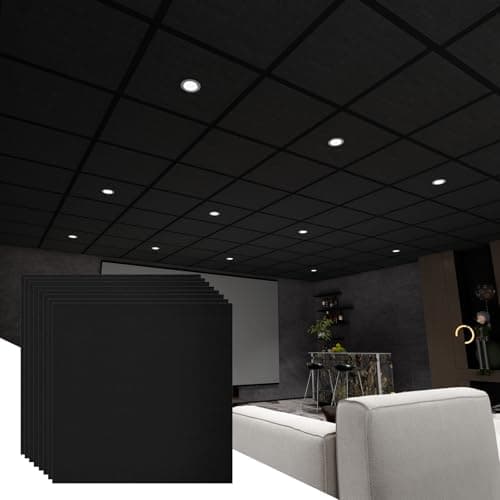
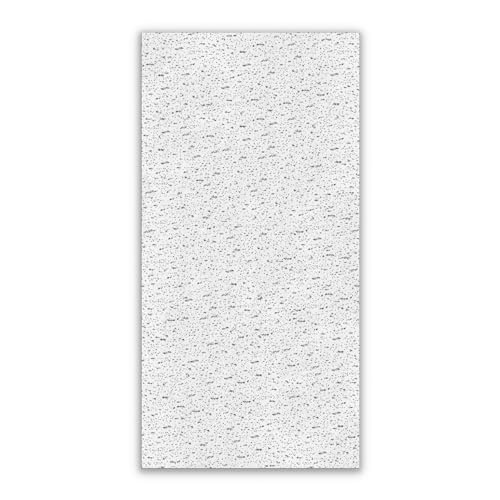
Five tiles for a suspended grid. Four of them call themselves acoustic and publish no absorption figure. One publishes NRC, CAC and light reflectance, item by item.
SMBy Scooter M.Published November 22, 2026Prices verified November 22, 2026
The short answer
Buy the Armstrong FISSURED 755. It is the only tile in this category that publishes a measured absorption figure - NRC 0.55 - alongside a CAC of 30 and a light reflectance of 0.79, item number by item number, on Armstrong's own data sheet. Everything else here publishes the words sound absorbing and no number. If your ceiling is a recording or video background and you want it dark, the Armstrong Backstage Noir tile is the heaviest material per square foot on this site at about 1.29 lb per sq ft - and it still publishes no NRC, which is worth knowing before you spend. And if the budget is the constraint, the Art3d polyester tiles are about a third the price per square foot and about a third of the material, which is a fair trade honestly stated.
This category sells the word acoustic and publishes nothing
Six tiles, all marketed as acoustic, sound absorbing or noise reducing. One publishes an NRC. The other five publish a sentence.
That is a worse ratio than the wall-panel category, where at least three products publish a figure, and it is stranger, because drop-in grid tiles are a commercial building product. The mineral fiber tiles in an office ceiling are specified by architects against published NRC and CAC values as a matter of routine. The ones sold loose on a consumer marketplace mostly arrive with the numbers stripped out.
What each tile publishes about its own acoustics
Tile
NRC
CAC
Standard named
Weight per sq ft
Armstrong FISSURED 755
0.55
30
Class A per ASTM E84 and CAN/ULC S102 for fire
0.66 lb
Armstrong Backstage Noir 1319
Not published
Not published
ASTM E84 Class A for fire
1.29 lb
uDecor Arena tegular
Not published
Not published
ASTM D5116 for air quality; Class A for fire
0.95 lb
Art3d polyester 2 x 2
Not published
Not published
None
0.39 lb
Art3d polyester 2 x 4
Not published
Not published
None
0.36 lb
BaseNoir 2 x 2
Not published
Not published
Class A flame retardant
See product card
Each entry is that product's own published claim or the confirmed absence of one. The Armstrong FISSURED acoustic figures are quoted from Armstrong's FISSURED Square Lay-in and Tegular data sheet against item number 755; Armstrong's own disclaimer on that sheet reads 'Values vary by item configuration'. Weight-per-square-foot figures are our arithmetic from published pack weights and tile sizes and include packaging in some cases.
NRC and CAC are two different jobs and nearly everyone conflates them
This is the one thing worth understanding before you buy a ceiling tile, and the Armstrong data sheet is the only document in this group that lets you see it.
NRC is absorption. How much of the sound hitting the tile from inside your room does not come back. It is what fixes a room that rings, and it is what every product here claims and almost none measures. NRC 0.55 means roughly 55 per cent absorbed, averaged across four test frequency bands.
CAC is blocking. Ceiling Attenuation Class describes how much sound is stopped from traveling UP through the tile, across the plenum above it, and back down into the next room. It is the figure that matters if the noise problem is a person in the room on the other side of a shared ceiling void.
A tile can be good at one and bad at the other. A thin, open, porous tile absorbs well and blocks badly. A dense, sealed tile blocks well and absorbs badly. Armstrong publishes both figures for the FISSURED tile - 0.55 and 30 - which is the only reason you can tell which kind of product you are buying.
Mass is the proxy, and the spread is three to one
When five of six products publish no absorption figure, the only thing left to compare them on is how much material you are actually buying. We compute pounds per square foot from each listing's published pack weight and tile size.
Material per square foot, worked
Armstrong Backstage Noir: 62 lb for 6 tiles at 24 x 48 in = 48 sq ft, so about 1.29 lb per sq ft
uDecor Arena: 3.8 lb per tile at 24 x 24 in = 4 sq ft, so about 0.95 lb per sq ft
Armstrong FISSURED 755: Armstrong publishes this directly as 0.66 lb per sq ft, 96 sq ft per carton
Art3d polyester 2 x 2: 18.77 lb for 12 tiles at 4 sq ft each = 48 sq ft, so about 0.39 lb per sq ft
Heaviest to lightest is therefore about 3.3 to 1
Our arithmetic from each listing's published figures, except the Armstrong FISSURED line, which is Armstrong's own published figure from the item 755 row of its data sheet. Shipping weights include packaging, so the polyester end of this range is flattered slightly. Mass is not absorption and we do not present it as a substitute for a measurement - it is what is left when nobody publishes one.
The useful surprise in that list is that the tile with the published NRC is not the heaviest one. Armstrong's own Backstage tile carries roughly twice the material per square foot of its own FISSURED tile and publishes no absorption figure for it. If mass were a reliable predictor, Backstage would win. It may well absorb more; we cannot say so, because the number does not exist, and this site does not publish numbers that do not exist.
How we ranked these
The same five metrics as the rest of this hub - absorption, coverage, mounting, finish and documentation - applied to a format where mounting is nearly constant. Every tile here drops into a standard 15/16 in grid with no glue, screws or anchors, so mounting separates these products hardly at all and the ranking is carried by what each one publishes and how much material you get. Full rubric on how we pick.
One deliberate consequence: the tile with the measurement ranks first even though it is neither the cheapest nor the heaviest. On a site whose entire method is reading what manufacturers publish, a published NRC with a named item number and a data sheet behind it outranks a heavier tile that publishes an adjective.
#
Product
Best for
Score
Price
01
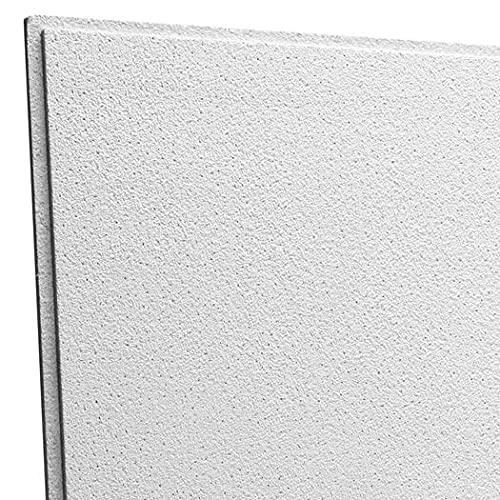
Armstrong FISSURED 755 Mineral Fiber Ceiling Tiles, 2 x 4 ft, 12-PackThe one product in this category that publishes a measured absorption figure, a sound-blocking figure and a light reflectance, item by item. NRC 0.55, CAC 30, LR 0.79.
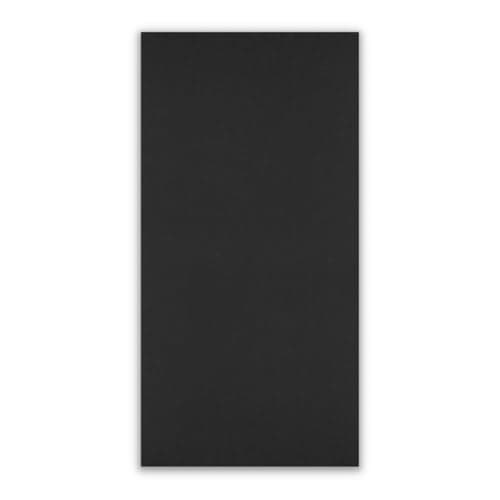
Armstrong Backstage Noir 1319 Drop Ceiling Tiles, 2 x 4 ft, 6-PackThe heaviest material per square foot on this page by a wide margin, in a tile that needs no fixings at all - provided you already have a suspended grid.
uDecor Arena Tegular Ceiling Tiles, 2 x 2 ft, Box of 10A tegular-edge tile at polyester money, Class A fire-rated and ASTM D5116 air-quality compliant. It publishes two standards and no absorption figure at all.
Art3d Acoustic Polyester Drop Ceiling Tiles, 2 x 2 ft, 12-PackThe same high-density polyester as the 2 x 4 tile in a 2 ft square, which is the size that survives a ceiling full of lights, vents and sprinkler heads.
Art3d Acoustic Polyester Drop Ceiling Tiles, 2 x 4 ft, 10-Pack80 sq ft of grid tile at about 1.62 dollars a square foot, cuttable with a utility knife. Thin and light, and the listing admits neither.
BaseNoir Black Acoustic Ceiling Tiles, 2 x 2 ft, 24-Pack96 sq ft of non-reflective black tile in one box, sold for glare control as much as for sound, and publishing less than anything else here.
Ranked on the five acoustic-hub metrics. Every pound-per-square-foot figure is our arithmetic from each product's published pack weight and tile size; coverage is one face, because a grid tile has its other face in the plenum. Prices on the buy rows are live.
01/Armstrong
FISSURED 755 Mineral Fiber Ceiling Tiles, 2 x 4 ft, 12-Pack
The only tile with a published NRC
7.8/ 10
The one product in this category that publishes a measured absorption figure, a sound-blocking figure and a light reflectance, item by item. NRC 0.55, CAC 30, LR 0.79.
The one product in this category that publishes a measured absorption figure, a sound-blocking figure and a light reflectance, item by item. NRC 0.55, CAC 30, LR 0.79.
Published specification
Tile size
24 x 48 x 5/8 in, square lay-in, 12 tiles
Armstrong published specification, item 755
NRC
0.55
Armstrong FISSURED Square Lay-in & Tegular data sheet, item 755
CAC
30 (Armstrong labels this Sound Blocking)
Armstrong FISSURED data sheet, item 755
Light reflectance
0.79, white panels only
Armstrong FISSURED data sheet, item 755
Material
Wet-formed mineral fiber, factory-applied latex paint
Armstrong published specification
Fire
Class A: ASTM E84 and CAN/ULC S102 surface burning. Flame Spread Index 25 or less, Smoke Developed Index 50 or less, UL labeled
Armstrong FISSURED data sheet
Weight
0.66 lb per sq ft; 96 sq ft per carton
Armstrong FISSURED data sheet, item 755
Coverage
96 sq ft, one face exposed
Our arithmetic from the published tile size and pack count
What the specs are good for
Publishes an NRC, a CAC and a light reflectance against a specific item number, which not one other tile in this category does
0.55 NRC is a real middling absorber rather than a claim, and it is the number everything else here should be compared against
CAC 30 is the only published figure anywhere on this site for sound passing THROUGH a ceiling into the space above, which is a different job from absorption
0.79 light reflectance means a ceiling you can actually work under; the black polyester tiles eat light
96 sq ft in one carton covers a small room in a single purchase
What they are not
About 2.06 dollars per sq ft, which is more than twice the cheapest polyester tile
0.66 lb per sq ft is only half the mass of Armstrong's own Backstage tile, so it is lighter than the heaviest option here
Mineral fiber cuts dustily and chips at the corners; polyester cuts clean with a knife
Useless without an existing 15/16 in suspended grid, which most homes do not have
White fissured commercial texture reads as an office ceiling, because it is one
Skip this if
Skip this if your ceiling is plaster or drywall. Nothing in the drop-in category applies to a solid ceiling, and gluing a grid tile to one is not a substitute for a panel designed to be mounted.
Who it is for. Anyone with a basement or converted commercial room that already has a grid, who wants the one tile whose absorption is a published measurement rather than a sentence.
Backstage Noir 1319 Drop Ceiling Tiles, 2 x 4 ft, 6-Pack
Best drop-in tile
7.0/ 10
The heaviest material per square foot on this page by a wide margin, in a tile that needs no fixings at all - provided you already have a suspended grid.
The heaviest material per square foot on this page by a wide margin, in a tile that needs no fixings at all - provided you already have a suspended grid.
Published specification
Tile size
24 x 48 in, square edge, 6 tiles
Armstrong published specification
Coverage
48 sq ft, one face exposed
Our arithmetic from the published tile size and pack count
Weight
62 lb for the pack, which is about 1.29 lb per sq ft
Listing published shipping weight; the per-square-foot figure is our arithmetic and includes packaging
Fire
ASTM E84 Class A fire-resistive
Armstrong published specification
Absorption
Not published on this listing. No NRC and no CAC figure
Absence confirmed against the published specification
Grid
Standard 15/16 in suspended ceiling grid, non-directional texture
Armstrong published specification
What the specs are good for
About 1.29 lb per sq ft, roughly three and a half times the Art3d polyester tile, and mass is what the cheap tiles do not have
Names ASTM E84 Class A, the only drop-in tile here that names a test standard for anything
Drops into an existing 15/16 in grid with no glue, screws or anchors, so the install is a ladder and ten minutes
Non-directional texture and a square edge mean offcuts are not obviously offcuts
A named building-products manufacturer rather than a listing-only brand, which in this category is itself a documentation signal
What they are not
No NRC and no CAC on the listing, so the one tile with real mass still will not tell you what it absorbs
About 4.30 dollars per sq ft against about 1.62 for the Art3d tile, which is 2.7 times the price
Completely useless without a suspended grid already in the room, and installing a grid is a different and much larger project
62 lb of tile arriving as one parcel is awkward to handle alone, and mineral fiber tiles chip at the corners if you are rough with them
Backstage Noir is black, which eats a great deal of light in a room that is not a theater
Skip this if
Skip this if you do not already have a drop ceiling. Nothing about this tile applies to a plaster or drywall ceiling, and no amount of adhesive makes it apply.
Who it is for. A basement or converted commercial space that came with a grid, where the existing tiles are thin builder-grade stock and swapping them is the cheapest acoustic work available.
A tegular-edge tile at polyester money, Class A fire-rated and ASTM D5116 air-quality compliant. It publishes two standards and no absorption figure at all.
A tegular-edge tile at polyester money, Class A fire-rated and ASTM D5116 air-quality compliant. It publishes two standards and no absorption figure at all.
Published specification
Tile size
24 x 24 x 0.63 in, tegular edge, 10 tiles
uDecor published specification
Coverage
40 sq ft, one face exposed
Our arithmetic from the published tile size and pack count
Weight
3.8 lb per tile, which is about 0.95 lb per sq ft
Listing published weight; the per-square-foot figure is our arithmetic
Fire
Class A fire rated
uDecor published specification
Air quality
Meets ASTM D5116; asbestos free
uDecor published specification
Absorption
Not published. Described as excellent sound absorption and noise reduction, with no figure
Absence confirmed against the published specification
Material
Described as a distinct texture unlike traditional mineral fiber
uDecor published specification
What the specs are good for
About 2.00 dollars per sq ft for a tegular edge, which is the detail that stops a grid looking like a grid
0.95 lb per sq ft is real material, about two and a half times the Art3d polyester tile
Names two standards, Class A for fire and ASTM D5116 for air quality, which is two more than most of this category
Humidity and sag resistance published, which matters in a basement
What they are not
No NRC and no coefficient, so the acoustic claim is a sentence
The listing text repeatedly calls a 2x2 tile a 2x4 and references 'armstrong ceiling tiles 2x2' in its own feature copy, which is keyword stuffing rather than specification
The material is described only as a distinct texture unlike mineral fiber, so what it actually is never gets stated
40 sq ft per box is half the Armstrong carton, so a room needs two or three boxes
Skip this if
Skip this if you want a published absorption figure, because it does not have one. The Armstrong Fissured tile is the only option here that does.
Who it is for. Someone replacing tatty builder-grade tiles in an existing grid who cares how the ceiling looks and is content to treat absorption as a bonus.
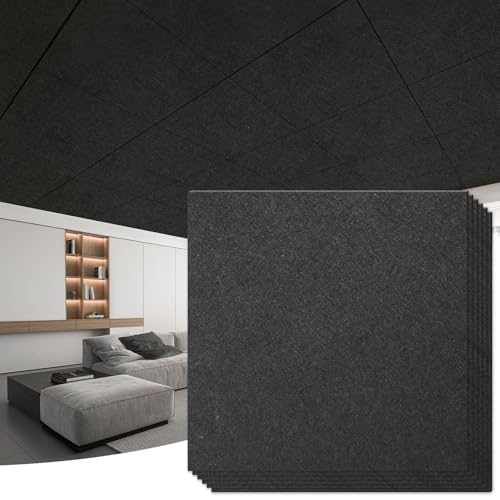
Acoustic Polyester Drop Ceiling Tiles, 2 x 2 ft, 12-Pack
Best for a grid with obstructions
6.6/ 10
The same high-density polyester as the 2 x 4 tile in a 2 ft square, which is the size that survives a ceiling full of lights, vents and sprinkler heads.
The same high-density polyester as the 2 x 4 tile in a 2 ft square, which is the size that survives a ceiling full of lights, vents and sprinkler heads.
Published specification
Tile size
24 x 24 x 0.197 in, square edge, 12 tiles
Art3d published specification
Coverage
48 sq ft, one face exposed
Our arithmetic from the published tile size and pack count
Weight
18.77 lb for the pack, which is about 0.39 lb per sq ft
Listing published weight; the per-square-foot figure is our arithmetic
Material
High-density polyester, described as low-emission, moisture resistant and sag resistant
Art3d published specification
Absorption
Not published. Described as outstanding sound absorption with no figure attached
Absence confirmed against the published specification
Grid
Standard 15/16 in T-grid, square edge, trims with a utility knife, table saw or jigsaw
Art3d published specification
What the specs are good for
About 1.59 dollars per sq ft, the cheapest grid coverage on this page
A 2 ft square is far easier to work around a light fitting than a 2 x 4 panel, and cuts clean with a knife
0.39 lb per sq ft is light enough for an old grid, and polyester will not shed or crumble when damp
The listing states it can be used on walls as well, which makes offcuts useful rather than waste
What they are not
0.197 in thick against 5/8 in for a mineral tile, so there is about a third of the material
No NRC, no coefficient, nothing measured
Black absorbs light as thoroughly as it absorbs anything else, and a whole ceiling of it changes the room
A light tile lifts in the draft from a ceiling diffuser
Skip this if
Skip this if the grid is the only acoustic work you are going to do. A 0.197 in tile over a whole ceiling is less absorbing material than four proper baffles.
Who it is for. Someone with a busy grid full of fittings who wants the whole ceiling done cheaply and treats it as a floor on the problem rather than a fix.
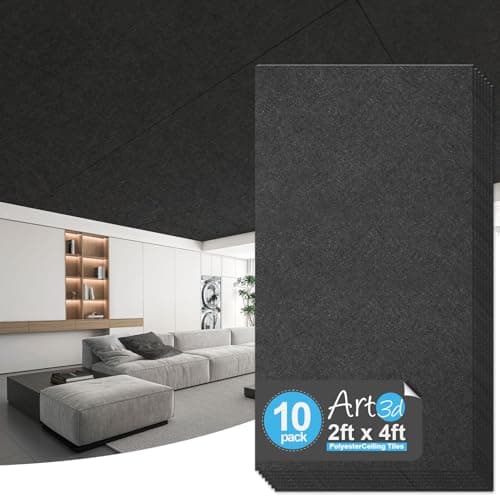
Acoustic Polyester Drop Ceiling Tiles, 2 x 4 ft, 10-Pack
Cheapest grid coverage
6.4/ 10
80 sq ft of grid tile at about 1.62 dollars a square foot, cuttable with a utility knife. Thin and light, and the listing admits neither.
80 sq ft of grid tile at about 1.62 dollars a square foot, cuttable with a utility knife. Thin and light, and the listing admits neither.
Published specification
Tile size
24 x 48 x 0.2 in, 10 tiles
Art3d published specification
Coverage
80 sq ft, one face exposed
Our arithmetic from the published tile size and pack count
Weight
28.7 lb for the pack, which is about 0.36 lb per sq ft
Listing published weight; the per-square-foot figure is our arithmetic
Material
High-density polyester, described as moisture resistant and sag resistant
Art3d published specification
Absorption
Not published. Described as outstanding sound absorption with no figure attached
Absence confirmed against the published specification
Grid
Standard 15/16 in T-grid, square edge, trims with a utility knife
Art3d published specification
What the specs are good for
About 1.62 dollars per sq ft, the cheapest coverage of any format on this page
Polyester cuts cleanly with a knife, so fitting around a light, a vent or a sprinkler head is a two-minute job rather than a dusty one
0.36 lb per sq ft is light enough that a tired old grid will take them without complaint
Will not shed, rust or crumble at the edges the way a damp mineral fiber tile does
10 tiles is enough for a small room in one purchase, with offcuts for the awkward perimeter
What they are not
0.2 in thick, which is a fraction of what a conventional mineral fiber ceiling tile gives you
About 0.36 lb per sq ft against 1.29 for the Armstrong tile, so you are buying roughly a third of the material per square foot
No NRC, no coefficient, nothing. Outstanding sound absorption is a sentence, not a result
A light, thin tile in a grid is more likely to lift in the draft from a ceiling diffuser
Black absorbs light as well as sound, and 80 sq ft of it will change how a room feels
Skip this if
Skip this if your grid is the only acoustic work you plan to do. A 0.2 in tile across a whole ceiling is less absorber than four proper baffles, and it cannot reach low frequency at all.
Who it is for. Someone with an existing grid who wants the whole ceiling covered this month and treats it as a floor on the problem rather than a fix.
96 sq ft of non-reflective black tile in one box, sold for glare control as much as for sound, and publishing less than anything else here.
96 sq ft of non-reflective black tile in one box, sold for glare control as much as for sound, and publishing less than anything else here.
Published specification
Tile size
24 x 24 in, 24 tiles
BaseNoir published specification
Coverage
96 sq ft, one face exposed
BaseNoir published specification, confirmed by our arithmetic from the tile size and count
Material
Polyester fiber, described as moisture resistant
BaseNoir published specification
Weight
Not published
Absence confirmed against the published specification
Fire
Described as Class A flame rating; no test standard named
BaseNoir published specification
Absorption
Not published. No NRC and no coefficient
Absence confirmed against the published specification
What the specs are good for
96 sq ft in one purchase at about 1.77 dollars per sq ft, enough for a whole small-room grid with spares
A genuinely non-reflective black face, which kills the ceiling bounce that puts a bright band across the top of a webcam frame
2 x 2 ft tiles fit the more common residential grid size and are far easier to handle on a ladder than 2 x 4
Drops in with no tools, no glue and nothing permanent
What they are not
No published weight at all, so the one arithmetic check available on every other tile here cannot be run on this one
Class A flame rating with no standard named is a claim, not a rating, and in a ceiling product that matters more than usual
No absorption figure of any kind
A listing-only brand with no published technical literature behind the product
96 sq ft of black ceiling will take a noticeable amount of light out of a room that is not already dark
Skip this if
Skip this if you need the ceiling to stay light, and skip it if the fire rating has to be documented rather than asserted - a rented or shared building will usually want the former.
Who it is for. A streaming room, edit suite or home theater with an existing grid, where a dark non-reflective ceiling is wanted for the camera as much as for the sound.
01Confirm you have a grid. Everything on this page is useless without an existing 15/16 in suspended ceiling. Installing a grid is a different, far larger project and it lowers the room by several inches.
02Measure the grid opening, not the tile. A nominal 2 x 2 grid opening is about 23.75 in square, which is why tiles are made slightly undersized. If your grid is metric or non-standard, tiles will not sit.
03Count the obstructions before choosing a tile size. A ceiling with lights, vents and sprinkler heads is far easier to do in 2 x 2 tiles than 2 x 4, because every obstruction costs you a cut and a 2 x 4 cut wastes twice the material.
04Check what the grid will carry. An old grid hung on light wire will take a 0.39 lb per sq ft polyester tile without complaint and may not be happy under 1.29 lb per sq ft of mineral fiber across a whole ceiling.
05Decide about light before you decide about sound. The black tiles here absorb light as thoroughly as they absorb anything. Armstrong publishes a light reflectance of 0.79 for the white FISSURED tile; a black ceiling publishes nothing and takes the room with it.
What a ceiling tile cannot fix
A room with no suspended ceiling. Which is most homes. If your ceiling is plaster or drywall, the ceiling products that apply to you are baffles and clouds, and acoustic ceiling baffles vs clouds is the page for that.
Noise coming through the floor above. A ceiling tile with a CAC of 30 addresses sound crossing a shared plenum between two rooms on the same story. It is not a floor-ceiling assembly and it does not treat footsteps overhead.
A room whose walls are the problem. Ceiling treatment is efficient because a ceiling is one large uninterrupted surface, but the first reflection your microphone hears usually comes off a wall. Where to place acoustic panels has the mirror trick for finding them.
FAQ
Questions people ask about this
Do acoustic drop ceiling tiles actually reduce noise?+
The ones that have been measured do. Armstrong publishes NRC 0.55 for its FISSURED tile, meaning roughly 55 per cent of the sound hitting it from the room is absorbed rather than reflected, averaged across four test bands. That is a genuine improvement to a room that rings. The difficulty is that five of the six tiles here publish no absorption figure at all, so for those products the claim is a sentence rather than a result.
What NRC should a ceiling tile have?+
For a room you take calls in, higher is better and 0.55 is a reasonable middling figure - the Armstrong FISSURED tile's published value. Commercial specifications for open offices often ask for 0.70 and above, and tiles at that level exist but are rarely sold loose on a consumer marketplace. The more useful advice is to buy any tile that publishes a number at all in preference to one that does not, because an unmeasured tile could be anywhere.
What is the difference between NRC and CAC on a ceiling tile?+
NRC is absorption: how much sound from your own room the tile soaks up rather than reflecting back. CAC is blocking: how much sound is stopped from traveling up through the tile, over the wall, through the plenum and down into the next room. They are different jobs and a tile can be good at one and poor at the other. Armstrong publishes both for the FISSURED tile, at 0.55 and 30, which is the only reason you can tell what you are buying.
Can I put acoustic tiles on a normal drywall ceiling?+
Not these. Every product here is a drop-in panel that sits in a 15/16 in suspended grid with no fixings at all, and nothing about it applies to a solid ceiling. Gluing a grid tile to drywall is not a substitute for a panel made to be mounted. For a solid ceiling the products are hanging baffles and clouds, which hang on cables and expose both faces.
Are 2x2 or 2x4 ceiling tiles better?+
It depends entirely on how busy your ceiling is. A 2 x 4 tile covers the same area in half the units and installs faster on a clear ceiling. A 2 x 2 tile is far easier to work around lights, vents and sprinkler heads, because each obstruction costs you one cut and a 2 x 4 cut wastes twice the material. Check what your grid is laid out for first: a 2 x 4 grid takes 2 x 2 tiles only if you add cross tees.
How many tiles do I need for a room?+
Divide the ceiling area by the tile area and add roughly 10 per cent for cuts at the perimeter. A 12 x 12 ft room is 144 sq ft, which is 36 tiles at 2 x 2 or 18 at 2 x 4, plus the waste allowance. Note that cartons here range from 40 to 96 sq ft, so the pack size usually decides the real number you buy.
Will black acoustic ceiling tiles make a room too dark?+
Yes, noticeably, and it is the most commonly regretted decision in this category. Armstrong publishes a light reflectance of 0.79 for its white FISSURED tile - most of the light that hits it comes back into the room. A black tile returns very little, and a whole ceiling of it will change how a room feels and how much artificial light it needs. Black is the right answer for a video background and rarely for a room you work in all day.
Sources
Where these numbers came from
We have not handled any of these products. Every figure on this page is either the manufacturer's own published specification, named as such, or our arithmetic from those figures, shown so you can check it. Prices come from Amazon through our price layer and carry the date they were verified.
Amazon product listings, retrieved 2026-10-03
Published specifications, dimensions, materials and manufacturer claims were read from each product's own listing data. Prices and availability refresh daily and carry their verification date on the page.
The full published method, and an explicit statement of what a specs-only approach cannot tell you.
ASTM C423 — Standard Test Method for Sound Absorption and Sound Absorption Coefficients by the Reverberation Room Method
The governing test method behind any NRC figure. We name it where a manufacturer publishes an NRC so you know what the number is a result of. We have not performed this test and we do not restate anyone's NRC as our own measurement.
ASTM E84 — Standard Test Method for Surface Burning Characteristics of Building Materials
The fire-rating standard ATS Acoustics cites for its Class 1 / Class A panels, and the one Armstrong cites for its Class A drop-in ceiling tiles. Named because they name it.
Our arithmetic: exposed absorbing surface of a ceiling panel
A suspended baffle or cloud hangs in open air, so both faces are exposed to the room and its absorbing surface is twice its face area. A drop-in grid tile has one face in the room and one in the plenum, so its absorbing surface is its face area. Every cost-per-square-foot figure on the ceiling page divides the verified price by that exposed surface, and every pounds-per-square-foot figure divides published pack weight by it. Both are derived from published dimensions and shown so you can check them; neither is a performance measurement.
Armstrong's own published data sheet, and the source of every FISSURED figure on this page: NRC 0.55 and CAC 30 against item 755, light reflectance 0.79 for white panels, Class A per ASTM E84 and CAN/ULC S102 with a Flame Spread Index of 25 or less and a Smoke Developed Index of 50 or less, wet-formed mineral fiber with a factory-applied latex paint finish, and 0.66 lb per sq ft at 96 sq ft per carton. Armstrong's own disclaimer on the sheet reads 'Values vary by item configuration', which is why we quote figures against the item number rather than the product name. We have performed no test and we do not restate Armstrong's results as our own measurements.