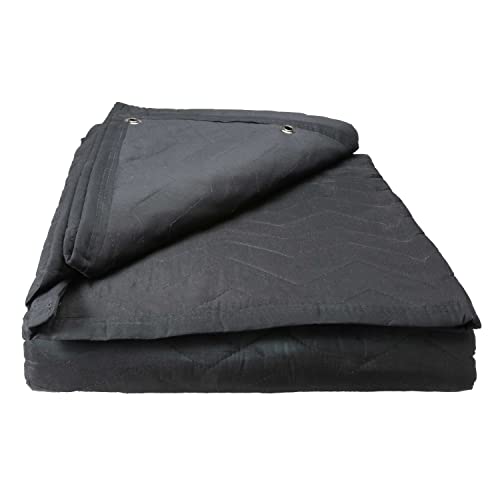
Five soft products sold for noise. One of them publishes a measurement, and that same listing is the one that tells you it absorbs rather than blocks.
SMBy Scooter M.Published November 22, 2026Prices verified November 22, 2026
The short answer
Buy the US Cargo Control sound dampening blanket. It is the only soft product in this category that publishes an NRC - 0.35 - and the only one whose own specification says it does Sound Absorption, NOT Sound Blocking or Sound Proofing. At 96 x 80 in it is 53.3 sq ft of absorbing surface, the cheapest absorbing area per dollar on this site, and it hangs from eighteen grommets with no frame. If the noise is coming around a hollow door rather than through a window, buy the TroyStudio door blanket instead - 0.8 in of weighted cotton cut to door size, with both screw hooks and hook-and-loop strips in the box. And if you want something that looks like a curtain, the RYB HOME 3-layer pair is the one to buy, because the middle felt liner is detachable and it is the only construction here you can actually inspect.
The word soundproof is doing something dishonest here
Every product on this page is sold under the word soundproof and not one of them is. Soundproofing means stopping sound passing from one side of a barrier to the other, and that takes mass, sealing and decoupling - a wall, in other words. A curtain is a porous absorber: sound goes into the fibers, some of it turns into a vanishingly small amount of heat, and the rest comes out the other side.
That distinction is not pedantry, because it changes what you should expect. Hang any of these over a window and the room will sound less live - less ring, less edge on a voice, a quieter-sounding recording. Hang any of these over a window and the traffic outside will still be there. This site has a whole page on the difference: acoustic panels vs soundproofing.
How we ranked these
The same five metrics as the rest of this hub - absorption, coverage, mounting, finish and documentation - with documentation carrying unusual weight, because four of the five products here publish no absorption figure of any kind and the fifth does. When one product in a category has a measurement and the rest have adjectives, the measurement is most of the ranking. Full rubric on how we pick.
Where no figure exists we fall back to weight per square foot, which we compute ourselves from each listing's published weight and size. It is not an absorption measurement and we do not present it as one. It is a proxy, and in a porous absorber it is the least bad proxy available: more material in the same area generally does more, and the spread here is large enough to be meaningful rather than noise.
What each product publishes about itself
Product
Published NRC
Size
Weight
Weight per sq ft
US Cargo Control blanket
0.35
96 x 80 in
12 lb
0.23 lb
TroyStudio door blanket
None
37.5 x 86.6 x 0.8 in
9.6 lb
0.43 lb
RYB HOME 3-layer, pair
None
52 x 84 in x 2
3.9 lb
0.06 lb
JaneTech acoustic curtain
None
70.9 x 39.4 in
Not published
Not computable
NICETOWN noise reducing, pair
None
42 x 84 in x 2
2.43 lb
0.05 lb
Each NRC column entry is that listing's own published figure or the confirmed absence of one. Sizes and weights are published; the weight-per-square-foot column is our arithmetic from them and is a material proxy, not a performance measurement.
Read the last column rather than the product names. The TroyStudio door blanket carries about seven times the material per square foot that the NICETOWN curtains do, and about eight times what the RYB HOME pair does. That is the real spread in this category, and no amount of the word soundproof on a listing changes which side of it a product sits on.
Thickness is the figure that decides what a soft absorber reaches
A porous absorber works on the frequencies whose wavelengths are comparable to its depth. That is why the 2 in mineral wool panels this site ranks first overall reach down into the range a speaking voice occupies, and why a 0.05 in curtain does not.
What a quarter inch of fabric can and cannot reach
Speed of sound, 343 m/s
A porous absorber does its most useful work around the frequency whose quarter wavelength matches its depth: f = c / 4D
0.8 in (the TroyStudio blanket) = 0.0203 m, so f = 343 / (4 x 0.0203) = about 4,200 Hz
2 in (the mineral wool panels on this site's main roundup) = 0.0508 m, so f = 343 / (4 x 0.0508) = about 1,690 Hz
A typical speaking voice has most of its energy between 100 and 1,000 Hz
Our arithmetic, and a first-order guide to where an absorber starts doing useful work rather than a prediction of how much it absorbs. A real absorber's measured curve is broader and messier than one number. The point of the sum is the direction, not the decimal: every soft product on this page works highest in the range and tails off below it, and the thinner it is the higher that tail-off sits.
This is also why hanging a curtain with a gap behind it genuinely helps. The air gap behaves as part of the absorber's depth, so a panel hung 4 in off the wall does more at the low end than the same panel pressed flat against it. A curtain rod already does this for you by accident, which is the one structural advantage soft treatment has over a flush-mounted panel.
Coverage is where soft treatment actually wins
Everything above argues against curtains, so here is the argument for them. Absorption is area times coefficient, and a curtain buys enormous area for very little money.
Absorbing area per dollar, soft versus hard
US Cargo Control blanket: 53.3 sq ft at NRC 0.35 = about 18.7 sabins of absorption
ATS Acoustics beveled panel: 8 sq ft at NRC 1.0 = about 8 sabins of absorption
The blanket is therefore about 2.3 times the total absorption of one measured panel
At the prices on this page when it was written, that is roughly 4.1 dollars per sabin for the blanket against 10.0 for the panel
Our arithmetic from each product's published NRC and size. A sabin is a square foot of perfect absorption and multiplying area by NRC is the standard first-order way to estimate it; it ignores where in the room the material sits and the fact that NRC is itself an average across four frequency bands. Prices move - the buy rows carry today's.
So the honest summary of this category is not that curtains are a con. It is that a blanket buys you a lot of mediocre absorption cheaply and a panel buys you a little excellent absorption dearly, and in a room that is too live, cheap mediocre absorption over a large area is frequently the better purchase. What it will not do is help with the neighbour.
Where to hang the thing
01The window, if the window is glass and the room rings. A large pane is a hard parallel surface and treating it is worth real sabins, which is why the window is the default and why three of these products are window-sized.
02The door, if calls are the problem. A hollow interior door is the biggest acoustic leak in most home offices. Mass over it helps, and it helps more once a door sweep and seal have dealt with the gap, which is cheaper and should come first.
03The wall behind you, if you are on camera. The surface directly behind your head is the one your microphone hears reflections from. A blanket on a rod a few inches off that wall is the single highest-value place to put soft material for call quality.
04Not the ceiling, from a rod. The ceiling is the most efficient surface in a room to treat and the worst one to hang fabric from. Use a ceiling baffle or cloud designed for it.
#
Product
Best for
Score
Price
01
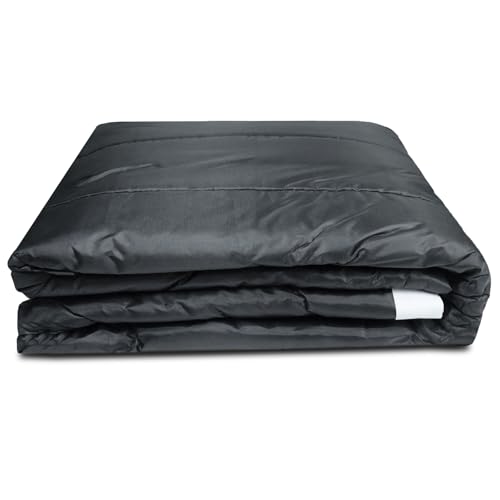
US Cargo Control Sound Dampening Blanket, 96 x 80 inThe only curtain or blanket we found that publishes an NRC figure, and the same listing says plainly that it absorbs rather than blocks. At 53 sq ft it buys more total absorption than any single panel here.
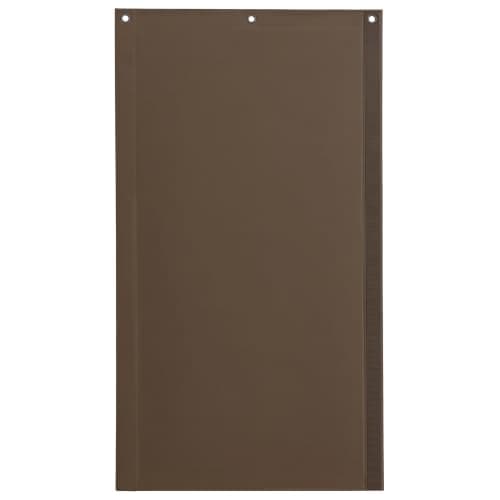
TroyStudio Thick Soundproof Blanket, 37.5 x 86.6 x 0.8 in0.8 in of weighted cotton in a door-shaped panel, with both screw hooks and hook-and-loop strips in the box. The only soft product here cut to a door rather than a window.
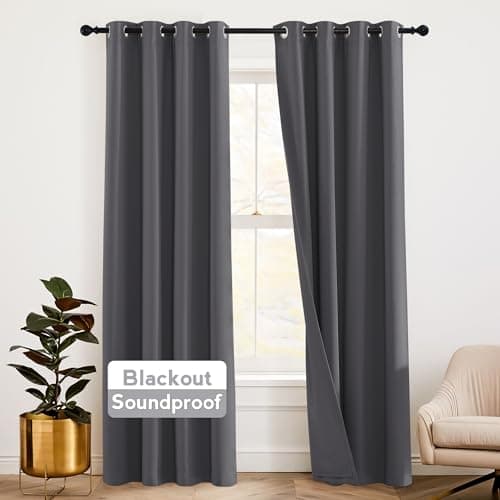
RYB HOME Soundproof Curtains, 3 Layers, 52 x 84 in (Pack of 2)The archetypal soundproof curtain: a detachable felt liner between two blackout layers, and a listing honest enough to state in its own copy that it is not 100 percent soundproof.
JaneTech Sound Dampening Acoustic Curtain, 70.9 x 39.4 inThe one product here built and sold specifically as an acoustic curtain for a home office, in a velvet finish. It is also the most expensive per square foot on this page and publishes the least about itself.
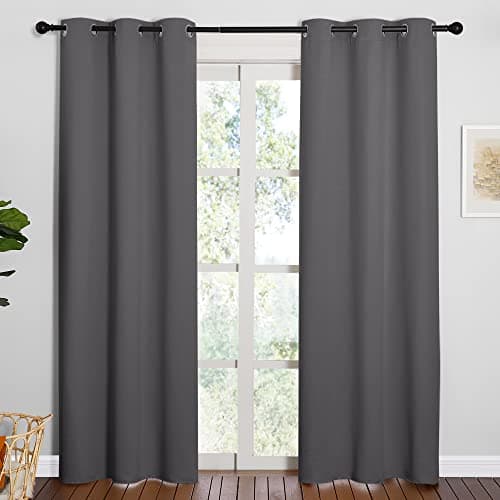
NICETOWN Noise Reducing Blackout Curtains, 42 x 84 in (Pack of 2)About forty cents a square foot, which makes it the cheapest soft surface on this page by a wide margin. The noise-reducing claim rests entirely on the phrase triple weave.
Ranked on the five acoustic-hub metrics, with documentation weighted heavily because in this category only one product publishes a figure at all. Surface-density figures are our arithmetic from each listing's published weight and size; prices on the buy rows are live.
01/US Cargo Control
Sound Dampening Blanket, 96 x 80 in
Best measured soft option
7.2/ 10
The only curtain or blanket we found that publishes an NRC figure, and the same listing says plainly that it absorbs rather than blocks. At 53 sq ft it buys more total absorption than any single panel here.
The only curtain or blanket we found that publishes an NRC figure, and the same listing says plainly that it absorbs rather than blocks. At 53 sq ft it buys more total absorption than any single panel here.
Published specification
Size
96 x 80 in
US Cargo Control published specification
Coverage
53.3 sq ft
Our arithmetic from the published size
NRC
0.35
US Cargo Control published specification
Stated use
Sound Absorption, NOT Sound Blocking or Sound Proofing
US Cargo Control published specification
Weight
12 lb
US Cargo Control published specification
Surface density
0.23 lb per sq ft
Our arithmetic from the published weight and size
Material
Woven polyester filled with 100% recycled cotton, zig-zag quilted
US Cargo Control published specification
Hanging
18 grommets; hang on the 80 in or the 96 in side
US Cargo Control published specification
Care
Machine washable, hang to dry
US Cargo Control published specification
What the specs are good for
Publishes an NRC figure at all, which nothing else in this group does
States its own limitation inside its own specification block rather than leaving the word soundproof to do the work
53.3 sq ft at about 1.43 dollars per square foot, the cheapest absorbing surface on this page
Eighteen grommets means it hangs from a rod, hooks or screws without a frame, and comes down without a trace
Machine washable, which no acoustic panel is
What they are not
NRC 0.35 is roughly a third of the measured panels here, so a square foot of it does about a third of the work
A thin quilt absorbs at high frequency; it will not reach the low end of a speaking voice the way 2 in of mineral wool does
It is a black quilted freight blanket and looks like one in a domestic room
0.23 lb per sq ft is far too little mass to reduce transmission, so it will not stop a conversation being overheard
Skip this if
Skip this if the room is one anybody else sees, or if you appear on camera in it. This is the right product for a garage, a closet booth or a wall that never appears in frame, and the wrong one for a living room that doubles as an office.
Who it is for. Someone who wants the most absorption per dollar on this page and genuinely does not care what it looks like.
0.8 in of weighted cotton in a door-shaped panel, with both screw hooks and hook-and-loop strips in the box. The only soft product here cut to a door rather than a window.
0.8 in of weighted cotton in a door-shaped panel, with both screw hooks and hook-and-loop strips in the box. The only soft product here cut to a door rather than a window.
Published specification
Size
37.5 x 86.6 x 0.8 in, one panel
TroyStudio published specification
Weight
9.6 lb
TroyStudio published specification
Fill
Thickened and weighted cotton filler in dirt-resistant oxford cloth
TroyStudio published specification
Density per sq ft
About 0.43 lb per sq ft over 22.6 sq ft
Our arithmetic from the published size and weight
Mounting
Screws and steel hooks for permanent use, or three self-adhesive hook-and-loop strips for temporary
TroyStudio published specification
Absorption
Not published. Described as absorbing sound to reduce reverb and echo, with no figure
Absence confirmed against the published specification
What the specs are good for
Cut to standard door size, which is the one opening in a home office that is usually both the biggest acoustic leak and the easiest thing to cover
0.8 in is roughly twenty times the thickness of a blackout curtain, and thickness is what decides how low a porous absorber still works
Publishes its own weight, which almost nothing in the soft category does, so the mass per square foot can actually be worked out
Ships with both a permanent and a temporary mounting kit, so a renter is not stuck drilling the door frame
What they are not
No NRC, no coefficient, no test standard. 'Absorbs sound' with no number attached
Covering a door with a blanket also covers the door: it has to be lifted or pushed aside every time you walk through
It is a moving blanket in a door shape, and the listing says so itself under furniture protection
The maker advises ventilating it before use for odour, which is an unusual thing to need to say
Skip this if
Skip this if your problem is noise arriving through a shared wall rather than around a door. Hanging mass over a door helps with what comes under and around the door; it does nothing about a wall.
Who it is for. Someone taking calls in a room with a hollow interior door, who has already fitted a sweep and a seal and wants the next reversible step.
Soundproof Curtains, 3 Layers, 52 x 84 in (Pack of 2)
Best for the window itself
6.8/ 10
The archetypal soundproof curtain: a detachable felt liner between two blackout layers, and a listing honest enough to state in its own copy that it is not 100 percent soundproof.
The archetypal soundproof curtain: a detachable felt liner between two blackout layers, and a listing honest enough to state in its own copy that it is not 100 percent soundproof.
Published specification
Size
52 in W x 84 in L per panel, 2 panels, 104 in total width
RYB HOME published specification
Coverage
60.7 sq ft across both panels
Our arithmetic from the published size
NRC
None published
Absent from the listing
Construction
3 layers: a front layer, a back layer and a detachable felt fabric liner in the middle
RYB HOME published specification
Weight
3.9 lb
Listing published specification
Surface density
0.06 lb per sq ft
Our arithmetic from the published weight and size
Light
100% blackout, triple weave
RYB HOME published specification
Care
Detach the felt liner before machine washing
RYB HOME published specification
What the specs are good for
The felt liner is detachable, so one product is a plain blackout curtain in summer and an absorber in winter
Does three jobs at once, and the thermal one is the only claim in this category that shows up on an energy bill
The only product group on this page a household will accept in a shared room without a discussion
Hangs on a standard rod: no fixings, no frame, no landlord conversation
The listing states that it is not 100 percent soundproof, which is more honesty than this category usually offers
What they are not
No NRC, no absorption coefficient and no frequency data. The listing offers that the effect is influenced by your environment and personal feeling, which is not a measurement
3.9 lb spread over 60.7 sq ft is 0.06 lb per sq ft, nowhere near the mass needed to reduce transmission
It only treats the window. The hard walls, ceiling and floor doing most of the reflecting are untouched
At the same price as the ATS beveled panel, the money buys coverage and comfort rather than measured absorption
Skip this if
Skip this if your problem is how the room sounds rather than what comes through the glass. A curtain over one window in a hard-surfaced room changes very little about an echo, and the same money buys more absorption as panels.
Who it is for. Someone whose noise arrives through a window, who also wants the room darker and warmer, and who needs the fix to look like furnishing.
The one product here built and sold specifically as an acoustic curtain for a home office, in a velvet finish. It is also the most expensive per square foot on this page and publishes the least about itself.
The one product here built and sold specifically as an acoustic curtain for a home office, in a velvet finish. It is also the most expensive per square foot on this page and publishes the least about itself.
Published specification
Size
70.9 x 39.4 in, single panel
JaneTech published specification
Coverage
19.4 sq ft
Our arithmetic from the published size
NRC
None published
Absent from the listing
Weight
Not published
Absent from the listing
Construction
Described as dense multi-layer with a soft velvet backing; no layer count, material percentage or thickness given
JaneTech published specification
Mounting
Mounting accessories included
JaneTech published specification
What the specs are good for
A velvet face rather than a quilted or blackout one, so it is the only soft option here that reads as deliberate decor
Sold as a hangable panel with its own mounting accessories, so it works on a wall, a door or across an opening
The only product in the group designed for the job this page is about rather than repurposed from bedding or freight
What they are not
No NRC, no absorption coefficient and no frequency data: nothing measured at all
No published weight, so the mass arithmetic every other product here can be held to cannot be run on this one
Dense multi-layer is an adjective, not a specification: no layer count, no material percentages, no thickness
About 6.19 dollars per square foot, roughly four times the US Cargo blanket and fifteen times the NICETOWN curtains
19.4 sq ft is a small surface for the money in a category where coverage is most of the effect
Skip this if
Skip this if you are comparing products on what they publish, which is the method this site runs on. Against a blanket that publishes an NRC at a quarter the cost per square foot, the premium here buys appearance and a marketing category rather than documented performance.
Who it is for. Someone who has decided they want a purpose-made acoustic curtain in a room where appearance governs, and who accepts that the performance is undocumented.
Noise Reducing Blackout Curtains, 42 x 84 in (Pack of 2)
Cheapest way to cover a window
6.4/ 10
About forty cents a square foot, which makes it the cheapest soft surface on this page by a wide margin. The noise-reducing claim rests entirely on the phrase triple weave.
About forty cents a square foot, which makes it the cheapest soft surface on this page by a wide margin. The noise-reducing claim rests entirely on the phrase triple weave.
Published specification
Size
42 in W x 84 in L per panel, 2 panels
NICETOWN published specification
Coverage
49 sq ft across both panels
Our arithmetic from the published size
NRC
None published
Absent from the listing
Weight
2.43 lb
Listing published specification
Surface density
0.05 lb per sq ft
Our arithmetic from the published weight and size
Light
States 85% to 99% of light and UV blocked
NICETOWN published specification
Hanging
6 grommets per panel, 1.6 in inner diameter
NICETOWN published specification
What the specs are good for
The cheapest way to get a soft, light-blocking surface over a window, at roughly 40 cents per square foot
No liner to detach, no frame and no fixings; it goes on a rod in minutes
Reads as ordinary curtains, because that is exactly what it is
Publishes its weight and its dimensions, which is what lets you run the mass arithmetic yourself
What they are not
The whole noise claim is the words noise-reducing and triple weave technology: no coefficient, no standard, no frequency
2.43 lb over 49 sq ft is 0.05 lb per sq ft, the lowest mass of anything on this page
With no felt or batting layer there is very little absorbing material present at all
42 in panels are narrow, so a wide window needs two pairs and the price advantage halves
Skip this if
Skip this if you are buying it to fix noise. Buy it because you want a dark, cheap, decent-looking window covering, and treat any acoustic effect as a rounding error you did not pay for.
Who it is for. Someone who wants the window covered cheaply and is not going to pretend a curtain is acoustic treatment.
A shared wall or a floor. Sound arriving through structure is not touched by anything soft hung in your room. That is a construction problem and this site says so plainly in acoustic panels vs soundproofing.
A single-glazed window with traffic behind it. A curtain over a thin pane reduces the ring of the room. It does not reduce the traffic. The fix for that is the glazing, and it is a different budget entirely.
Low-frequency noise of any kind. Plant, a washing machine, a neighbour's television bass, a road. Everything on this page tails off below roughly 1,000 Hz and the thinnest products tail off far higher than that.
How much you need. One curtain is not a treated room. How many acoustic panels do you need? does the coverage sum for a real room, and the answer is usually a larger number than people expect.
FAQ
Questions people ask about this
Do soundproof curtains actually work?+
They absorb, and they do not soundproof. Hung over a window or a hard wall they reduce the liveness of a room - less ring, less edge on a voice, better call audio - because a porous fabric converts a little sound energy on the way in and on the way out. They do not stop sound passing from one side to the other, because that needs mass and sealing rather than fiber. Only one product in this group publishes an absorption figure at all: the US Cargo Control blanket, at NRC 0.35.
What NRC do soundproof curtains have?+
Almost none of them publish one. Across the five products here, four publish no absorption figure of any kind and one publishes NRC 0.35. For comparison, the 2 in mineral wool panels this site ranks first publish NRC 1.0, so a square foot of measured panel does roughly three times the work of a square foot of the best-documented blanket here. Where no figure is published we fall back to weight per square foot, which we compute from the listing's own weight and size and label as a proxy rather than a measurement.
Are soundproof curtains better than acoustic panels?+
Per square foot, no. Per dollar, often yes. A measured panel absorbs roughly three times as much per square foot, but a blanket buys several times the area for the same money, so total absorption per dollar can favour the soft option by more than two to one. Panels win on appearance, on reaching lower frequencies and on staying where you put them. The honest split is that fabric is the cheap way to make a live room less live and panels are the way to treat it properly.
Will a soundproof curtain stop my neighbours hearing me?+
No. Containing your voice is a transmission problem and it is solved by mass, sealing and decoupling - walls, doors and the gaps around them. Hanging fabric inside your room reduces the reflections your own microphone picks up and does essentially nothing for what passes through a wall. The reversible things that do help are a door sweep and seal, and if privacy rather than noise is the goal, a sound masking machine on the far side of the door.
How thick should a soundproof curtain be?+
As thick as you will tolerate, because thickness sets how low it still works. A porous absorber does its most useful work around the frequency whose quarter wavelength matches its depth, so by our arithmetic 0.8 in of blanket is most effective around 4,200 Hz while 2 in of mineral wool reaches to about 1,690 Hz. Most of a speaking voice sits between 100 and 1,000 Hz, below all of it, which is why no soft product here should be bought expecting to fix a voice-range problem on its own.
Should I hang the curtain against the wall or away from it?+
Away from it. An air gap behind a porous absorber behaves as part of its depth, so the same fabric mounted a few inches off a wall reaches lower than the same fabric pressed flat against it. Buying more width than the opening helps too: fabric hanging in folds presents more surface and more edge to the room than fabric stretched taut. Both are free, and neither appears on any listing on this page.
Can I just use a moving blanket?+
Our top pick essentially is one - US Cargo Control sells freight blankets and this is one with an NRC published against it. That is the argument for it: quilted recycled cotton in a woven polyester shell is a perfectly good porous absorber, it has grommets, it is machine washable and it costs a fraction of anything sold as acoustic treatment. The argument against is that it is a black quilted freight blanket and looks like one in a domestic room.
Sources
Where these numbers came from
We have not handled any of these products. Every figure on this page is either the manufacturer's own published specification, named as such, or our arithmetic from those figures, shown so you can check it. Prices come from Amazon through our price layer and carry the date they were verified.
Amazon product listings, retrieved 2026-10-03
Published specifications, dimensions, materials and manufacturer claims were read from each product's own listing data. Prices and availability refresh daily and carry their verification date on the page.
The full published method, and an explicit statement of what a specs-only approach cannot tell you.
ASTM C423 — Standard Test Method for Sound Absorption and Sound Absorption Coefficients by the Reverberation Room Method
The governing test method behind any NRC figure. We name it where a manufacturer publishes an NRC so you know what the number is a result of. We have not performed this test and we do not restate anyone's NRC as our own measurement.
Our arithmetic: the quarter-wavelength depth of an air gap
A porous absorber works on air movement, and air movement is at its greatest a quarter of a wavelength away from a hard surface. So a gap of depth D behind a panel does its most useful work around the frequency whose quarter wavelength is D, which is f = c / 4D with c taken as 343 m/s. Every gap-to-frequency figure on this page is that one sum: 4 in gives about 844 Hz, 12 in about 281 Hz, 16 in about 214 Hz, 24 in about 141 Hz. It is a first-order guide to where a gap starts helping, not a prediction of absorption, and a real panel's measured curve is broader and messier than one number.