The best-documented panel on this site costs under eighty dollars. The cheapest costs under twenty-five. Between them is a thirty-fold difference in coverage per dollar.
SMBy Scooter M.Published November 22, 2026Prices verified November 22, 2026
The short answer
Buy the ATS Acoustics beveled edge panel. At about 80 dollars it is the only panel under this cap - and one of only two on the whole site - that publishes a measured NRC of 1.0, in a 2 in mineral wool build with a solid wood frame and a full wood back. Nothing else under a hundred dollars has been measured. If you cannot drill, buy the TO-TH self-adhesive 6-pack instead: about 24 sq ft of peel-and-stick coverage for about 70 dollars, and read the honest note below about the rating it publishes. And if the budget has to cover a whole wall rather than one panel, the TO-TH 5-pack and the INNO felt tiles buy far more area per dollar - which, past a point, matters more than the coefficient does.
The surprising thing about this price cap
On most of this site, a price cap means dropping to a worse tier of product. Here it does not. The panel this site ranks first overall for documentation costs under eighty dollars, and the cap barely touches the top of the category.
What the cap actually removes is quantity, not quality: the multi-panel packs, the full-wall slat systems and the fiberglass bundles that cost one to two hundred dollars because they contain six, eight or ten panels. So the real trade on this page is one excellent panel against a lot of unmeasured area, and that trade is genuinely difficult, because coverage is the variable that decides whether a room improves.
What each panel under the cap publishes, and what it covers
Panel
Published absorption
Thickness
Coverage
Mounting
ATS Acoustics beveled edge
NRC 1.0
2 in
8 sq ft, 1 panel
Screws
ATS Acoustics Sona
NRC 1.0
2 in
8 sq ft, 1 panel
Screws, template supplied
TO-TH self-adhesive 6-pack
NCR "Noise Cancellation Rating" up to 0.95 - not a standard we can identify
Not published
About 24 sq ft, 6 panels
Self-adhesive
TO-TH large 5-pack
Over 0.9 above 3000 Hz; nothing published below it
Not published
5 panels
Adhesive
Art3d wood slat 4-pack
Not published - no NRC, no test named
0.39 in
30.8 sq ft, 4 panels
Adhesive or hardware
INNO PET felt tiles 16-pack
NRC 0.6 to 0.85, stated as a range, no standard named
0.4 in
15.5 sq ft, 16 tiles
96 adhesive tabs supplied
TONOR hexagon 12-pack
Not published for this product
0.4 in
About 10 sq ft, 12 panels
Self-adhesive
Each absorption entry is that listing's own published figure or the confirmed absence of one. An NRC is the result of a test to ASTM C423; where no standard is named, the figure is a manufacturer claim and we present it as one.
Two panels here have been measured. Five have not
ATS Acoustics publishes NRC 1.0 for both of its panels under this cap, alongside a Class 1 / Class A fire rating named to ASTM E84 and a stated mineral wool core. That combination - a measured absorption figure, a named fire standard and a published core material - does not appear anywhere else on this page, at any price.
Of the other five: one publishes a figure for a frequency band only, one publishes a range without a standard, one publishes nothing at all for this product while publishing an NRC for its own larger panels, one publishes nothing acoustic whatsoever, and one publishes an acronym we cannot identify.
That is not a reason to dismiss unmeasured panels. Polyester and PET felt genuinely absorb at high frequencies and genuinely reduce the ring of a bare room. It is a reason to buy them on thickness and area rather than on their numbers, because the numbers are sentences.
Coverage per dollar: the figure that decides whether the room changes
One measured panel on an otherwise bare wall does almost nothing to a room, and this is the arithmetic that proves it.
What 100 dollars buys in absorbing area
ATS beveled edge: 8 sq ft at NRC 1.0 = about 8 sabins, for about 80 dollars - roughly 10.0 dollars per sabin
INNO PET felt tiles: 15.5 sq ft at a claimed NRC of 0.6 to 0.85 - taking the low end, about 9.3 sabins, for about 50 dollars, or roughly 5.4 dollars per sabin
Art3d wood slat: 30.8 sq ft at an unknown coefficient, for about 85 dollars - cost per sabin not computable
TONOR hexagon: about 10 sq ft at an unknown coefficient, for about 22 dollars - not computable
Coverage per dollar alone: TONOR gives about 0.45 sq ft per dollar, Art3d about 0.36, INNO about 0.31, and ATS about 0.10
Our arithmetic. A sabin is a square foot of perfect absorption and multiplying area by NRC is the standard first-order way to estimate it; it ignores placement and the fact that NRC is an average across four frequency bands. Where no coefficient is published, cost per sabin genuinely cannot be computed and we say so rather than substituting a guess. Prices move - the buy rows carry today's.
Coverage per dollar runs about 4.5 to 1 across this page, and the cheapest panel by area is the one with no published figure at all. That is the shape of the whole category: you can buy a small amount of something measured, or a large amount of something unmeasured, and the honest answer for most rooms is a mix of the two.
Before deciding how to split it, do the coverage sum for your actual room. How many acoustic panels do you need? works it through, and the number it produces is usually larger than a single hundred-dollar purchase.
Thickness, not the rating, predicts what a panel reaches
The published thicknesses under this cap range from 0.39 in to 2 in, a five-fold spread, and thickness is the most reliable predictor of behaviour in the whole category.
Where each thickness starts doing useful work
A porous absorber works best around the frequency whose quarter wavelength matches its depth: f = c / 4D, with c = 343 m/s
2 in (ATS panels) = 0.0508 m, so about 1,690 Hz
0.4 in (felt tiles, hexagons) = 0.0102 m, so about 8,400 Hz
0.39 in (wood slat) = 0.0099 m, so about 8,650 Hz
A speaking voice carries most of its energy between 100 and 1,000 Hz
Our arithmetic, and a first-order guide to where an absorber begins to work rather than a prediction of how much it absorbs. A real panel's measured curve is broader and messier than one number, and a thin panel still does useful work well below its quarter-wave frequency. The point is the ordering: 2 in of mineral wool reaches five times lower than 0.4 in of felt, and both are above the fundamental of a voice.
This is also the free improvement that nothing on this page mentions. An air gap behind a panel behaves as part of its depth, so mounting a thin panel on battens a couple of inches off the wall extends what it reaches downward at no cost at all.
How we ranked these
The same five metrics as the rest of this hub - absorption, coverage, mounting, finish and documentation - with the ranking deliberately led by documentation and absorption rather than by coverage per dollar. Full rubric on how we pick.
That is a choice worth defending, because the arithmetic above argues the other way. The reason a measured panel ranks first is that it is the only purchase on this page whose result you can predict. Everything below it may well perform fine; nobody has told you how well, and on a site whose entire method is reading what manufacturers publish, an unmeasured product cannot rank above a measured one of the same type. Where coverage genuinely is the right answer, the page says so in the text rather than in the ranking.
#
Product
Best for
Score
Price
01
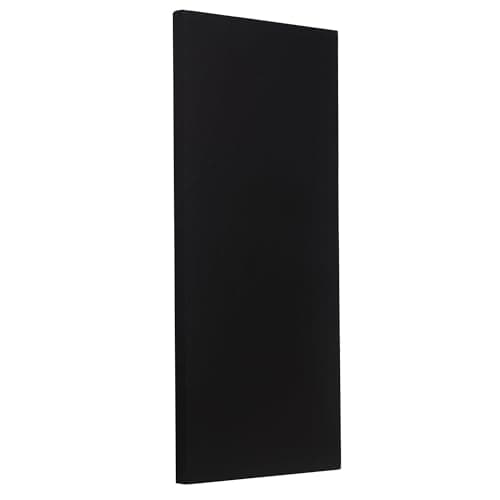
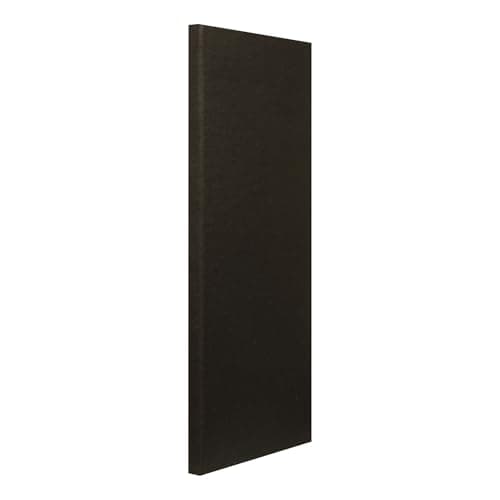
ATS Acoustics Beveled Edge Panel, 24 x 48 x 2 inThe same NRC 1.0 mineral-wool build as the Sona panel in jute burlap with a beveled edge, for about 16 dollars less.
ATS Acoustics Sona Fabric Panel, 24 x 48 x 2 inThe only panel here with a published NRC of 1.0 and a named fire rating, in a 2 in mineral-wool build. It costs what a real panel costs.
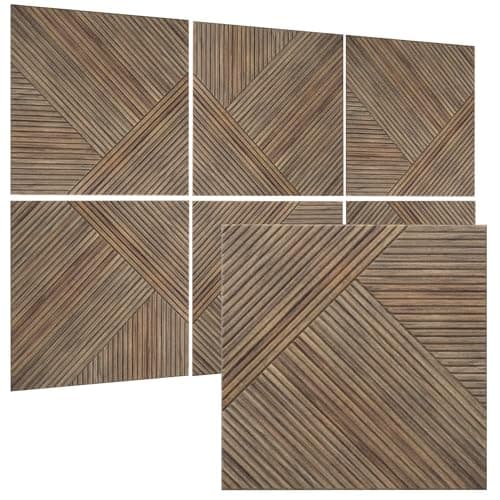
TO-TH Self-Adhesive Acoustic Panels, 6-Pack 23.6 in Square24 sq ft of peel-and-stick square for about 70 dollars, carrying a rating the listing has given a name we cannot find a standard for.
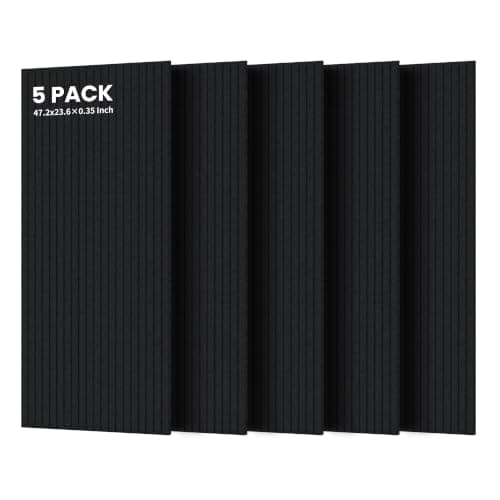
TO-TH Large Acoustic Panels, 5-PackStates an absorption coefficient over 0.9 specifically above 3000 Hz, which is the most frequency-specific claim here and also the narrowest.
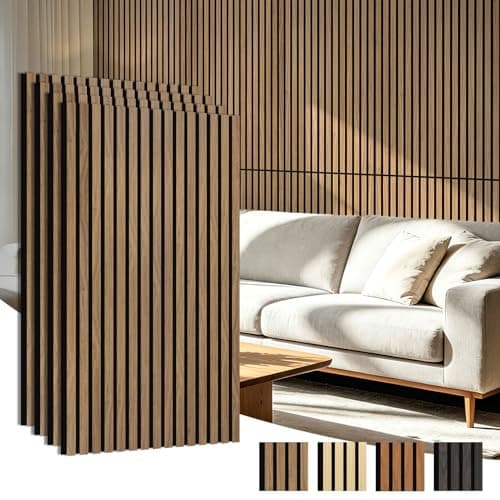
Art3d Acoustic Wood Slat Panel, 4-Pack 47 x 23.6 in30.8 sq ft of slatted wood over felt for 85 dollars, and the only option here that a video call will read as architecture rather than treatment.
INNO STICKERS PET Felt Tiles, 16-Pack 11.8 x 11.8 inPublishes an NRC range of 0.6 to 0.85 rather than a single flattering number, which is the most honest absorption statement on this page.
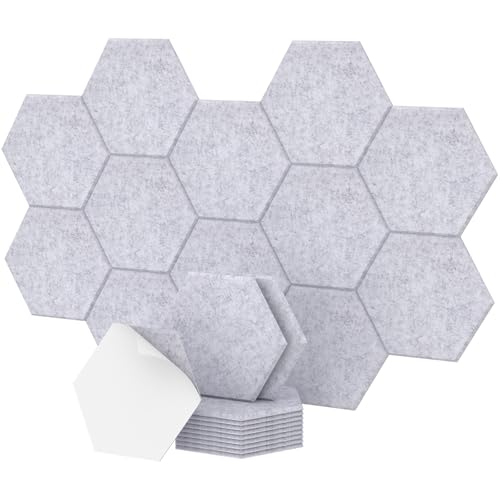
TONOR Hexagon Acoustic Panels, 12-Pack 12 x 10 inAbout twenty-two dollars of polyester hexagons. It is the cheapest thing on this page that is made of an absorbing material at all.
Every pick was under $100 on the price check stamped above. Cost-per-square-foot figures are our arithmetic from the live price and each listing's published pack size, and they move with the price; the buy rows carry today's.
01/ATS Acoustics
Beveled Edge Panel, 24 x 48 x 2 in
Best measured panel under 80 dollars
8.4/ 10
The same NRC 1.0 mineral-wool build as the Sona panel in jute burlap with a beveled edge, for about 16 dollars less.
The same NRC 1.0 mineral-wool build as the Sona panel in jute burlap with a beveled edge, for about 16 dollars less.
Published specification
Panel size
24 x 48 x 2 in
ATS Acoustics published specification
Coverage per panel
8 sq ft
Our arithmetic from the published panel size
NRC
1.0 (publisher states out of 1)
ATS Acoustics published specification
Core
Mineral wool, solid wood internal frame, full wood back
ATS Acoustics published specification
Fabric
100% jute burlap
ATS Acoustics published specification
Weight
8.25 lb
Listing published specification
What the specs are good for
Same published NRC 1.0 and same mineral wool core as the Sona panel, for less money
Beveled edge reads as a deliberate architectural element rather than a studio accessory
Full wood back means it sits flat against drywall without bowing
What they are not
Burlap is a coarser, more rustic texture than the Sona fabric and shows dust
The listing does not restate the ASTM E84 fire rating that the Sona panel carries
Still a single panel per purchase
Skip this if
Skip this if the room is a living space where the panel has to look soft and finished. Burlap looks like what it is, and in a shared room that reads as equipment.
Who it is for. Anyone who wants the measured build and does not care that the fabric is agricultural.
The only panel here with a published NRC of 1.0 and a named fire rating, in a 2 in mineral-wool build. It costs what a real panel costs.
The only panel here with a published NRC of 1.0 and a named fire rating, in a 2 in mineral-wool build. It costs what a real panel costs.
Published specification
Panel size
24 x 48 x 2 in
ATS Acoustics published specification
Coverage per panel
8 sq ft
Our arithmetic from the published panel size
NRC
1.0 (publisher states out of 1)
ATS Acoustics published specification
Fire rating
Class 1 / Class A per ASTM E84
ATS Acoustics published specification
Core
Mineral wool, solid wood internal frame
ATS Acoustics published specification
Weight
8.25 lb
Listing published specification
Mounting
Flush to wall; template and hardware included
ATS Acoustics published specification
What the specs are good for
Publishes an NRC figure and the fire-rating standard it was tested to, which most of this category does not
2 in thickness with a mineral wool core, which is what makes a difference below about 500 Hz where a voice actually sits
Solid wood frame and full wood back, so it mounts flat and stays flat
Mounting template and hardware in the box
What they are not
Roughly 12 dollars per square foot, five to ten times the felt tiles further down this list
One panel per box: an eight-panel wall is eight purchases and a real budget
Needs wall fixings, so it is not a rental-friendly install
Skip this if
Skip this if you are renting and cannot put holes in the wall, or if your budget for the whole room is under about 300 dollars. At that point you are better off with fewer square feet of something cheaper than one excellent panel on an otherwise bare wall.
Who it is for. Someone who takes calls for a living, has a hard-surfaced room, and would rather buy the measured thing once.
Self-Adhesive Acoustic Panels, 6-Pack 23.6 in Square
Cheapest real no-drill coverage
5.4/ 10
24 sq ft of peel-and-stick square for about 70 dollars, carrying a rating the listing has given a name we cannot find a standard for.
24 sq ft of peel-and-stick square for about 70 dollars, carrying a rating the listing has given a name we cannot find a standard for.
Published specification
Panel size
23.6 x 23.6 in, six panels covering 72 x 48 in
TO-TH published specification
Pack weight
10.4 lb
Listing published specification
Material
100 per cent polyester fiber, UV-printed wood-effect face
TO-TH published specification
Claimed rating
NCR "Noise Cancellation Rating" up to 0.95 - not a standard we can identify
TO-TH published claim
Mounting
Self-adhesive; the maker also lists walls, ceilings and doors
TO-TH published specification
What the specs are good for
The lowest cost per square foot in the no-drill tier
Polyester fiber rather than foam, so it is a genuine absorber at speech frequencies rather than a studio-look product
Six panels is enough to treat the one wall that is causing the problem
Stated as formaldehyde-free and odorless, which is a fair thing to want on a wall you sit next to all day
What they are not
The headline figure is an "NCR (Noise Cancellation Rating)", which is not ASTM C423 NRC and is not a standard we can identify - we are reporting the claim, not endorsing the number
No thickness published for this model, and thickness is the single most predictive figure in this category
24 sq ft treats one wall and no more
Adhesive-only, so the same paint risk as every other peel-and-stick panel here
Skip this if
Skip this if the published figures are what you are buying on. A made-up rating name and no published thickness is the thinnest documentation of any panel we list, and TONOR's 8-pack publishes both a real NRC and a density for a comparable price per square foot.
Who it is for. A renter on the tightest budget who wants one wall treated with real polyester fiber and is choosing on price and finish rather than on published performance.
Absence confirmed against the published specification
What the specs are good for
The only listing here that attaches its absorption claim to a frequency, which is more useful than a bare NRC
Low mass per area at about 2 kg/m2, so adhesive mounting is genuinely viable
Vertical stripe finish is restrained enough for a shared room
What they are not
Above 3000 Hz is a narrow band. Speech intelligibility lives mostly between 500 and 4000 Hz, so this covers the top of the range only
Publishing nothing below 3000 Hz, when the problem in most offices is 250 to 1000 Hz, is a conspicuous silence
Five panels, and the listing does not state the panel size, so you cannot compute coverage before buying
Skip this if
Skip this if the complaint is that the room sounds boxy or boomy. That is low-mid energy and a panel that only publishes figures above 3000 Hz is answering a different question.
Who it is for. Someone whose room has a bright, hissy, sibilant quality rather than a boomy one.
30.8 sq ft of slatted wood over felt for 85 dollars, and the only option here that a video call will read as architecture rather than treatment.
30.8 sq ft of slatted wood over felt for 85 dollars, and the only option here that a video call will read as architecture rather than treatment.
Published specification
Panel size
47.24 x 23.62 x 0.39 in, 4 panels
Listing published specification
Coverage
30.8 sq ft total
Art3d published specification
Weight
5.7 lb per panel
Listing published specification
Absorption
Not published. Art3d states no NRC and names no test
Absence confirmed against the published specification
Mounting
Adhesive or basic hardware
Art3d published specification
What the specs are good for
The best finish on this page by a distance: on camera it reads as a feature wall
30.8 sq ft for 85 dollars is reasonable value even ignoring acoustics
Wipes clean, and solid slats resist the warping that cheap veneer slat panels do
What they are not
No published NRC, no absorption coefficient, no test standard. There is felt behind the slats and we do not know what it does
Slats cover part of the felt, which necessarily reduces the absorbing area versus a flat panel of the same size
Heavier than felt tiles, so adhesive alone is a risk on a warm wall
Skip this if
Skip this if the room is genuinely echoey and you are buying one product to fix it. Buy these because you want the wall to look like this, and treat any acoustic benefit as a bonus you cannot size in advance.
Who it is for. Someone whose office is also a visible room, who is on camera, and who would rather the fix not look like a fix.
Publishes an NRC range of 0.6 to 0.85 rather than a single flattering number, which is the most honest absorption statement on this page.
Publishes an NRC range of 0.6 to 0.85 rather than a single flattering number, which is the most honest absorption statement on this page.
Published specification
Tile size
11.8 x 11.8 x 0.4 in, 16 tiles
INNO STICKERS published specification
Coverage
15.5 sq ft total
INNO STICKERS published specification
NRC
0.6 to 0.85, stated as a range (no test standard named)
INNO STICKERS published specification
Material
Recycled PET felt
INNO STICKERS published specification
Mounting
96 adhesive tabs supplied; permanent install needs extra adhesive
INNO STICKERS published specification
What the specs are good for
A published RANGE instead of a single best-case number, which is how absorption actually behaves across frequency
Small tiles let you put absorption exactly where the reflection is, instead of covering a whole wall
Adhesive tabs are removable, so this is the least committal option here
Moisture-resistant and vacuumable
What they are not
15.5 sq ft is a spot treatment, not a room treatment
Adhesive tabs are explicitly described as temporary; a permanent install needs adhesive you buy separately
16 small tiles means 16 alignment decisions and a grid that is obvious when it is slightly off
Skip this if
Skip this if you need more than about 16 sq ft. Buying three boxes to cover a wall costs more per square foot than the 10-pack of large panels above and takes four times as long to hang.
Who it is for. Someone with one bad reflection, a rented wall, and no appetite for a project.
About twenty-two dollars of polyester hexagons. It is the cheapest thing on this page that is made of an absorbing material at all.
About twenty-two dollars of polyester hexagons. It is the cheapest thing on this page that is made of an absorbing material at all.
Published specification
Panel size
12 x 10 x 0.4 in, 12 panels
TONOR published specification
Coverage
About 10 sq ft total
Our arithmetic from the published panel size
Material
100% polyester fiber
TONOR published specification
Absorption
Not published for this product. TONOR publishes an NRC for its large panels but not for these
Absence confirmed against the published specification
Mounting
Self-adhesive; smooth dry surfaces only
TONOR published specification
What the specs are good for
Low enough to be the lowest-risk way to find out whether absorption helps your room at all
Polyester fiber rather than open-cell foam, so it is a real absorber and not a studio prop
Hexagons tile into a pattern that tolerates approximate placement
What they are not
No published absorption figure, even though the same brand publishes NRC 0.9 for its larger panels
10 sq ft will not change a room; it will change one reflection
Adhesive is for smooth surfaces only and the listing says so
Skip this if
Skip this if you already know you have an echo problem and have budget. Ten square feet is a sample, not a solution, and twelve small panels take as long to hang as four big ones.
Who it is for. Someone who is not yet convinced any of this works and wants to spend the least possible finding out.
01Treat the first reflection points before anything else. The wall beside you and the wall behind your screen do more for call audio than the same panels anywhere else in the room. Where to place acoustic panels has the mirror trick for finding them in two minutes.
02Buy area for a bare room and quality for a treated one. If the room has nothing at all in it, a large pack of thin felt will change more than one excellent panel. If you already have soft furnishings and rugs, the thick measured panel is the better next purchase.
03Mount thin panels with a gap. Battens or spacers behind a 0.4 in panel extend its useful range downward for the price of a length of timber.
04Do not treat the whole room at once. Put up half, listen for a week, then decide. Over-absorbed rooms sound dead and unpleasant, and it is easier to add than to remove.
05Check whether your problem is absorption at all. If the noise comes from outside the room, nothing on this page helps. Acoustic panels vs soundproofing is the two-minute version of that check.
What a hundred dollars of panels cannot do
Stop sound entering or leaving. Absorption treats the sound inside your room. It does nothing about a shared wall, a hollow door or a window onto a road.
Reach low frequencies. Everything under this cap tails off below roughly 1,700 Hz at best and far higher than that for the thin products. Rumble, plant noise and bass through a floor are untouched.
Cover a room. 8 to 30 sq ft is a start, not a treatment, and the coverage sum in the guides will tell you honestly how far short it is.
Go up in a rental without thought. Adhesive is the risk, not the screw. The best acoustic panels for a rental has the deposit arithmetic, and the conclusion is not the one most people expect.
FAQ
Questions people ask about this
Can you get good acoustic panels under $100?+
Yes, and that is unusual for a price cap. The panel this site ranks first for documentation anywhere costs under eighty dollars: ATS Acoustics publishes NRC 1.0 for a 2 in mineral wool panel with a named fire standard and a published core. What the cap removes is quantity rather than quality - the multi-panel packs and full-wall systems that cost more because they contain six to ten panels. So the trade at this budget is one measured panel against a larger area of unmeasured material.
How many acoustic panels can I get for $100?+
Between one and sixteen, depending on what you buy, and the coverage ranges from 8 to about 31 sq ft. One measured 2 in panel is 8 sq ft. A 16-pack of PET felt tiles is 15.5 sq ft. A 4-pack of wood slat panels is 30.8 sq ft. Coverage per dollar varies by about four and a half to one across this page, and the cheapest coverage comes from the products that publish no absorption figure at all.
Is a cheap acoustic panel better than no panel?+
On a hard, bare, reflective wall, yes - polyester and PET felt genuinely absorb at high frequencies and genuinely reduce the ring of a room, which is what makes calls sound better. The honest caveats are that thin panels do almost nothing below about 1,000 Hz where most of a voice sits, and that very few of them publish a figure so you cannot predict the result. Buy them on published thickness and area rather than on their claims.
What NRC should an acoustic panel have?+
Higher is better, and 1.0 is the top of the practical range - two panels under this cap publish it. More important than the target is whether a figure exists at all: five of the seven panels here publish no NRC measured to a named standard, and one publishes an acronym that does not correspond to any standard we can identify. A panel with a published NRC and a named test is a different proposition from one with an adjective, even at the same thickness.
Do thin acoustic panels work?+
They work high and not low. A porous absorber does its most useful work around the frequency whose quarter wavelength matches its depth, so by our arithmetic a 0.4 in felt tile is most effective around 8,400 Hz while a 2 in mineral wool panel reaches about 1,690 Hz. Most of a speaking voice sits between 100 and 1,000 Hz, below both. The free fix is an air gap: mounting a thin panel a couple of inches off the wall extends what it reaches downward at no cost.
Should I buy one good panel or lots of cheap ones?+
Both, in that order, and it depends on the room. In a completely bare, hard room, area wins - a large pack of thin felt changes more than one excellent panel on an otherwise empty wall, because absorption is area times coefficient. In a room that already has a rug, curtains and soft furniture, the thick measured panel is the better next purchase because the easy high-frequency absorption is already done. Do the coverage sum for your room before deciding.
Can I put acoustic panels up without drilling for under $100?+
Yes - three products under this cap are adhesive-mounted, covering between 10 and 24 sq ft. The trade is documentation: the no-drill tier is the least-measured part of this category, because adhesive has to hold the panel up and so the panel has to be thin and light. Worth knowing before you commit: adhesive can take paint with it on removal, while four screw holes behind a panel are filler and a dab of paint.
Sources
Where these numbers came from
We have not handled any of these products. Every figure on this page is either the manufacturer's own published specification, named as such, or our arithmetic from those figures, shown so you can check it. Prices come from Amazon through our price layer and carry the date they were verified.
Amazon product listings, retrieved 2026-10-03
Published specifications, dimensions, materials and manufacturer claims were read from each product's own listing data. Prices and availability refresh daily and carry their verification date on the page.
The full published method, and an explicit statement of what a specs-only approach cannot tell you.
ASTM C423 — Standard Test Method for Sound Absorption and Sound Absorption Coefficients by the Reverberation Room Method
The governing test method behind any NRC figure. We name it where a manufacturer publishes an NRC so you know what the number is a result of. We have not performed this test and we do not restate anyone's NRC as our own measurement.
ASTM E84 — Standard Test Method for Surface Burning Characteristics of Building Materials
The fire-rating standard ATS Acoustics cites for its Class 1 / Class A panels, and the one Armstrong cites for its Class A drop-in ceiling tiles. Named because they name it.
Our arithmetic: the quarter-wavelength depth of an air gap
A porous absorber works on air movement, and air movement is at its greatest a quarter of a wavelength away from a hard surface. So a gap of depth D behind a panel does its most useful work around the frequency whose quarter wavelength is D, which is f = c / 4D with c taken as 343 m/s. Every gap-to-frequency figure on this page is that one sum: 4 in gives about 844 Hz, 12 in about 281 Hz, 16 in about 214 Hz, 24 in about 141 Hz. It is a first-order guide to where a gap starts helping, not a prediction of absorption, and a real panel's measured curve is broader and messier than one number.