The cheap ones do essentially nothing, the expensive ones absorb rather than block, and the listings use the same words for both.
SMBy Scooter M.Published October 3, 2026Prices verified October 3, 2026
The short answer
No. A plain room divider does essentially nothing to sound, and an acoustic partition absorbs reflections rather than blocking transmission. Blocking sound requires mass and an airtight path, and a divider has neither: it does not reach the ceiling, it does not reach the floor, and even the good ones weigh about an ounce per square foot of core. What a cored partition genuinely does is reduce the reflections bouncing between two desks and take the edge off speech spill, which in a shared room is a real and noticeable change.
Why mass is the whole story for blocking
To stop sound passing through a barrier you need the barrier to be heavy and continuous. Heavy, because a sound wave has to physically move the barrier to get through it and a heavy barrier moves less. Continuous, because sound is exceptionally good at finding gaps.
A room divider fails both tests by design:
It has almost no mass. The KERRAM is 1.13 in of polyester fiber, which is a low-density material chosen specifically because low density absorbs well.
It does not reach the ceiling. A 66 in partition in an 8 ft room leaves 30 in of open air above it.
It does not reach the floor, because it stands on feet or casters.
It has open ends. Sound travels around a panel almost as readily as through the air in front of it.
That is not a design flaw. A divider that reached the ceiling, sealed to the floor and weighed enough to block sound would be a wall, and it would cost what walls cost.
What a cored partition does do
This is the part that gets lost in the blocking argument, and it is genuinely worth money in the right situation.
It interrupts the direct path. Two people at facing desks hear each other directly. A panel between them removes the shortest, loudest route, which is a bigger subjective change than the physics suggests.
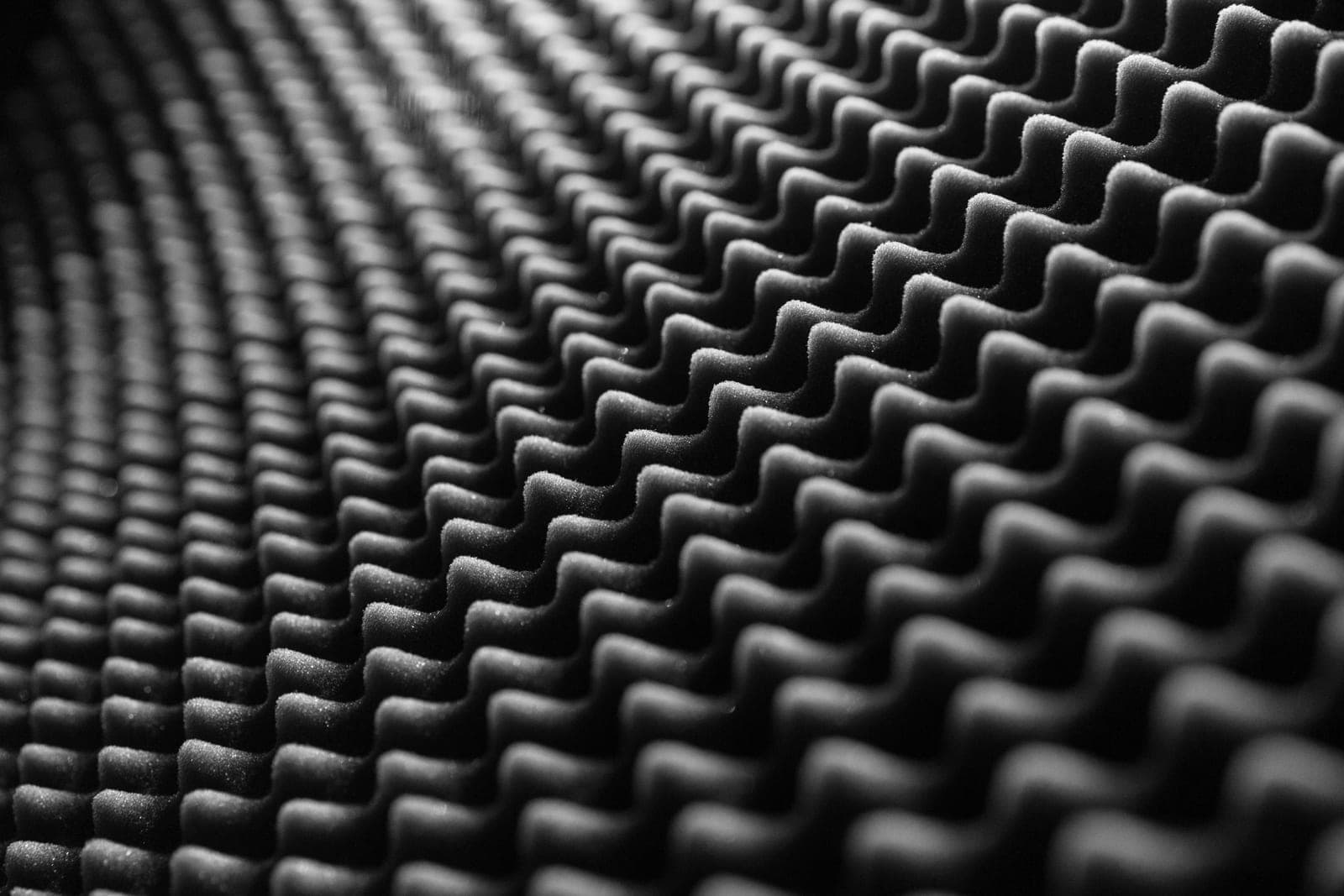
It absorbs the first reflections. A polyester or PET core absorbs sound hitting it instead of bouncing it back into the room, which is the same mechanism as a wall panel applied to a vertical surface you can put wherever you like.
It makes a shared room calmer rather than quieter. Those are different, and the difference is worth being precise about: the overall sound level barely moves, and the room stops feeling chaotic.
How to tell the two apart from a listing
This is the practical skill, because both products photograph identically and both get titled with the same words.
Reading a divider listing
What the listing says
What it means
Names a core material: PET, polyester fiber, acoustic felt
There is an absorber inside. This is the real signal
Publishes a panel thickness, e.g. 1.13 in
Best available evidence. Thickness predicts absorption better than anything else published
Describes only the outer fabric and the frame: Oxford fabric, iron frame, steel frame
No core. It is a visual screen, and usually an honest one
States a percentage: absorbs at least 85% of noise
A marketing sentence. No frequency, no standard, no measurement
Titled soundproof with no core named
The word is doing no work. Read the specification
Weighs 9 to 21 lb for 30-plus sq ft
Fabric on a frame. No absorbing mass is present at that weight
When a divider is the right purchase anyway
Being clear about what it does not do is not the same as saying do not buy one.
01The problem is visual. A bedroom behind you on calls is solved completely by a 50-dollar screen, and nothing about sound enters into it.
02Two people share one room. A cored partition between two desks genuinely changes how workable that is. This is the best acoustic case for the product.
03You cannot touch the walls. A partition is an absorber on a stand, which is the rental-friendly version of wall treatment.
04The room has two jobs. A folding partition zones a dining room into an office at nine and back at six, which no wall treatment can do.
What to do if you genuinely need to block sound
In ascending order of cost and effectiveness.
Seal the door gap, about 17 dollars. A typical interior door has 20 square inches of straight-through opening at the bottom. This is the highest-value purchase in the whole category. How to soundproof a home office door.
Heavy curtains over a window, 60 to 200 dollars. Mass and absorption at once, and the easiest structural-ish fix available.
An office pod, 3,200 to 5,400 dollars. The only consumer product that genuinely blocks, because it is a closed box with a sealed door. Office pods.
Construction - a second layer of drywall, a solid-core door, resilient channel. Effective, expensive, not reversible.
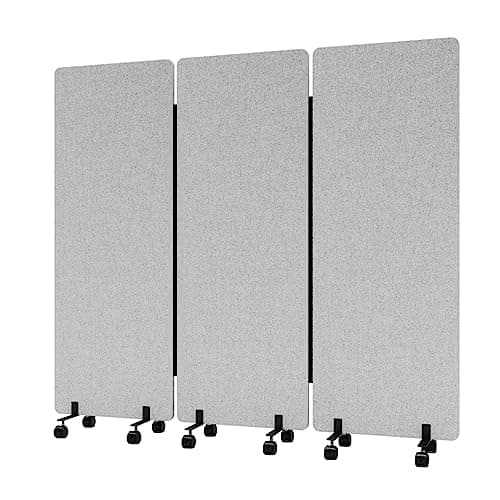
KERRAM 3-Panel Foldable Office Partition with WheelsNames its core material as 100% high-density polyester fiber, states a 1.13 in panel thickness, folds flat, and runs on 10 self-locking casters.
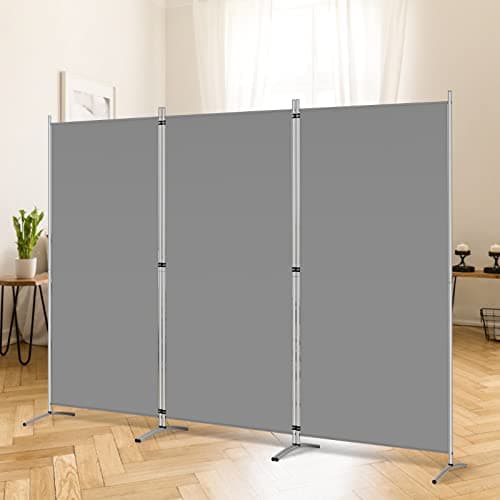
RANTILA 3-Panel Folding Privacy Screen, 102 x 71 in102 inches of sightline for 50 dollars. Fabric on a steel frame, 13.3 lb, no acoustic material and no claim of any.
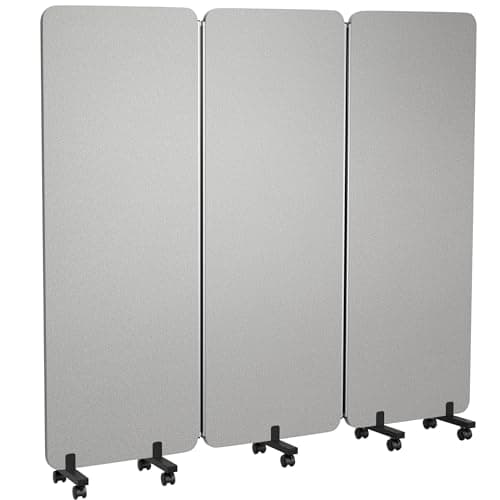
YASRKML 3-Panel Soundproof Room Divider, Portable AcousticFlame-retardant PET with a fabric wrap, 12 self-locking wheels and a reinforced metal base, at about 60 dollars less than the KERRAM.
Scores are ours, from the published rubric on our methodology page. They are editorial judgments about published specifications, not test results — we have not handled these units.
01/KERRAM
3-Panel Foldable Office Partition with Wheels
Best acoustic partition
8.2/ 10
Names its core material as 100% high-density polyester fiber, states a 1.13 in panel thickness, folds flat, and runs on 10 self-locking casters.
Names its core material as 100% high-density polyester fiber, states a 1.13 in panel thickness, folds flat, and runs on 10 self-locking casters.
Published specification
Overall size
71 in wide x 66 in high
KERRAM published specification
Panel thickness
1.13 in
KERRAM published specification
Core
100% high-density polyester fiber, fabric outer
KERRAM published specification
Frame
Aluminum
KERRAM published specification
Casters
10 self-locking swivel casters
KERRAM published specification
Assembly
3 to 5 minutes; casters only, no panel assembly
KERRAM published specification
Absorption
Not published as a figure. The core material and thickness are published, the NRC is not
Absence confirmed against the published specification
What the specs are good for
States a panel thickness AND a core material, which together are the two facts that decide whether a partition does anything acoustically
1.13 in of high-density polyester is a genuine absorber, unlike fabric on a steel frame
Folds completely flat for storage, which no other acoustic partition here does
Aluminum frame keeps the weight down without the flex of a thin steel tube
Ten self-locking casters and a 3 to 5 minute setup
What they are not
No NRC or absorption coefficient published, so the thickness and material are the only evidence
380 dollars for 32 sq ft of partition
Only 20 units showed in stock at the time of writing, so availability is thin
Skip this if
Skip this if you need the partition to block sound rather than absorb it. 1.13 in of polyester fiber reduces reflections and speech spill; it is not a wall and it will not stop a conversation being audible on the other side.
Who it is for. Someone in a shared room who needs the calls to stop bouncing and the partition to disappear into a cupboard at weekends.
102 inches of sightline for 50 dollars. Fabric on a steel frame, 13.3 lb, no acoustic material and no claim of any.
102 inches of sightline for 50 dollars. Fabric on a steel frame, 13.3 lb, no acoustic material and no claim of any.
Published specification
Overall size
102 in wide x 20 in deep x 71 in high
RANTILA published specification
Panel size
34 in wide x 71 in high, 3 panels
RANTILA published specification
Weight
13.3 lb
Listing published specification
Frame
Steel
RANTILA published specification
Fabric
UV protected, waterproof
RANTILA published specification
Hinges
Double hinged, folds either direction
RANTILA published specification
Acoustic material
None. RANTILA makes no acoustic claim for this product, which is to its credit
Absence confirmed against the published specification
What the specs are good for
102 in of coverage for 50 dollars, which is about a fifth of the cost per inch of any acoustic partition here
Double hinges fold both ways, so it makes an L, a Z or a straight run
13.3 lb: one person carries it with one hand
Makes no acoustic claim at all, which is more honest than most of this category
What they are not
No acoustic material whatsoever. It changes what people see and nothing about what they hear
13.3 lb across 50 sq ft of fabric is a sail: it will move if a door opens or a fan points at it
Needs 20 in of floor depth folded into a zigzag to stand up at all
Skip this if
Skip this if you are trying to make calls quieter. We have scored its acoustic metric a 2 rather than a 1 only because any solid object between two people blocks a little high-frequency sound. That is physics, not a feature.
Who it is for. Someone whose actual problem is a bed, a laundry pile or a kitchen appearing on every video call.
Flame-retardant PET with a fabric wrap, 12 self-locking wheels and a reinforced metal base, at about 60 dollars less than the KERRAM.
Flame-retardant PET with a fabric wrap, 12 self-locking wheels and a reinforced metal base, at about 60 dollars less than the KERRAM.
Published specification
Overall size
72 in wide x 66 in high maximum
YASRKML published specification
Panel size
24 in wide x 66 in high, 3 panels
YASRKML published specification
Core
Flame-retardant PET with fabric wrapping
YASRKML published specification
Casters
12 self-lockable universal wheels with brakes
YASRKML published specification
Base
Reinforced rust-proof metal
YASRKML published specification
Surface
Tackable
YASRKML published specification
Absorption
Manufacturer states it "absorbs at least 85% of noise". No NRC, no frequency range, no standard
YASRKML published specification
What the specs are good for
Flame-retardant PET core named explicitly, which puts it in the acoustic tier rather than the visual-screen tier
Twelve braked casters on a reinforced metal base: the most caster-and-base hardware of any partition here
Zip-linked and usable as one, two or three panels
Tackable surface, so it doubles as pinboard
What they are not
The "85% of noise" figure is a marketing sentence, not a measurement. No NRC, no frequency band, no test standard
Does not publish a panel thickness, which is the single most useful number for an absorber
Only 13 units in stock at the time of writing
Skip this if
Skip this if you want to compare absorbers on thickness, because YASRKML does not publish one. The KERRAM at 1.13 in tells you what you are buying; this tells you a percentage with nothing behind it.
Who it is for. Someone who wants a PET-cored partition on good casters and will accept less spec data to save 60 dollars.
A room divider is a sightline product that some manufacturers have made partly acoustic. Bought as a sightline product it works perfectly and costs 30 to 70 dollars. Bought as an absorber for a shared room it works reasonably and costs 320 to 450. Bought to stop someone hearing you, it does not work at any price in the category.
Cheap fabric-on-frame dividers do essentially nothing. Partitions with a PET or polyester core absorb reflections and interrupt the direct path between two people, which makes a shared room noticeably calmer. Neither blocks sound from passing around, over or under them.
What material blocks sound best in a room divider?+
None of them block well, because blocking needs mass and these are deliberately light. For absorption, PET and polyester fiber at a published thickness are what to look for, and 1 in or more is meaningfully better than a thin felt skin.
Can a room divider make my calls private?+
No. It does not reach the ceiling or the floor and has no mass, so speech travels around it. For genuine privacy the only consumer product that works is an enclosure, which starts at about 3,200 dollars.
How do I tell if a divider has an acoustic core?+
The listing will name the material: PET, polyester fiber, acoustic felt. If it only describes the outer fabric and the frame, there is no core. A published panel thickness is the strongest signal; a percentage claim with no standard is the weakest.
Is a thicker room divider quieter?+
It absorbs more, and specifically it absorbs lower in frequency, because a porous absorber works where the quarter-wavelength fits inside its depth. It does not block more in any meaningful sense, because the open path around the panel is unchanged.
Sources
Where these numbers came from
We have not handled any of these products. Every figure on this page is either the manufacturer's own published specification, named as such, or our arithmetic from those figures, shown so you can check it. Prices come from Amazon through our price layer and carry the date they were verified.
Amazon product listings, retrieved 2026-10-03
Published specifications, dimensions, materials and manufacturer claims were read from each product's own listing data. Prices and availability refresh daily and carry their verification date on the page.
The full published method, and an explicit statement of what a specs-only approach cannot tell you.
ASTM C423 — Standard Test Method for Sound Absorption and Sound Absorption Coefficients by the Reverberation Room Method
The governing test method behind any NRC figure. We name it where a manufacturer publishes an NRC so you know what the number is a result of. We have not performed this test and we do not restate anyone's NRC as our own measurement.