A partition is a divider that was designed as office furniture: heavier, modular, tackable, and priced accordingly.
SMBy Scooter M.Published October 3, 2026Prices verified October 3, 2026
The short answer
Buy the VIVO PP-3-T072G if the partition is staying put, the mobile PP-3-T072G-M if the room has two jobs, and the KERRAM if the reason you are buying is noise rather than sightlines. VIVO is the only maker here with a consistent model line, matching dimensions across the listing and a real part number, which in this category is rarer than it should be. KERRAM is the only one that publishes a core material and a panel thickness.
Partition or divider? The distinction is real
The words are used interchangeably in listings, and there is no standards body policing them. But there is a genuine product difference underneath, and it is worth naming.
What the two words usually describe
Room divider
Office partition
Typical price
30 to 70 dollars
320 to 650 dollars
Construction
Fabric over a steel or iron frame
Panel with a core, on a weighted or castered base
Typical weight
9 to 21 lb
47 to 67 lb
Surface
Decorative fabric
Tackable, so it works as a pinboard
Configuration
Hinged, folds
Zip-linked or bracketed; use one panel or several
Acoustic material
None
Sometimes, and sometimes published
Generalized from the products we examined, 2026-10-03. There are exceptions in both directions, which is exactly why you read the specification rather than the title.
The dividing line that matters for a buyer is weight. A 51 lb VIVO partition stands where you put it and does not move when a door opens. A 9 lb screen is a sail. If the thing will be in a room with air movement, pay for mass. The cheaper end of the category is covered honestly on best room dividers for a home office.
Zip-linking is the feature worth paying for
Both the VIVO systems and the YASRKML connect their panels with zippers. That sounds like a trivial detail and it changes what the product is.
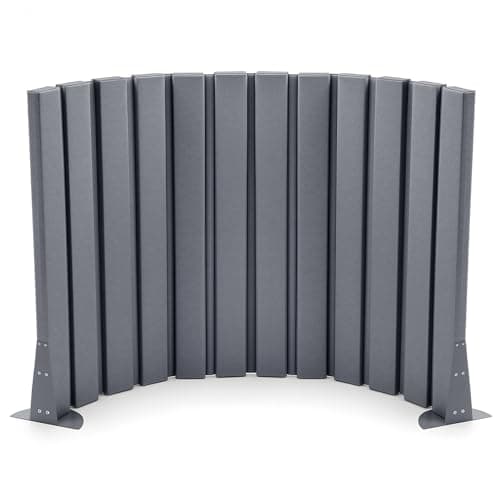
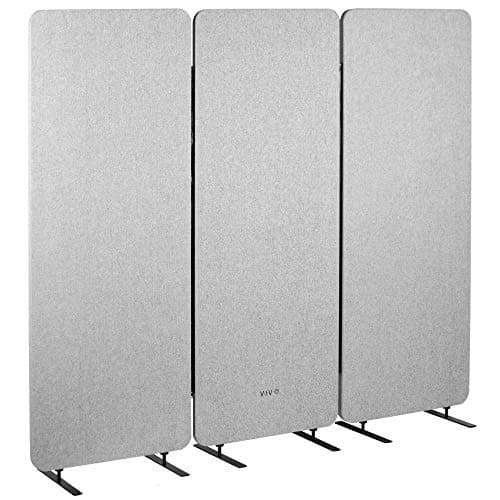
A hinged folding screen is one object with a fixed width. A zip-linked system is three separate panels you can use as one 24 in screen beside a desk, as a 72 in straight wall, or as a curved partition wrapping a corner - and you can change your mind next month. For a home office that is still finding its layout, that flexibility is worth more than it costs.
The KERRAM takes a different route: aluminum-framed panels that fold completely flat for storage and configure into a straight wall, an L or a C. Different mechanism, same flexibility, plus the one thing no zip-link system offers, which is disappearing into a cupboard at the weekend.
The tackable surface
Every VIVO and YASRKML partition here has a tackable face, meaning you can pin things to it. This is the quietly useful feature of the whole category.
A home office usually has no spare wall. Between a window, a door, a desk against one wall and shelving against another, there is frequently nowhere to put a calendar. A 72 by 66 in partition is 33 sq ft of pinnable surface that arrived anyway. In a small room that is a genuine second function rather than a bullet point.
What to check before buying
01Floor depth. A partition on flexible feet needs roughly 2 ft of base depth, and the published panel dimensions do not include it. Measure the floor, not the wall.
02Weight, published. Under about 20 lb across 30-plus sq ft of panel and it will move. Two products in this whole category do not publish a weight at all, and we marked both down for it.
03Whether the casters lock. All of them on the VIVO mobile, ten self-locking on the KERRAM, twelve on the YASRKML. A mobile partition whose wheels do not lock is a partition that drifts.
04Delivery method. The heavier partitions here ship by truck with a required recipient, not by courier. That is a diary entry, not a doorstep drop.
How we ranked these
The hub's five metrics - coverage, acoustic, stability, mobility and documentation - applied identically. Full rubric on how we pick. Every figure is quoted from the product's own published specification on the date in the sources.
#
Product
Best for
Score
Price
01
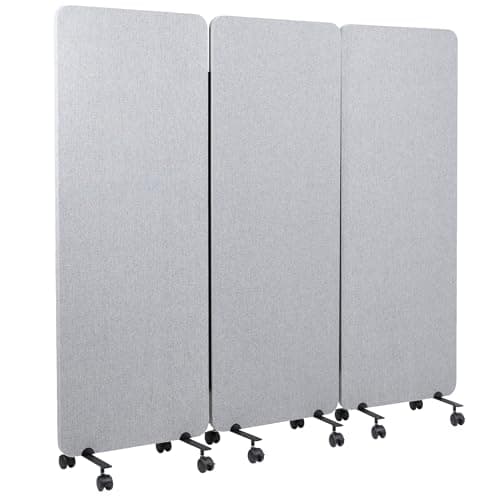
VIVO Freestanding Privacy Panel, 72 x 66 in (PP-3-T072G)Three zip-linked 23.8 in panels on flexible feet, 51.4 lb, tackable surface. The only partition here with a model number and a consistent spec sheet.
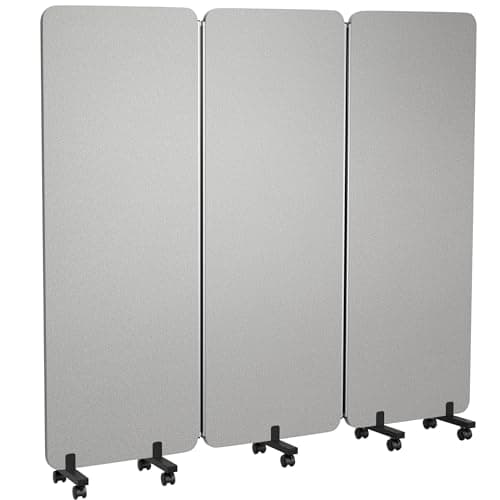
VIVO Freestanding Mobile Privacy Panel, 72 x 66 in (PP-3-T072G-M)The same three-panel VIVO system on lockable wheels, 55.2 lb. Fifty dollars for casters, which is worth it if the room has two jobs.
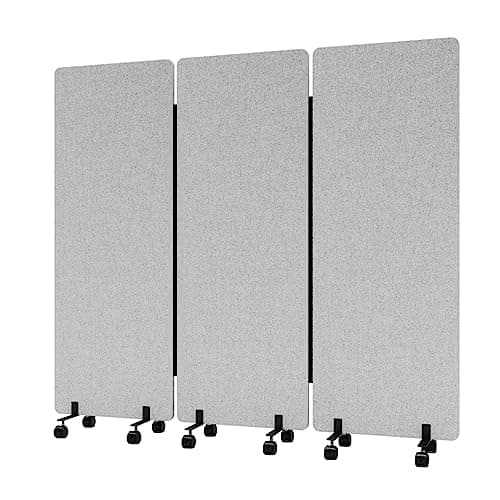
KERRAM 3-Panel Foldable Office Partition with WheelsNames its core material as 100% high-density polyester fiber, states a 1.13 in panel thickness, folds flat, and runs on 10 self-locking casters.
YASRKML 3-Panel Soundproof Room Divider, Portable AcousticFlame-retardant PET with a fabric wrap, 12 self-locking wheels and a reinforced metal base, at about 60 dollars less than the KERRAM.
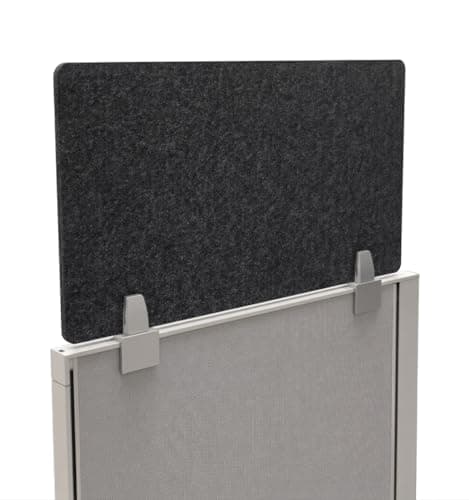
OBEX Cubicle-Mounted PET Privacy Screen, 18 x 42 inPET construction with brackets documented to fit 1.5 to 2.5 in partitions, and a larger-bracket version named for thicker walls.
AmazingSpark Acoustic Room Divider, 48 in x 6 ft FoldableOne 6 ft acoustic felt panel, 70.8 in wide, with support stands. The most expensive divider here and the least documented for the money.
Scores are ours, from the published rubric on our methodology page. They are editorial judgments about published specifications, not test results — we have not handled these units.
01/VIVO
Freestanding Privacy Panel, 72 x 66 in (PP-3-T072G)
Best office partition
7.6/ 10
Three zip-linked 23.8 in panels on flexible feet, 51.4 lb, tackable surface. The only partition here with a model number and a consistent spec sheet.
Three zip-linked 23.8 in panels on flexible feet, 51.4 lb, tackable surface. The only partition here with a model number and a consistent spec sheet.
Published specification
Overall size
72.4 in wide x 65.8 in high
VIVO published specification
Panel size
23.8 in wide x 65.8 in high, 3 panels
VIVO published specification
Weight
51.4 lb
Listing published specification
Model
PP-3-T072G
VIVO published specification
Surface
Tackable
VIVO published specification
Configuration
Zipper connections; straight wall or curve; usable singly
VIVO published specification
Absorption
Not published for this model. VIVO states sound-reducing material on its clamp-on panels but publishes no figure for any of them
Absence confirmed against the published specification
What the specs are good for
A real model number and dimensions that match across the listing, which is rarer in this category than it should be
51.4 lb across three panels on flexible feet, so it stands where you put it and does not walk
Zip connections mean you can use one panel at a desk and three to wall off a corner, from the same purchase
Tackable surface turns the partition into usable wall, which a small room does not otherwise have
What they are not
No published absorption figure, at 400 dollars. That is the main thing to understand before buying it
Flexible feet take up about 2 ft of floor depth at the base
No wheels on this model; the mobile version is a separate 450-dollar product
Skip this if
Skip this if you are buying it to make calls quieter. It is a sightline and a pinboard, and a good one. For noise, our acoustic-partition picks below publish a core material and this does not.
Who it is for. Someone carving a work corner out of a shared room who wants a partition that looks deliberate and survives being moved.
Freestanding Mobile Privacy Panel, 72 x 66 in (PP-3-T072G-M)
Best partition that moves daily
7.8/ 10
The same three-panel VIVO system on lockable wheels, 55.2 lb. Fifty dollars for casters, which is worth it if the room has two jobs.
The same three-panel VIVO system on lockable wheels, 55.2 lb. Fifty dollars for casters, which is worth it if the room has two jobs.
Published specification
Overall size
72.4 in wide x 66 in high
VIVO published specification
Panel size
23.8 in wide x 66 in high, 3 panels
VIVO published specification
Weight
55.2 lb
Listing published specification
Model
PP-3-T072G-M
VIVO published specification
Casters
Feet with wheels, all lockable
VIVO published specification
Absorption
Not published
Absence confirmed against the published specification
What the specs are good for
All casters lock, which is what separates a mobile partition from a partition that drifts
3.8 lb heavier than the static version, so the wheels did not come at the cost of mass
Same zip-link flexibility: one panel or three
Moving it is a ten-second job, which means it will actually get moved rather than left up
What they are not
No published absorption figure, same as the static model
450 dollars, the most expensive partition on this page
Wheels raise the panel slightly, opening a floor gap that a static base does not have
Skip this if
Skip this if the partition is going to live in one place. You are paying 50 dollars and a floor gap for mobility you will not use. Buy the static PP-3-T072G instead.
Who it is for. A dining room that becomes an office at 9 and a dining room again at 6.
Names its core material as 100% high-density polyester fiber, states a 1.13 in panel thickness, folds flat, and runs on 10 self-locking casters.
Names its core material as 100% high-density polyester fiber, states a 1.13 in panel thickness, folds flat, and runs on 10 self-locking casters.
Published specification
Overall size
71 in wide x 66 in high
KERRAM published specification
Panel thickness
1.13 in
KERRAM published specification
Core
100% high-density polyester fiber, fabric outer
KERRAM published specification
Frame
Aluminum
KERRAM published specification
Casters
10 self-locking swivel casters
KERRAM published specification
Assembly
3 to 5 minutes; casters only, no panel assembly
KERRAM published specification
Absorption
Not published as a figure. The core material and thickness are published, the NRC is not
Absence confirmed against the published specification
What the specs are good for
States a panel thickness AND a core material, which together are the two facts that decide whether a partition does anything acoustically
1.13 in of high-density polyester is a genuine absorber, unlike fabric on a steel frame
Folds completely flat for storage, which no other acoustic partition here does
Aluminum frame keeps the weight down without the flex of a thin steel tube
Ten self-locking casters and a 3 to 5 minute setup
What they are not
No NRC or absorption coefficient published, so the thickness and material are the only evidence
380 dollars for 32 sq ft of partition
Only 20 units showed in stock at the time of writing, so availability is thin
Skip this if
Skip this if you need the partition to block sound rather than absorb it. 1.13 in of polyester fiber reduces reflections and speech spill; it is not a wall and it will not stop a conversation being audible on the other side.
Who it is for. Someone in a shared room who needs the calls to stop bouncing and the partition to disappear into a cupboard at weekends.
Flame-retardant PET with a fabric wrap, 12 self-locking wheels and a reinforced metal base, at about 60 dollars less than the KERRAM.
Flame-retardant PET with a fabric wrap, 12 self-locking wheels and a reinforced metal base, at about 60 dollars less than the KERRAM.
Published specification
Overall size
72 in wide x 66 in high maximum
YASRKML published specification
Panel size
24 in wide x 66 in high, 3 panels
YASRKML published specification
Core
Flame-retardant PET with fabric wrapping
YASRKML published specification
Casters
12 self-lockable universal wheels with brakes
YASRKML published specification
Base
Reinforced rust-proof metal
YASRKML published specification
Surface
Tackable
YASRKML published specification
Absorption
Manufacturer states it "absorbs at least 85% of noise". No NRC, no frequency range, no standard
YASRKML published specification
What the specs are good for
Flame-retardant PET core named explicitly, which puts it in the acoustic tier rather than the visual-screen tier
Twelve braked casters on a reinforced metal base: the most caster-and-base hardware of any partition here
Zip-linked and usable as one, two or three panels
Tackable surface, so it doubles as pinboard
What they are not
The "85% of noise" figure is a marketing sentence, not a measurement. No NRC, no frequency band, no test standard
Does not publish a panel thickness, which is the single most useful number for an absorber
Only 13 units in stock at the time of writing
Skip this if
Skip this if you want to compare absorbers on thickness, because YASRKML does not publish one. The KERRAM at 1.13 in tells you what you are buying; this tells you a percentage with nothing behind it.
Who it is for. Someone who wants a PET-cored partition on good casters and will accept less spec data to save 60 dollars.
PET construction with brackets documented to fit 1.5 to 2.5 in partitions, and a larger-bracket version named for thicker walls.
PET construction with brackets documented to fit 1.5 to 2.5 in partitions, and a larger-bracket version named for thicker walls.
Published specification
Panel size
18 in wide x 42 in high
Listing published specification
Material
Polyethylene terephthalate (PET)
OBEX published specification
Bracket range
Fits partitions 1.5 to 2.5 in thick; a large-bracket version exists for thicker walls
OBEX published specification
Range
8 widths and 3 heights in the line
OBEX published specification
Absorption
Described as acoustical design for noise reduction; no NRC published
Absence confirmed against the published specification
What the specs are good for
PET, which is an actual absorbing material rather than a woven fabric over a frame
Publishes its bracket range AND tells you the part number family to use if your wall is thicker, which almost nobody does
Eight widths and three heights, so you can match a real cubicle rather than approximate it
Installs without dismantling the existing partition
What they are not
No published NRC despite the acoustical framing
Needs an existing cubicle or panel wall; it cannot clamp to a plain desktop
89 dollars for 5.25 sq ft
Skip this if
Skip this if you do not already have a partition wall to mount it on. This is a cubicle accessory, and in a spare bedroom there is nothing for the brackets to grip.
Who it is for. A home office that inherited real office furniture, or a shared workspace with existing panel walls.
One 6 ft acoustic felt panel, 70.8 in wide, with support stands. The most expensive divider here and the least documented for the money.
One 6 ft acoustic felt panel, 70.8 in wide, with support stands. The most expensive divider here and the least documented for the money.
Published specification
Overall size
70.8 in wide x 48 in high
Listing published specification
Nominal size
48 in x 6 ft as described by the seller
AmazingSpark published specification
Material
Acoustic felt with sound-absorbing materials
AmazingSpark published specification
Supplied with
Support stands and fastening accessories
AmazingSpark published specification
Absorption
Not published
Absence confirmed against the published specification
Thickness
Not published
Absence confirmed against the published specification
What the specs are good for
A genuine acoustic felt construction rather than fabric on a frame
Folds and stores flat when not in use
Support stands included rather than sold separately
What they are not
644 dollars with no published absorption figure and no published thickness, which is the worst spec-to-price ratio on this page
The listing's stated size and its dimension fields disagree, so the actual footprint is unclear before it arrives
Only 4 units in stock at the time of writing
Skip this if
Skip this unless you specifically need the exact format and have ruled out the KERRAM and YASRKML. At nearly double their price it publishes less, not more, and we could not find a figure to justify the gap.
Who it is for. Someone who needs this specific 48-inch-tall format and has the budget not to mind.
If the requirement is genuine privacy, no partition at any price delivers it. Sound goes over, under and around. Room divider vs acoustic partition walks the escalation honestly, and it ends at office pods.
FAQ
Questions people ask about this
What is the difference between an office partition and a room divider?+
In practice: weight, core and price. A divider is fabric on a frame at 9 to 21 lb for 30 to 70 dollars; a partition is a cored panel on a weighted or castered base at 47 to 67 lb for 320 to 650. The words are used interchangeably in listings, so read the specification.
How many partition panels do I need?+
Three 24 in panels giving 72 in of width is the standard configuration and covers a desk plus the space either side of it. One panel is a desk screen; four or more is a room layout question, which how to divide a room for a home office covers.
Are office partitions good for sound?+
Only the ones with a published core. Of the partitions here, KERRAM names 100% high-density polyester fiber at 1.13 in and YASRKML names flame-retardant PET. The VIVO panels are the best built and publish nothing acoustic at all, which is the fact a buyer needs rather than a criticism.
Can office partitions be used in a rental?+
Yes, and it is one of their main advantages. Nothing is fixed to a wall, nothing leaves a mark, and the whole thing moves out with you. That applies to the cheap screens too.
Do partitions need to be anchored?+
No, and none of these can be. They rely on base geometry and mass, which is why the published weight matters so much. A 51 lb partition on flexible feet is stable; a 9 lb screen on the same footprint is not.
Sources
Where these numbers came from
We have not handled any of these products. Every figure on this page is either the manufacturer's own published specification, named as such, or our arithmetic from those figures, shown so you can check it. Prices come from Amazon through our price layer and carry the date they were verified.
Amazon product listings, retrieved 2026-10-03
Published specifications, dimensions, materials and manufacturer claims were read from each product's own listing data. Prices and availability refresh daily and carry their verification date on the page.