Every panel that measures well needs a hole in your wall. Every panel that needs no hole publishes less. That trade is this entire page.
SMBy Scooter M.Published October 23, 2026Prices verified November 22, 2026
The short answer
If you rent and want the most absorption you can get without a single hole, buy the WoveN SounD self-adhesive slat 10-pack - about 77 sq ft of peel-and-stick coverage, the highest claimed NRC in the no-drill tier and the only published core density in it. If you want the best-documented no-drill panel rather than the biggest, buy the TONOR self-adhesive 8-pack, which publishes a real NRC of 0.9 and a core density of 212.2 kg/m3. And if you cannot risk the paint at all, do not buy a panel: buy a freestanding acoustic partition. It needs no fixings, no adhesive and no landlord conversation, it is the only option here that cannot damage anything, and it is the one we would choose in a rental we cared about getting the deposit back from.
The trade nobody states plainly
This site ranks acoustic panels on what their makers publish, and the uncomfortable result of applying that rule to the no-drill tier is worth saying up front: the panels you can put up without drilling are the panels with the weakest documentation on this site.
That is not a coincidence. Adhesive has to hold the panel up, so an adhesive panel is thin and light. Thin and light is exactly what limits absorption at the frequencies that matter in a room with a voice in it. So the physics and the documentation point the same way, and the honest version of this page is not a list of panels that are secretly as good as the screwed ones. It is a list of the best available compromises, with each compromise named.
What you give up by not drilling
Screw-mounted (the hub's top picks)
No-drill (this page)
Typical thickness
2 in
0.35 to 0.4 in
Published NRC
Up to 1.0, with ASTM C423 named
0.9 to 0.95 claimed, no test standard named by anyone
Typical panel weight
About 8 lb
Under 2 lb
Useful below about 500 Hz
Yes
No
Holes in the wall
4 to 16 per panel
None
Risk to the paint
A patchable hole
Possible paint loss on removal
The screw-mounted column describes the ATS Acoustics panels this site ranks first overall; the no-drill column describes the products on this page. Thicknesses, NRCs and weights are each product's published figures.
The five no-drill routes, in order of how much they can do
Mounting method, not brand, is what sorts this category. There are five ways to treat a room you are not allowed to make holes in, and they are not interchangeable.
1. Peel-and-stick panels
The main event, and four of the six picks below. A thin polyester or PET panel with factory adhesive on the back, pressed onto a smooth painted wall. Coverage is the whole argument here - because every panel in this tier is thin, the only lever you have left is area, and a 77 sq ft pack does roughly three times what a 24 sq ft pack does regardless of which one claims the higher NRC.
The failure mode is the surface. Every maker on this page specifies a smooth, clean, fully cured wall, and every one of them is right to. On textured paint, wallpaper, or emulsion applied in the last few weeks, the adhesive either lets go in a month or takes the surface with it.
2. Small adhesive tiles
The same idea at a tenth of the area: PET felt squares or hexagons, stuck up in a cluster. Treating a whole room this way is expensive per square foot, but there is one job tiles do better than panels - a single reflective spot, usually the wall directly behind a monitor or the one a bare desk faces. A dozen 11.8 in tiles is a handful of square feet, costs very little, and if the adhesive does mark the paint the mark is the size of a postcard.
3. Removable hanging strips, with a real panel
The route people ask about most and the one with the least margin. Hook-and-loop picture-hanging strips are sold specifically as damage-free, and the question is whether they will hold a proper 2 in panel. Here is the arithmetic, which is the part the strip packaging does not do for you.
Can hanging strips hold a real acoustic panel?
ATS Acoustics 24 x 48 x 2 in panel, published weight: 8.25 lb
Heavy-duty picture-hanging strip sets publish per-set holding figures in the region of 5 to 6 lb
8.25 lb / 6 lb per set = at least 2 sets, before any safety margin
With the 2x margin any sane person applies to something above a desk: 3 to 4 sets per panel
A thin 0.4 in no-drill panel, by contrast, weighs under 2 lb - one set, comfortably
Our arithmetic. The panel weight is ATS Acoustics' published figure. The strip figure is the range these products publish for themselves and varies by brand and size, so read the pack you actually buy - we have tested nothing. Note also that strip makers commonly warn against freshly painted walls, which is the same constraint as the adhesive panels.
The conclusion is that strips genuinely can hold a real panel, with enough of them, and that is a legitimate way to get 2 in of mineral wool onto a rented wall. It is also four adhesive contact patches per panel instead of one large one, so it is not obviously gentler on the paint - it is just less of it. We are not ranking a strip product as a pick because no strip is an acoustic product and we would be padding the page.
4. Something on a rod
A tension rod takes no fixings at all, and heavy fabric hung in front of a hard surface is real absorption at speech frequencies. This site has a whole page on how well that works and where it does not, because the curtain category is full of products claiming to block sound when they absorb it: acoustic panels vs curtains has the comparison and the picks.
5. Nothing touching the wall at all
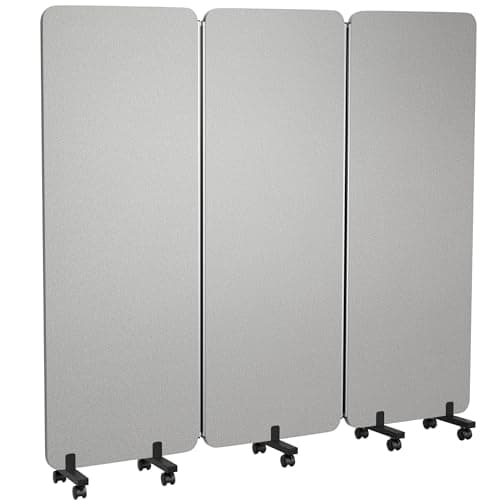
The route that solves the problem the renter actually has, and the one most people never consider. A freestanding acoustic partition is a cored, absorbing panel on legs. It makes no holes, needs no adhesive, leans on nothing, and when you move out it goes in the van. It also stands where the sound is, which is usually better placement than the wall anyway - a partition between your desk and the rest of the room intercepts speech on its way out, which a panel on the far wall does not.
It costs more than a pack of thin panels and it takes floor space, which is why it is the last pick below rather than the first. But it is the only option on this page that carries zero risk of damage, and this site's room-divider hub already says as much: dividers are among the best products here for renters, precisely because nothing about them is permanent.
Nobody in this tier names a test standard
This is the finding that should govern how you read the claimed figures below. Across the four peel-and-stick panels here, three publish a single-number absorption rating and not one of them names the standard it was measured to.
What each no-drill panel publishes about its own absorption
Product
Claimed figure
Standard named
Thickness published
WoveN SounD slat 10-pack
NRC 0.95, described as "lab-verified"
No
Yes, 0.4 / 0.8 in
TONOR self-adhesive 8-pack
NRC 0.9, plus a core density of 212.2 kg/m3
No
Yes, 0.35 in
TO-TH self-adhesive 6-pack
NCR "Noise Cancellation Rating" up to 0.95
No - and NCR is not a standard we can identify
No
TONOR peel-and-stick 12-pack
None published
n/a
Yes, 0.354 in
ATS Acoustics, for comparison (screwed)
NRC 1.0
Yes - ASTM E84 for fire; absorption figure published as a measured NRC
Yes, 2 in
Each row is that listing's own published claim. An NRC is a result of a test to ASTM C423; where no standard is named, the figure is a manufacturer claim and we present it as one.
Read that bottom row carefully. One product in this category invented a rating name. TO-TH publishes an "NCR (Noise Cancellation Rating)" of up to 0.95, and there is no such standard that we can find. It may well be a loose rendering of NRC with the letters transposed, and the panel is real polyester fiber that will do real work. But a made-up acronym on the one specification a buyer cares about is the clearest possible signal about how much weight to put on the number, and it is the reason that panel ranks where it does rather than on price alone.
How we ranked these
The same five metrics as the rest of this hub - absorption, coverage, mounting, finish and documentation - with two adjustments for the constraint this page is about. Mounting is weighted heavily, because a panel that needs fixings scores zero here regardless of how good it is. And documentation does more work than usual, because when every product in a tier is thin and light, what each maker is willing to put in writing is most of what is left to choose on. Full rubric on how we pick.
#
Product
Best for
Score
Price
01
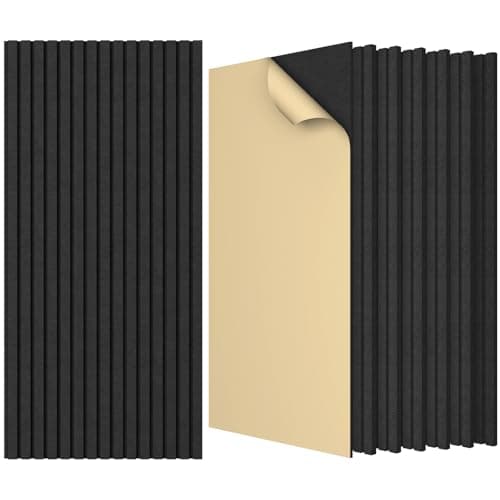
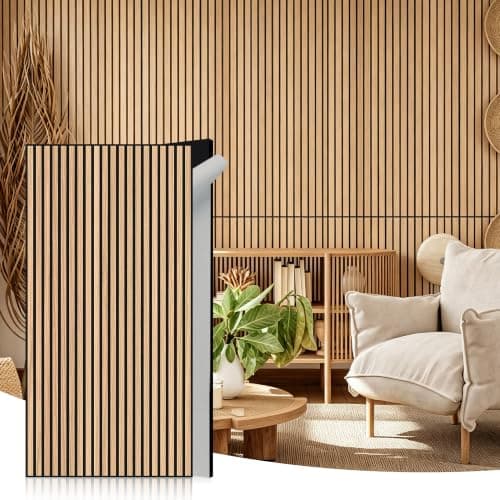
WoveN SounD Self-Adhesive Slat Acoustic Panels, 10-Pack 47.2 x 23.6 in77 sq ft of peel-and-stick slat panel with the highest claimed NRC in the no-drill tier and the only published core density in it.
TONOR Self-Adhesive Acoustic Panels, 8-Pack 47.2 x 23.6 inPublishes both an NRC of 0.9 and a material density, which almost nothing else at this price does, and sticks on without a single screw.
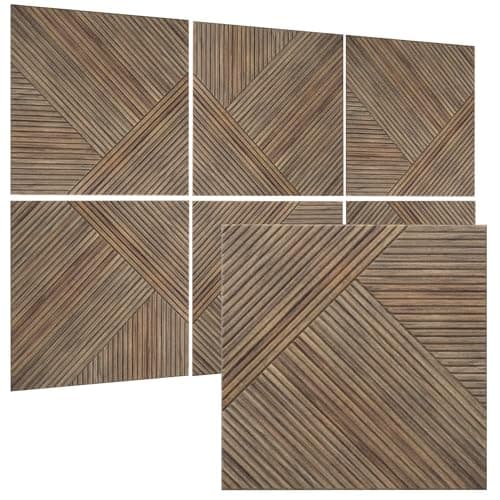
TO-TH Self-Adhesive Acoustic Panels, 6-Pack 23.6 in Square24 sq ft of peel-and-stick square for about 70 dollars, carrying a rating the listing has given a name we cannot find a standard for.
TONOR Peel-and-Stick Acoustic Panels, 12-Pack 23.6 in Square46.5 sq ft of 23.6 in squares that cut cleanly with a utility knife, from a maker that publishes no absorption figure for them at all.
INNO STICKERS PET Felt Tiles, 16-Pack 11.8 x 11.8 inPublishes an NRC range of 0.6 to 0.85 rather than a single flattering number, which is the most honest absorption statement on this page.
KERRAM 3-Panel Foldable Office Partition with WheelsNames its core material as 100% high-density polyester fiber, states a 1.13 in panel thickness, folds flat, and runs on 10 self-locking casters.
Ranked on the five acoustic-hub metrics, with mounting weighted heavily because on this page it is the constraint. Coverage figures are each listing's published pack size; prices on the buy rows are live.
01/WoveN SounD
Self-Adhesive Slat Acoustic Panels, 10-Pack 47.2 x 23.6 in
Best no-drill coverage
7.0/ 10
77 sq ft of peel-and-stick slat panel with the highest claimed NRC in the no-drill tier and the only published core density in it.
77 sq ft of peel-and-stick slat panel with the highest claimed NRC in the no-drill tier and the only published core density in it.
Published specification
Panel size
47.2 x 23.6 in, 7.73 sq ft each
WoveN SounD published specification
Pack
10 panels, about 77 sq ft
WoveN SounD published specification
Claimed NRC
0.95, described as lab-verified; no test standard named
WoveN SounD published claim
Core
Polyester, published at 12.1 lb/ft3
WoveN SounD published specification
Thickness
Dual density, published as 0.4 in / 0.8 in
WoveN SounD published specification
Mounting
Self-adhesive backing; no fixings, no drilling
WoveN SounD published specification
What the specs are good for
The largest no-drill coverage on this page at about 77 sq ft, which in absorption terms is most of the effect
Publishes a core density (12.1 lb/ft3), which no other peel-and-stick panel here does
A slat face, so it reads as deliberate wall treatment rather than as acoustic panels
Adhesive backing means no fixings at all, and nothing to patch when you move out
What they are not
Claims NRC 0.95 and names no test standard, so the number is a claim rather than a result
The listing also carries several claims we cannot check at all - an interior-designer percentage, a cooling-bill saving and a magazine mention - which is not a good sign on the figures we can read
At 0.4 in over most of its face it cannot do anything below roughly 500 Hz, whatever the single-number rating says
Adhesive on painted drywall is the one mounting method that can take paint with it
Skip this if
Skip this if your wall is textured, freshly painted or papered. Every peel-and-stick panel on this page needs a smooth, cured, clean surface, and on anything else the adhesive either fails or takes the surface with it.
Who it is for. A renter or anyone who cannot make holes, who wants real coverage rather than a few tiles and will accept an undocumented absorption figure to get it.
Self-Adhesive Acoustic Panels, 8-Pack 47.2 x 23.6 in
Best for walls you cannot drill
8.0/ 10
Publishes both an NRC of 0.9 and a material density, which almost nothing else at this price does, and sticks on without a single screw.
Publishes both an NRC of 0.9 and a material density, which almost nothing else at this price does, and sticks on without a single screw.
Published specification
Panel size
47.2 x 23.6 x 0.35 in, 8 panels
TONOR published specification
Coverage
About 61.9 sq ft total
Our arithmetic from the published panel size
NRC
0.9 (manufacturer's published figure; no test standard named)
TONOR published specification
Density
212.2 kg/m3
TONOR published specification
Material
100% polyester fiber
TONOR published specification
Mounting
Self-adhesive backing
TONOR published specification
What the specs are good for
An NRC figure AND a density figure, which together are the most spec data anyone publishes in the peel-and-stick tier
212.2 kg/m3 is a genuinely high density for polyester felt and it is why the NRC claim is plausible
No fixings at all, which makes this the rental answer
About 62 sq ft, enough for two walls of a small room
What they are not
Names no test standard for the NRC, so the figure is unaudited
0.35 in thick: same low-frequency limitation as every felt panel
Adhesive needs a smooth, clean, dry wall and can lift paint on removal
Skip this if
Skip this if your walls are textured, freshly painted, or anything other than smooth and sound. Adhesive panels on a rough or chalky surface fall off, usually about three weeks later.
Who it is for. A renter with smooth walls and a landlord, who still wants a density figure behind the purchase.
Self-Adhesive Acoustic Panels, 6-Pack 23.6 in Square
Cheapest real no-drill coverage
5.4/ 10
24 sq ft of peel-and-stick square for about 70 dollars, carrying a rating the listing has given a name we cannot find a standard for.
24 sq ft of peel-and-stick square for about 70 dollars, carrying a rating the listing has given a name we cannot find a standard for.
Published specification
Panel size
23.6 x 23.6 in, six panels covering 72 x 48 in
TO-TH published specification
Pack weight
10.4 lb
Listing published specification
Material
100 per cent polyester fiber, UV-printed wood-effect face
TO-TH published specification
Claimed rating
NCR "Noise Cancellation Rating" up to 0.95 - not a standard we can identify
TO-TH published claim
Mounting
Self-adhesive; the maker also lists walls, ceilings and doors
TO-TH published specification
What the specs are good for
The lowest cost per square foot in the no-drill tier
Polyester fiber rather than foam, so it is a genuine absorber at speech frequencies rather than a studio-look product
Six panels is enough to treat the one wall that is causing the problem
Stated as formaldehyde-free and odorless, which is a fair thing to want on a wall you sit next to all day
What they are not
The headline figure is an "NCR (Noise Cancellation Rating)", which is not ASTM C423 NRC and is not a standard we can identify - we are reporting the claim, not endorsing the number
No thickness published for this model, and thickness is the single most predictive figure in this category
24 sq ft treats one wall and no more
Adhesive-only, so the same paint risk as every other peel-and-stick panel here
Skip this if
Skip this if the published figures are what you are buying on. A made-up rating name and no published thickness is the thinnest documentation of any panel we list, and TONOR's 8-pack publishes both a real NRC and a density for a comparable price per square foot.
Who it is for. A renter on the tightest budget who wants one wall treated with real polyester fiber and is choosing on price and finish rather than on published performance.
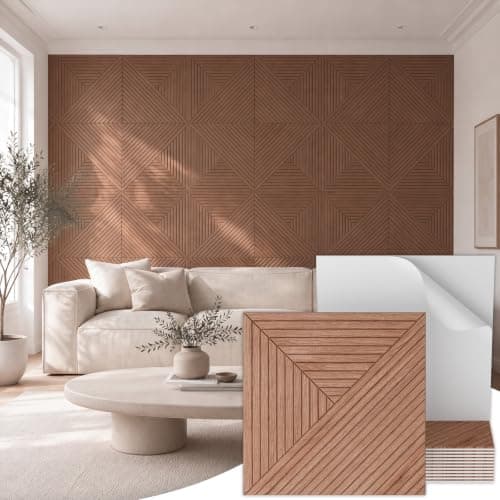
Peel-and-Stick Acoustic Panels, 12-Pack 23.6 in Square
Best for an awkward wall
5.6/ 10
46.5 sq ft of 23.6 in squares that cut cleanly with a utility knife, from a maker that publishes no absorption figure for them at all.
46.5 sq ft of 23.6 in squares that cut cleanly with a utility knife, from a maker that publishes no absorption figure for them at all.
Published specification
Panel size
23.6 x 23.6 in
TONOR published specification
Pack
12 panels, about 46.5 sq ft
TONOR published specification
Thickness
0.354 in
Listing published specification
Pack weight
16.4 lb
Listing published specification
Material
High-density polyester fiber, grooved face
TONOR published specification
Absorption figure
None published for this model
Absence confirmed against the published specification
Mounting
Peel-and-stick to a smooth wall; no power tools, nails or anchors
TONOR published specification
What the specs are good for
A 23.6 in square is the easiest format to lay out around a window, a door frame or an outlet
The maker states it trims with a standard utility knife, which is the difference between a tidy edge and a visible bodge
46.5 sq ft is genuine coverage, not a decorative handful of tiles
The same TONOR adhesive backing as the 8-pack, which is the best-documented no-drill panel we have
What they are not
Publishes no NRC, no absorption coefficient and no test standard for this model - on this site that is a markdown, not a neutral
0.354 in of polyester fiber is a high-frequency treatment; it will take the edge off a hard room and will do nothing to rumble
The maker warns of an odor for three to five days, which it is fair to them to repeat
Costs more per square foot than TONOR's own larger 8-pack
Skip this if
Skip this if you have a clear run of flat wall. The square format exists to fit around obstacles, and if you do not need that, TONOR's own 47.2 x 23.6 in panels cover the same area for less and publish an NRC.
Who it is for. A renter treating a wall with a window, a radiator or a door in the middle of it, who would rather cut small panels than fight large ones.
Publishes an NRC range of 0.6 to 0.85 rather than a single flattering number, which is the most honest absorption statement on this page.
Publishes an NRC range of 0.6 to 0.85 rather than a single flattering number, which is the most honest absorption statement on this page.
Published specification
Tile size
11.8 x 11.8 x 0.4 in, 16 tiles
INNO STICKERS published specification
Coverage
15.5 sq ft total
INNO STICKERS published specification
NRC
0.6 to 0.85, stated as a range (no test standard named)
INNO STICKERS published specification
Material
Recycled PET felt
INNO STICKERS published specification
Mounting
96 adhesive tabs supplied; permanent install needs extra adhesive
INNO STICKERS published specification
What the specs are good for
A published RANGE instead of a single best-case number, which is how absorption actually behaves across frequency
Small tiles let you put absorption exactly where the reflection is, instead of covering a whole wall
Adhesive tabs are removable, so this is the least committal option here
Moisture-resistant and vacuumable
What they are not
15.5 sq ft is a spot treatment, not a room treatment
Adhesive tabs are explicitly described as temporary; a permanent install needs adhesive you buy separately
16 small tiles means 16 alignment decisions and a grid that is obvious when it is slightly off
Skip this if
Skip this if you need more than about 16 sq ft. Buying three boxes to cover a wall costs more per square foot than the 10-pack of large panels above and takes four times as long to hang.
Who it is for. Someone with one bad reflection, a rented wall, and no appetite for a project.
Names its core material as 100% high-density polyester fiber, states a 1.13 in panel thickness, folds flat, and runs on 10 self-locking casters.
Names its core material as 100% high-density polyester fiber, states a 1.13 in panel thickness, folds flat, and runs on 10 self-locking casters.
Published specification
Overall size
71 in wide x 66 in high
KERRAM published specification
Panel thickness
1.13 in
KERRAM published specification
Core
100% high-density polyester fiber, fabric outer
KERRAM published specification
Frame
Aluminum
KERRAM published specification
Casters
10 self-locking swivel casters
KERRAM published specification
Assembly
3 to 5 minutes; casters only, no panel assembly
KERRAM published specification
Absorption
Not published as a figure. The core material and thickness are published, the NRC is not
Absence confirmed against the published specification
What the specs are good for
States a panel thickness AND a core material, which together are the two facts that decide whether a partition does anything acoustically
1.13 in of high-density polyester is a genuine absorber, unlike fabric on a steel frame
Folds completely flat for storage, which no other acoustic partition here does
Aluminum frame keeps the weight down without the flex of a thin steel tube
Ten self-locking casters and a 3 to 5 minute setup
What they are not
No NRC or absorption coefficient published, so the thickness and material are the only evidence
380 dollars for 32 sq ft of partition
Only 20 units showed in stock at the time of writing, so availability is thin
Skip this if
Skip this if you need the partition to block sound rather than absorb it. 1.13 in of polyester fiber reduces reflections and speech spill; it is not a wall and it will not stop a conversation being audible on the other side.
Who it is for. Someone in a shared room who needs the calls to stop bouncing and the partition to disappear into a cupboard at weekends.
01Read the tenancy agreement, specifically for fixings. Many agreements permit small screws and nails and prohibit adhesive products by name, because adhesive is the one that causes expensive damage. If yours allows a picture hook, it allows an acoustic panel, and you should be buying the 2 in one.
02Test the adhesive on one panel, in a corner, for a week. Paint age, paint type and wall texture all decide the outcome and none of them is printed on the box. One panel low on the wall behind a door tells you what six panels at eye height will do.
03Clean the wall and let it dry fully. Every maker here specifies it and it is the single most common reason adhesive panels fall off in month two.
04Photograph the wall before you start. Dated photographs of the surface you began with are worth more in a deposit dispute than any argument about what the adhesive was supposed to do.
05Plan the removal before the install. Warming the adhesive and pulling slowly and parallel to the wall is far gentler than pulling outward. Decide now whether you will have the patience, because the alternative is a repaint.
What this page cannot fix
A shared wall. Absorption treats the sound in your room. It does not stop sound arriving from the flat next door, and it does not stop your calls reaching them. Thin adhesive panels least of all.
A hollow door. In most rentals the door is the biggest acoustic hole in the room and the cheapest thing to improve, and all of it is reversible: how to soundproof a home office door covers the sweeps and seals that leave no trace.
A ceiling. Ceiling treatment is efficient and almost none of it is available to a tenant. The best sound absorbing panels for a ceiling says which format is reversible and which is not, and the short answer is that only a drop-in grid tile is.
How much you need. Coverage is the variable that decides whether any of this works, and three panels will not do it. How many acoustic panels do you need? does the sum for a real room, and it is worth doing before buying a pack size.
FAQ
Questions people ask about this
Can you put acoustic panels up in a rental without drilling?+
Yes. Peel-and-stick panels need no fixings and are sold specifically for this, and small adhesive PET tiles work the same way on a smaller scale. The trade is that adhesive panels are thin - 0.35 to 0.4 in against 2 in for a screwed panel - so they work on voices and hard-room echo and not on low-frequency noise. If you cannot risk the paint at all, a freestanding acoustic partition needs no wall contact of any kind.
Will acoustic panels damage the wall when I take them down?+
Adhesive panels can, and it depends on the paint rather than on the panel. On fully cured, smooth, good-quality paint most come away cleanly if you warm the adhesive and pull slowly parallel to the wall. On fresh emulsion, textured paint or wallpaper, the adhesive can take the surface with it - and a large rectangle of missing paint means repainting the wall, because a patch will not match. Test one panel in an inconspicuous spot for a week first.
Are screw holes or adhesive worse for a deposit?+
Usually adhesive. Four small screw holes behind a panel are filler and a dab of paint, and most agreements treat that as normal wear; a stripped patch of emulsion is a whole-wall repaint. Many tenancy agreements actually permit small fixings while naming adhesive products as prohibited, for exactly this reason. Check yours before assuming the no-drill route is the safe one.
Can picture-hanging strips hold an acoustic panel?+
A thin no-drill panel weighs under 2 lb and one set holds it easily. A proper 2 in panel is a different question: the ATS Acoustics 24 x 48 in panel publishes 8.25 lb, and heavy-duty strip sets publish holding figures around 5 to 6 lb per set, so by our arithmetic you need two sets minimum and three or four with a sensible margin for something hanging above a desk. Read the figure on the pack you buy, and note that strip makers typically warn against freshly painted walls too.
Do any no-drill acoustic panels publish a real NRC?+
They publish numbers, but none of the four here names the standard behind it. The TONOR 8-pack is the best documented, with NRC 0.9 and a published core density of 212.2 kg/m3. One listing goes further and publishes an 'NCR (Noise Cancellation Rating)' of 0.95, which is not a standard we can identify. Treat all of these as manufacturer claims, and treat published thickness as the more reliable guide to what a panel will actually do.
What is the best option for a rental if I can't stick anything to the wall either?+
A freestanding acoustic partition. It has an absorbing core, stands on its own legs, touches no surface permanently, and moves out with you. It also sits between you and the room rather than on a distant wall, which is often better placement than a panel. It costs more than a pack of thin panels and takes floor space, and it is the only option on this page with no risk of damage whatsoever.
Is it worth treating a room I'm only in for a year?+
The reversible options are, because they come with you. A freestanding partition, a curtain on a tension rod and a door sweep are all purchases you keep across several homes, which changes the arithmetic completely. Adhesive panels are the opposite: they are consumed by the install and cannot be moved to the next flat, so judge those on whether one year of a quieter room is worth the pack price on its own.
Sources
Where these numbers came from
We have not handled any of these products. Every figure on this page is either the manufacturer's own published specification, named as such, or our arithmetic from those figures, shown so you can check it. Prices come from Amazon through our price layer and carry the date they were verified.
Amazon product listings, retrieved 2026-10-03
Published specifications, dimensions, materials and manufacturer claims were read from each product's own listing data. Prices and availability refresh daily and carry their verification date on the page.
The full published method, and an explicit statement of what a specs-only approach cannot tell you.
ASTM C423 — Standard Test Method for Sound Absorption and Sound Absorption Coefficients by the Reverberation Room Method
The governing test method behind any NRC figure. We name it where a manufacturer publishes an NRC so you know what the number is a result of. We have not performed this test and we do not restate anyone's NRC as our own measurement.