A desktop organizer trades desk surface for storage. A wall organizer trades holes in your wall for the same storage. That is the whole decision.
SMBy Scooter M.Published October 23, 2026Prices verified November 22, 2026
The short answer
Go on the wall if you own the room and the problem is paper volume; stay on the desk if you rent, or if the problem is the five things you touch every hour. Concretely: the Spampur steel pegboard 4-pack is the best wall buy - it is the only product in this entire hub, wall or desk, that publishes a load rating (50 lb per panel), and 200 lb of published capacity for forty dollars is more storage per dollar than any desktop organizer can approach. If you cannot drill, buy the Delifox 7-compartment organizer, which ships cubicle and door hangers, needs no holes at all, and stands on a desk if you change your mind. And if what is actually cluttering your desk is six live documents rather than sixty, buy a desktop organizer - the WALI 4-tier is this site's top pick and it puts the paper within arm's reach, which is the one thing a wall cannot do.
What each one actually costs you
This hub's standing rule is that every organizer trades desk surface for storage, and the only question worth asking is what the trade buys. Moving to the wall changes what you are trading, not whether you are trading.
The trade, side by side
Desktop organizer
Wall-mounted organizer
What you give up
Desk surface, permanently
Holes in a wall, and the deposit if you rent
Desk area returned
None - it is on the desk
Its whole footprint, 0.3 to 0.6 sq ft typically
Reach from a seated position
Immediate
Requires standing, or at least leaning
Install
Put it down
Stud-finding, drilling, anchors - 10 to 40 minutes
Reversible
Completely
Patch and paint
Capacity per dollar
Low - a tray costs what a six-pocket wall set costs
High - the wall is free real estate
Published load ratings
None in this hub
One product out of five
Failure mode
It gets buried
It falls on you
Desk-area figures are our arithmetic from the published footprints of this hub's desktop picks. The load-rating row is a count of the products on this page.
The last row is the one that gets underrated and it is the reason a load rating matters more on a wall than on a desk. An overloaded desktop organizer simply sits there looking untidy. An overloaded wall unit comes off the wall, and depending on what you put in it that is a bad day for a laptop or a foot. That asymmetry is why this page scores documentation harder than the rest of the hub.
The desk-area arithmetic, which is the honest case for the wall
Here is the sum, because the answer is less dramatic than the wall-storage marketing suggests and more useful once you have it.
What moving to the wall gives back
A typical 4-tier desktop file organizer footprint: about 13 x 10 in = 0.9 sq ft
A 6-tier paper sorter: about 13 x 11 in = 1.0 sq ft
A 48 x 24 in desk, total surface: 8 sq ft
So one desktop organizer occupies roughly 11 to 13 per cent of a small desk
Moving it to the wall returns that - call it one-eighth of your desk
The same wall also holds the Spampur pegboard's published 200 lb across 5.3 sq ft of vertical area, which no desk could carry at all
Our arithmetic from the published footprints of this site's desktop picks and a 48 x 24 in desk. Your desk and your organizer may differ; the ratio is the point.
One-eighth of a small desk is a real gain and it is also not a transformation. If your desk is cluttered because there is too much paper in the room, the wall genuinely fixes it, because the wall has capacity the desk never had. If your desk is cluttered because of the six things you are working on today, moving storage to the wall just means standing up every time you need one of them, and in a fortnight the paper is back on the desk anyway.
Only one product here tells you what it holds
This hub has a standing finding: no desk organizer publishes a load rating. Checking the wall-mounted tier, it is almost as bad, and the exception is instructive.
What each wall product publishes about capacity and mounting
Product
Load rating
Hole spacing
Needs a drill?
Spampur steel pegboard
Up to 50 lb per panel, 4 panels
Not published
Yes - drill and hammer, per the maker
samstar 6 wall pockets
Not published
About 13.2 in hole to hole
Yes
Delifox 7-compartment
Not published
n/a - hangers supplied
No - cubicle and door hangers, or screws if you want
NOZE pegboard and shelf
Not published
Not published
Yes - bracket install
Gawerk 6 wall pockets
Not published
Not published
Yes
Every desktop organizer in this hub
Not published
n/a
No
Each row is that listing's own published specification, with absences confirmed against it.
The Spampur pegboard publishes 50 lb per panel, which across four panels is 200 lb of stated capacity. We cannot verify it and we have not tried to. What we can say is that it is the only figure available in this hub, it is attached to the only steel product on this page, and the 8.3 lb set weight is consistent with steel rather than the PP plastic most office pegboards use. On a wall, where the failure mode involves gravity and your head, a published number from a product whose stated weight corroborates its stated material is worth a great deal.
A stud-spacing problem worth knowing before you drill
One product here publishes its mounting hole spacing, and the moment it does, an arithmetic problem appears that applies to the whole category.
Hole spacing against US framing
samstar wall pocket, published hole-to-hole spacing: about 13.2 in
Standard US wall framing: studs at 16 in on center
13.2 in is less than 16 in, and is not a divisor of it
So for any given pocket: at most one of its two holes can land on a stud
The other hole needs a drywall anchor, which is the component people skip
Six pockets: 12 holes, of which at most 6 reach framing
Our arithmetic. The 13.2 in figure is samstar's published spacing; 16 in on center is standard US residential framing, though older and some commercial construction differs. We are not criticizing samstar for this - it is the only product here that published the number at all, which is why this sum is possible.
The practical consequence: buy proper drywall anchors and assume you will need them. A plastic expansion plug in half-inch drywall holds a few pounds; a toggle or self-drilling anchor holds considerably more. If the plan is a wall of paper above a desk, the anchors are not an accessory to the project, they are the project, and the four products here that publish no hole spacing give you no way to plan it in advance.
Where cubicle walls change the answer completely
If the surface behind your desk is a cubicle panel rather than drywall, the whole calculation flips, and so does the shortlist.
A cubicle panel is a fabric-over-frame partition designed to be hung from, and you cannot drill it. That eliminates every pegboard and every screw-mounted pocket set on this page and leaves exactly one product: the Delifox 7-compartment organizer ships two sets of hangers for a cubicle panel or a door. It is also the one product here a renter can use, which makes it the most broadly useful pick on the page even though it is not the highest capacity.
The same logic extends to the other vertical surface people forget: a desk privacy panel. If you already have a fabric clamp-on panel in front of you, it is a hanging surface too - which is a point in favour of the ones with a tackable PET face. The best desk privacy panels has those.
The one place wall storage and this site's other advice collide
Worth flagging, because we would rather say it than have you discover it after drilling. The wall directly above a desk is also the best place for an acoustic panel, and it is where this site tells you to put one. The reflective surface behind and beside a monitor is a primary cause of the hard, echoey sound people hear on calls, and treating it is the single highest-value square footage in the room.
You cannot have both on the same patch of wall. If your room has a noise problem as well as a paper problem, decide which wall gets which before you start: paper above the desk and absorption on the side wall, or the reverse. Where to place acoustic panels in an office explains which surfaces matter acoustically, and most of the time there is a workable split.
How we ranked these
The same five metrics as the rest of this hub - capacity, footprint, build, value and documentation - applied across both formats so the two sides are genuinely comparable. Footprint scores high for everything wall-mounted by definition, since the desk area it consumes is zero; that is the structural advantage of the format and pretending otherwise would be dishonest. Documentation carries extra weight here for the reason given above: on a wall, an unpublished load rating is a safety question rather than a tidiness question. Full rubric on how we pick.
#
Product
Best for
Score
Price
01
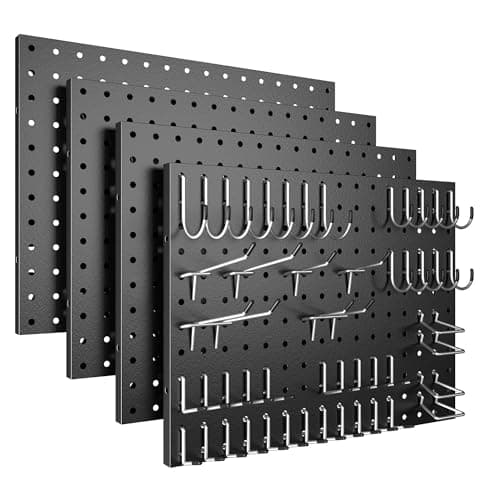
Spampur Steel Pegboard Panels, 4-Pack with 50 HooksFour 16 x 12 in steel panels with a published 50 lb capacity each, which makes it the only wall product in this catalog that tells you what it can hold.
Delifox 7-Compartment Wall File Organizer, 17 inThe only unit here you can hang with no fixings at all: it ships cubicle and door hangers, takes screws if you want them, and stands on a desk if you change your mind.
samstar Mesh Wall File Pockets, 6-Pack with Label PanelsSix separate letter-size pockets you lay out yourself, and the only wall product here that publishes its mounting hole spacing.
NOZE Pegboard with Floating Shelf and LED, 31.5 inA 31.5 in pegboard with a 10 in deep pine shelf and a light under it, which is the one product here that gives a wall both open storage and a surface.
Gawerk Mesh Wall File Pockets, 6-PackThe same six-pocket modular idea at the lowest price on the page, in a 2.4 lb set that publishes a pocket size and nothing else.
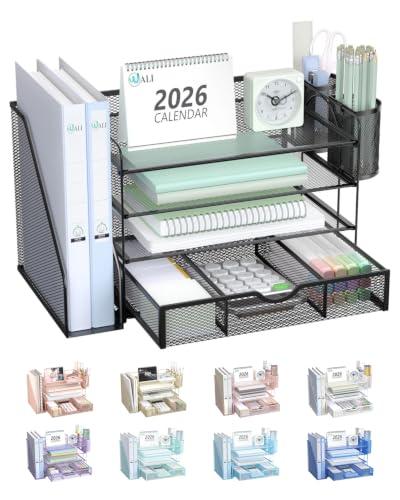
WALI 4-Tier Desk File Organizer with DrawerFour letter trays, a vertical file section, two pen holders and a sliding drawer in a 13.58 by 9.84 in footprint. Seventeen dollars.
Marbrasse 6-Tier Paper Organizer Letter Tray with HandleSix letter trays on a reinforced steel frame with a carrying handle, 3 lb, in a 16.93 by 9.84 in footprint.
The first five are wall-mounted, the last two are this site's top desktop picks, so whichever side of the decision you land on there is a ranked answer here. Scored on the same five organizer metrics.
01/Spampur
Steel Pegboard Panels, 4-Pack with 50 Hooks
Only published load rating
8.8/ 10
Four 16 x 12 in steel panels with a published 50 lb capacity each, which makes it the only wall product in this catalog that tells you what it can hold.
Four 16 x 12 in steel panels with a published 50 lb capacity each, which makes it the only wall product in this catalog that tells you what it can hold.
Published specification
Panel size
16 x 12 in each, four panels
Spampur published specification
Load rating
Up to 50 lb per panel
Spampur published specification
Configurations
64 x 12 in or 32 x 24 in, or any arrangement you like
Spampur published specification
Hole pattern
1/4 in holes at 1 in spacing; fits standard 1/8 in and 1/4 in pegboard hooks
Spampur published specification
Material
Powder-coated steel
Spampur published specification
Weight
8.3 lb for the set
Listing published specification
Included
50 hooks plus screws and expansion anchors
Spampur published specification
What the specs are good for
50 lb per panel is the only published load figure anywhere in this hub, wall-mounted or desktop, and on a wall it is the figure that decides whether the thing is safe
Steel rather than the PP plastic most office pegboards use, and the 8.3 lb set weight is consistent with that
Standard 1 in hole spacing on 1/4 in holes, so any pegboard hook, bin or shelf you already own fits and the system is not proprietary
Four separate panels means you place them where the wall actually allows - around a window, above a monitor, in a corner
200 lb of published total capacity for forty dollars is far more storage per dollar than any desktop organizer can offer
What they are not
Needs a drill and a hammer by the maker's own instructions - this is the least rental-friendly pick on the page
No hole spacing published for the mounting holes themselves, so stud alignment is guesswork until the box is open
A pegboard holds things in the open: it is visible storage, and it looks like a workshop unless you are disciplined
Marketed primarily for garages and tools, and the hook assortment reflects that rather than paper
Nothing in the set holds a letter-size document properly without buying a pegboard file pocket separately
Skip this if
Skip this if paper is the problem. A pegboard is superb for tools, cables, headphones and the small objects that colonize a desk, and it is the wrong product for forty loose documents - buy a wall file pocket set for those.
Who it is for. Someone with a wall they are allowed to drill, who wants published capacity and a system they can extend rather than a fixed object.
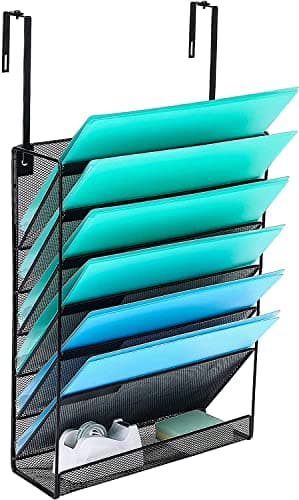
The only unit here you can hang with no fixings at all: it ships cubicle and door hangers, takes screws if you want them, and stands on a desk if you change your mind.
The only unit here you can hang with no fixings at all: it ships cubicle and door hangers, takes screws if you want them, and stands on a desk if you change your mind.
Published specification
Dimensions
12.5 x 4 x 17 in
Delifox published specification
Compartments
6 file compartments at 12.25 x 6.5 x 1.25 in, plus a 12.25 x 3.75 x 1.25 in tool compartment
Delifox published specification
Weight
4.7 lb
Listing published specification
Mounting
2 sets of hangers for a cubicle panel or a door; screws and drywall anchors also included
Delifox published specification
Material
Metal mesh, with label panels per slot
Delifox published specification
Load rating
Not published
Absence confirmed against the published specification
What the specs are good for
Three mounting modes in one box - cubicle hanger, door hanger, or screws - so it is the only pick here that works in a rental or a cubicle with no holes at all
It also stands upright on a desk, which means buying it is not a bet on where the storage should live
Publishes every internal compartment dimension, so you can confirm a letter folder fits before buying
1.25 in per slot is a realistic depth: six slots hold six live projects, not six reams
Label panels per slot, which is the difference between a filing system and a pile at altitude
What they are not
Publishes no load rating, like almost everything in this category
A door hanger moves every time the door does, and paper in it will eventually slide
4.7 lb empty is the heaviest single-unit wall organizer here, so the drywall anchors matter if you do screw it up
1.25 in slots are shallow - this is a live-paper product and not archive storage
Skip this if
Skip this if the wall is the only option and you are happy to drill. For a fixed install the pegboard systems give you far more capacity per dollar, and the mounting flexibility you are paying for here is wasted.
Who it is for. A renter, or anyone in a cubicle, who needs paper off the desk today and cannot or will not make holes.
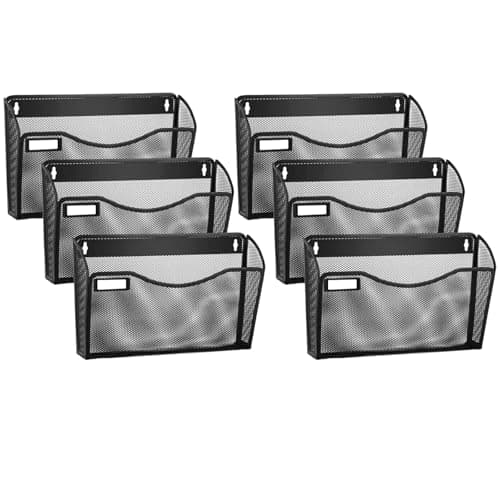
Six separate letter-size pockets you lay out yourself, and the only wall product here that publishes its mounting hole spacing.
Six separate letter-size pockets you lay out yourself, and the only wall product here that publishes its mounting hole spacing.
Published specification
Pocket size
13.8 x 3.7 in (top) / 2 in (bottom) x 8.5 in each
samstar published specification
Pack
6 pockets
Listing published specification
Hole spacing
About 13.2 in between mounting holes
samstar published specification
Stud alignment
13.2 in against a 16 in stud spacing means at most one hole lands on a stud
Our arithmetic from the published hole spacing
Capacity
A4 and letter folders, papers and files
samstar published specification
Weight
6.0 lb for the set
Listing published specification
Material
Mesh metal with a label panel per pocket
samstar published specification
Load rating
Not published
Absence confirmed against the published specification
What the specs are good for
The only wall unit here that publishes hole-to-hole spacing, which is the figure that decides whether you are drilling into a stud or trusting an anchor
Six independent pockets means the layout follows your workflow and the wall's obstacles rather than a fixed frame
13.8 in wide takes a letter folder across its width without bowing it, which the narrower pockets here do not
Mesh metal with a label panel per pocket, so it works as a genuine filing system
6.0 lb for six pockets is the sturdiest per-pocket build on the page
What they are not
13.2 in hole spacing does not match the 16 in stud centers of US framing, so by our arithmetic at most one screw per pocket can reach a stud and the rest rely on drywall anchors
No load rating published, which matters more here than it would on a desk
Six pockets means twelve holes and twelve anchors - a long install
The arched front means the top sheet is always visible, which is useful for finding things and bad for anything confidential
Skip this if
Skip this if you are renting. Twelve holes in drywall is a deposit conversation, and the Delifox organizer does most of this job with no holes at all.
Who it is for. Someone building a proper paper wall above a desk in a room they own, who wants to know where the screws are going before they start.
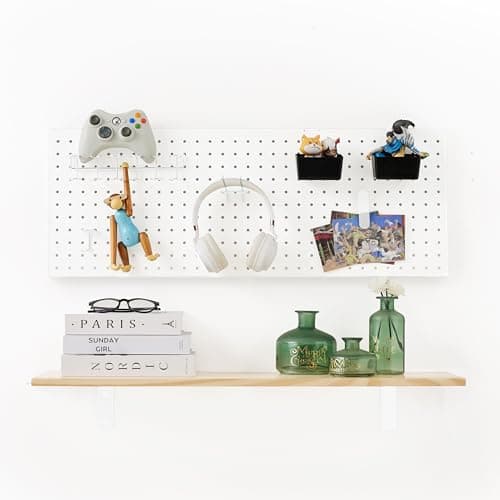
A 31.5 in pegboard with a 10 in deep pine shelf and a light under it, which is the one product here that gives a wall both open storage and a surface.
A 31.5 in pegboard with a 10 in deep pine shelf and a light under it, which is the one product here that gives a wall both open storage and a surface.
Published specification
Pegboard
31.5 in wide x 11.81 in high, 12 mm MDF, 1 in hole spacing
NOZE published specification
Shelf
31.5 in wide x 10 in deep x 0.8 in thick, kiln-dried solid pine
NOZE published specification
Lighting
LED strip under the shelf, 3000K
NOZE published specification
Pack
2 units
Listing published specification
Weight
6 lb
Listing published specification
Mounting
Pre-drilled holes, brackets and hardware included
NOZE published specification
Load rating
Not published
Absence confirmed against the published specification
Hooks
Not included; standard 1 in pegboard accessories fit
NOZE published specification
What the specs are good for
A 10 in deep shelf is the only horizontal surface on this page, and a surface is what a desktop organizer is really competing to provide
31.5 in of pegboard plus the shelf covers the full wall above a standard desk in one purchase
Two units in the box, so you can run it the width of a desk or split it over two walls
The under-shelf LED is a genuine use for the position: above a desk is exactly where task light is missing
Standard 1 in pegboard spacing, so it takes the same hooks as any other pegboard system
What they are not
Publishes no load rating at all, and a 12 mm MDF board with a pine shelf on brackets is precisely where you want one
MDF rather than steel: it will not take the 50 lb the Spampur panels publish, and we have no figure to say what it will take
Ships no hooks, so the usable product costs more than the price suggests
6 lb for two units is light, which is pleasant to hang and tells you something about the construction
A permanent bracket install - there is no low-damage version of this one
Skip this if
Skip this if the wall above your desk is where the acoustic panels are going. This occupies the same prime real estate, and on a site about quiet that is a real trade rather than a theoretical one.
Who it is for. Someone furnishing the wall above a desk in a room they own, who wants a shelf, hanging storage and task light from one fitting.
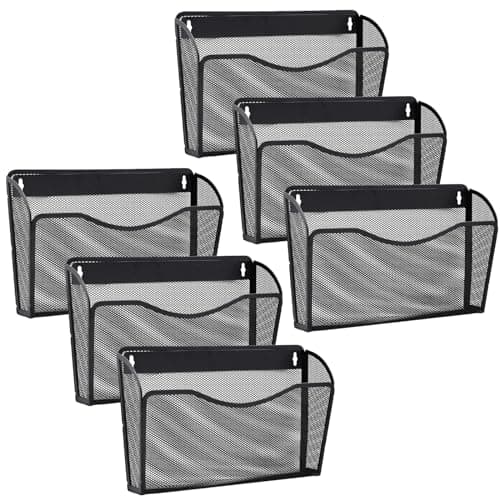
The same six-pocket modular idea at the lowest price on the page, in a 2.4 lb set that publishes a pocket size and nothing else.
The same six-pocket modular idea at the lowest price on the page, in a 2.4 lb set that publishes a pocket size and nothing else.
Published specification
Pocket size
13.9 x 4.1 in (top) / 2 in (bottom) x 8.5 in each
Gawerk published specification
Pack
6 pockets
Listing published specification
Capacity
A4 and letter folders and papers
Gawerk published specification
Weight
2.4 lb for the set
Listing published specification
Material
Metal mesh, described as a dense mesh that will not leak small items
Gawerk published specification
Hole spacing
Not published
Absence confirmed against the published specification
Load rating
Not published
Absence confirmed against the published specification
What the specs are good for
The least expensive route to six wall pockets, and six is the number at which a wall becomes a filing system
4.1 in at the top is the deepest pocket mouth here, so a thick folder goes in without a fight
Fully modular: mount them in a row, a column, a block, or across two walls
At 2.4 lb for the set it is the lightest wall load on the page, which is the one honest advantage of a thin build
What they are not
Publishes neither a load rating nor a hole spacing - the two figures that matter most for something going on a wall
2.4 lb across six pockets is 0.4 lb each, and a thin mesh pocket full of paper will bow
No label panel, so you will be reading spines at head height
Marketed for cubicles as well as walls but ships no cubicle hanger, unlike the Delifox
Skip this if
Skip this if the pockets will be full. For forty dollars less than nothing much you are buying six very light pressed-mesh pockets, and the samstar set at a few dollars more is visibly heavier per pocket and publishes its hole spacing.
Who it is for. Someone who wants six wall pockets for the price of one desktop organizer and is storing light, live paper in them.
Four letter trays, a vertical file section, two pen holders and a sliding drawer in a 13.58 by 9.84 in footprint. Seventeen dollars.
Four letter trays, a vertical file section, two pen holders and a sliding drawer in a 13.58 by 9.84 in footprint. Seventeen dollars.
Published specification
Dimensions
13.58 in wide x 9.84 in deep x 5.71 in high
Listing published specification
Sections
4 letter trays, 1 vertical file section, 2 metal pen holders, 1 sliding divided drawer
WALI published specification
Material
Thickened steel wire mesh with dense small aperture
WALI published specification
Assembly
Required; no tools
WALI published specification
Load rating
Not published
Absence confirmed against the published specification
What the specs are good for
Four trays AND vertical filing AND a drawer AND pen holders, in under one square foot of desk, for 17 dollars
The vertical section is the part most organizers at this price leave out, and it is where live folders go
Dense small mesh rather than wide wire, so paper clips do not fall through
The sliding drawer is divided, so it does not become a single tray of chaos
What they are not
No published load rating, and four loaded letter trays is real weight on a wire frame
5.71 in tall means the trays are shallow; each holds a modest stack, not a ream
Mesh collects dust and is awkward to clean
Assembly required, which at this price means thin fixings
Skip this if
Skip this if your paper arrives in stacks rather than sheets. Four shallow trays overflow fast, and at that point you need a desktop drawer unit or a filing cabinet, not more trays.
Who it is for. Any desk with a paper problem and a square foot to spare. This is the default pick for the hub.
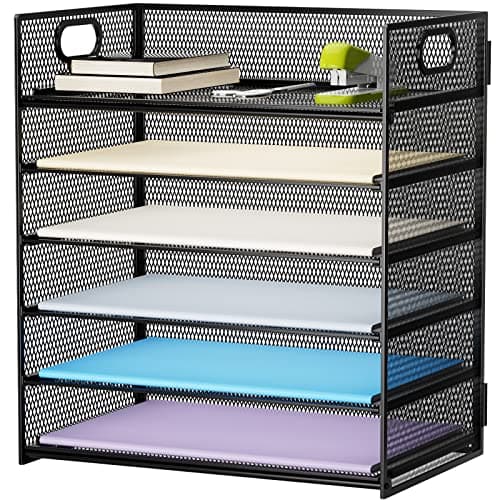
Six letter trays on a reinforced steel frame with a carrying handle, 3 lb, in a 16.93 by 9.84 in footprint.
Six letter trays on a reinforced steel frame with a carrying handle, 3 lb, in a 16.93 by 9.84 in footprint.
Published specification
Dimensions
16.93 in wide x 9.84 in deep x 3.15 in high as listed
Listing published specification
Weight
3 lb
Listing published specification
Tiers
6
Marbrasse published specification
Capacity
Letter and A4
Marbrasse published specification
Material
Lightweight metal mesh with a solid steel frame
Marbrasse published specification
Extra
Portable carrying handle
Marbrasse published specification
Load rating
Not published
Absence confirmed against the published specification
What the specs are good for
Six tiers, the most paper separation per dollar in this hub
A carrying handle, which means the whole sorted stack moves to the kitchen table and back without losing its order
3 lb: light enough to lift one-handed when loaded
Twenty dollars
What they are not
No published load rating, and six tiers of paper on a 3 lb frame is the most load-per-pound here
The listed 3.15 in height is implausible for a six-tier unit and is likely the packed depth, so the real height is unknown
No drawer and no pen storage: it sorts paper and does nothing else
Six shallow tiers encourage a six-category system you will not maintain
Skip this if
Skip this if you want one object to tidy a whole desk. It is a paper sorter, deliberately, and the WALI does sorting plus a drawer plus pens for three dollars less.
Who it is for. Someone with genuinely distinct paper categories — invoices, receipts, filing, action, read, archive — who will keep them apart.
Too much paper. Both of these are places to put paper, and neither reduces how much of it there is. If the volume is the problem, the answer is upstream: setting up a paper filing system and a document filing system for a home both start by cutting the volume, and it is startling how much of a full cabinet turns out to be shreddable.
Archive storage. Neither a wall pocket nor a desktop tray is where years of records go. That is a drawer: the best file cabinets for a home office ranks on cost per filing inch, and a cabinet beats both formats here by an order of magnitude on that measure.
The space under the desk. It is the other free real estate in a home office and it competes directly with the wall - it needs no drilling, holds far more, and is invisible. Desk organizer vs under-desk storage is that version of this decision, and for a renter it is usually the better one.
FAQ
Questions people ask about this
Why would I choose wall-mounted organizers over desktop organizers?+
Three reasons. It returns the desk area the organizer was occupying - about one-eighth of a small desk per unit, by our arithmetic. It has far more capacity per dollar, because wall space is free whereas desk space is the scarcest surface in the room. And it can hold things a desk cannot: the one pegboard here that publishes a rating states 50 lb per panel. The cost is holes in the wall, a longer install, and having to stand up to reach anything.
When is a desktop organizer the better choice?+
When you rent, when the surface behind you cannot be drilled, and whenever the paper in question is paper you touch several times a day. Reach is the desktop organizer's real advantage and it is not a small one - storage you have to stand up for stops getting used, and then the paper comes back onto the desk. The rule of thumb: daily paper on the desk, weekly or monthly paper on the wall.
Can I put a wall organizer up without drilling?+
Yes, with the right product. The Delifox 7-compartment organizer ships two sets of hangers for a cubicle panel or a door and needs no holes at all, and it also stands upright on a desk. Everything else on this page is a screw install by the maker's own instructions. Adhesive hooks are an option for very light pockets, but nothing here publishes a weight for you to check them against.
How much weight can a wall-mounted office organizer hold?+
Almost none of them will say. Of the five wall products here, one publishes a figure: the Spampur steel pegboard, at up to 50 lb per panel. The other four publish nothing, as does every desktop organizer in this hub. That absence matters more on a wall than on a desk, because an overloaded wall unit comes off the wall rather than just looking untidy. Where no figure exists, the published material and weight are the only proxies - steel over plastic, and heavier over lighter.
What are the best cubicle shelves?+
For a cubicle panel specifically, the Delifox 7-compartment organizer is the pick on this page, because it ships hangers made for a cubicle panel and a door and does not need a single hole. A cubicle wall is fabric over a frame - it is designed to be hung from and it cannot be drilled - which rules out every pegboard and every screw-mounted pocket set here.
Do I need drywall anchors for a wall file organizer?+
Almost certainly, and plan for it. The one product here that publishes its hole spacing states about 13.2 in, and US framing is typically 16 in on center, so by our arithmetic at most one of a pocket's two screws can reach a stud and the other needs an anchor. A plastic expansion plug holds a few pounds; use a toggle or self-drilling anchor if the pocket is going to be full.
Is a pegboard good for a home office?+
For tools, cables, headphones and the small objects that colonize a desk, it is excellent, and the steel version here is the only product in this hub with a published load rating. For paper it is the wrong product on its own - a pegboard holds nothing letter-sized until you add a pegboard file pocket, and it stores everything in the open, which looks like a workshop unless you are disciplined about it.
Should I put an organizer or an acoustic panel above my desk?+
They compete for the same wall, and the wall above and beside a monitor is the most acoustically valuable surface in a small room. If the room has both a paper problem and a call-quality problem, split the surfaces - storage above the desk and absorption on the side wall, or the reverse - rather than trying to do both in one place. Under-desk storage is the usual way out of the conflict, since it needs no wall at all.
Sources
Where these numbers came from
We have not handled any of these products. Every figure on this page is either the manufacturer's own published specification, named as such, or our arithmetic from those figures, shown so you can check it. Prices come from Amazon through our price layer and carry the date they were verified.
Amazon product listings, retrieved 2026-10-03
Published specifications, dimensions, materials and manufacturer claims were read from each product's own listing data. Prices and availability refresh daily and carry their verification date on the page.