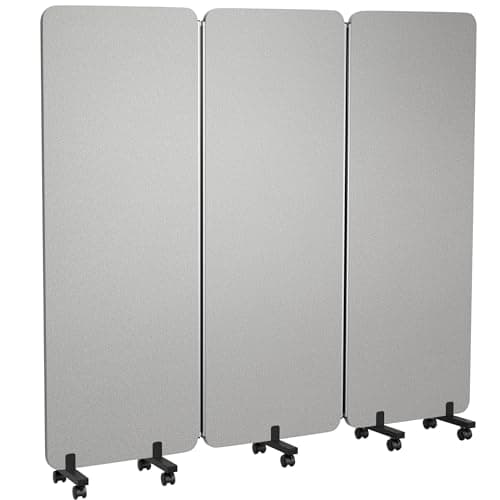
A divider on casters has given up the one thing that was holding it still. What replaces that friction is mass and a working brake, and three of these five will not tell you what they weigh.
SMBy Scooter M.Published October 12, 2026Prices verified October 15, 2026
The short answer
Buy the KERRAM 3-panel. It is the only partition here that pairs real mobility hardware - ten self-locking swivel casters - with a published core material and panel thickness, and it is the only one that folds completely flat when the room needs to be a room again. If you want the best-built mobile partition and do not need it to absorb anything, buy the VIVO PP-3-T072G-M: it is the only product on this page that publishes its weight, and at 55.2 lb it is the only one you can be confident will stay where you put it. Below roughly fifty dollars you are buying a large fabric sail on casters, which is a real product with a real use, but not in a room with a door that slams.
Wheels remove the thing that was holding it still
A freestanding divider stays upright because of two forces: its own weight, and the friction between its feet and the floor. Put it on casters and you have deliberately deleted the second one. That is the whole point - it is why you can reposition 30 sq ft of partition with one hand - but it changes which specification matters.
On a static screen, the base design is the stability story. On a wheeled screen, two things are: how much it weighs, and whether the brake actually holds. Everything else on the listing is secondary. A tall, light, wide panel on free-rolling casters will drift away from a passing draft, and because it rolls rather than tips, it will do so silently until it is somewhere you did not want it.
This matters more than it sounds in exactly the rooms these get bought for. A dining room that becomes an office has a door, a hallway and usually a vent. A partition that moves easily for you also moves easily for the air conditioning.
Weight per square foot of panel, for the two products that publish a weight
VIVO PP-3-T072G-M: 72.4 in x 66 in = 4,778 sq in = 33.2 sq ft of panel
VIVO published weight: 55.2 lb -> 55.2 / 33.2 = 1.66 lb per sq ft
MAYOLIAH rolling screen: 71 in x 75 in = 5,325 sq in = 37.0 sq ft of panel
MAYOLIAH published weight: 9 lb -> 9 / 37.0 = 0.24 lb per sq ft
Difference: the VIVO carries just under seven times as much mass per square foot of sail
Our arithmetic, from each listing's own published dimensions and weight. Both are legitimate products; they are not interchangeable in a room with moving air.
Mobility hardware, as published
This is the whole decision on one page. Note how much of it is blank.
What each product publishes about moving and stopping
Product
Casters
Brake described as
Published weight
Folds flat
KERRAM 3-panel
10 swivel
Self-locking
Not published
Yes, completely
VIVO PP-3-T072G-M
Count not published
All lockable
55.2 lb
No; zip-links apart
YASRKML 3-panel
12 universal
Self-lockable, with brakes
Not published
No; zip-links apart
MAYOLIAH single panel
4
Lockable
9 lb
No
VAMFUTRE single panel
Count not published
Individual locking brakes
Not published
No
Compiled from each listing's own published specification. Availability and prices re-verified against the Amazon Creators API on 2026-10-12.
Self-locking, lockable, braked: nobody defines these
Read the five listings together and you get four different phrases for the same feature. KERRAM says self-locking. YASRKML says self-lockable universal wheels with brakes. VIVO says the feet have wheels and all of them lock. VAMFUTRE says individual locking brakes. Not one of them says what the mechanism is or how much lateral force it holds.
What you can safely take from the wording is narrow but useful: a caster described as having an individual brake is one you have to set deliberately, per wheel, and a divider with ten or twelve of those is a divider somebody will eventually move without setting half of them. A caster described as self-locking engages when the load settles on it, which in practice is the arrangement that survives a household. If you are buying for a room where other people will shift the partition, prefer the self-locking description and prefer fewer wheels to set.
The more honest summary: this is a category where the hardware language is marketing copy, so weight and caster count are the only two facts you can actually compare across products.
What the wheels cost you
Three real costs, none of which appear on the listing as a downside.
A floor gap. Casters raise the bottom of the panel. On a visual screen that is a few inches of ankle-height sightline you did not expect. On an acoustic partition it is worse, because the gap sits exactly where sound travels under a barrier, and a partition's absorbing work is already limited by not reaching the floor or the ceiling. If the partition's job is privacy from a seated eyeline, measure before you assume.
A price premium. VIVO sells the same three-panel system in static and mobile versions, and the mobile one costs about fifty dollars more. That is the clearest read in the category on what casters are worth, because every other variable is held constant. Worth it if the room genuinely has two jobs; wasted if the partition is going to stand in one corner for two years.
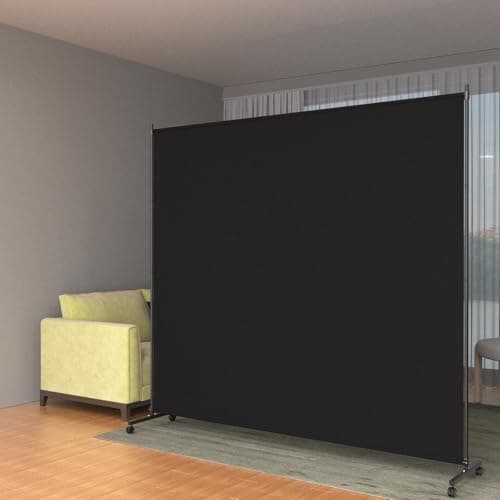
Base depth. Wheeled bases are wider than feet, because they have to be. The MAYOLIAH needs 20 in of clear floor for its base alone. In a small room that depth is the constraint that decides whether a partition fits at all, well before height or width does.
Folding flat is what decides whether you keep using it
The KERRAM is the only partition on this page that folds completely flat, on aluminum frames, and whose only assembly job is attaching the casters. The VIVO and YASRKML zip apart into separate panels, which is useful but is not the same thing - you still have three 66 in panels to lean somewhere. The two single-panel screens do not fold at all.
This is the quiet failure mode of the whole category. A partition in a dedicated office is furniture and never moves. A partition in a shared room gets put up and taken down, and one that has nowhere to go stops being taken down by about week six, at which point it is a permanent fixture in a room that did not want one. If your room has two jobs, the fold matters more than any spec in the table above.
How we ranked these
The same five metrics as the rest of this hub - coverage, acoustic, stability, mobility and documentation - but this page weights mobility and stability hardest, because that is what a buyer searching for wheels is choosing between. That is why the order here is not the order on best acoustic room dividers, which weights published core material and thickness instead. Same products, same scores, different question. Full rubric on how we pick.
#
Product
Best for
Score
Price
01
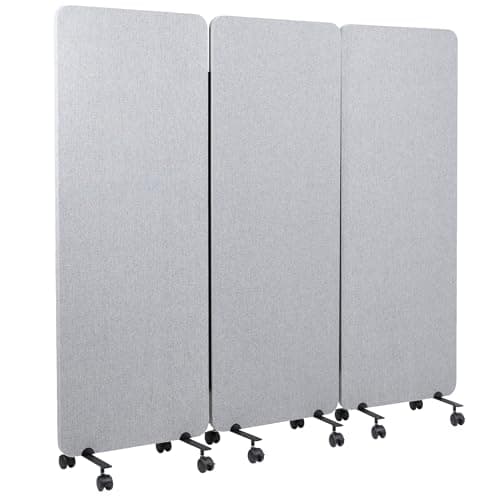
KERRAM 3-Panel Foldable Office Partition with WheelsNames its core material as 100% high-density polyester fiber, states a 1.13 in panel thickness, folds flat, and runs on 10 self-locking casters.
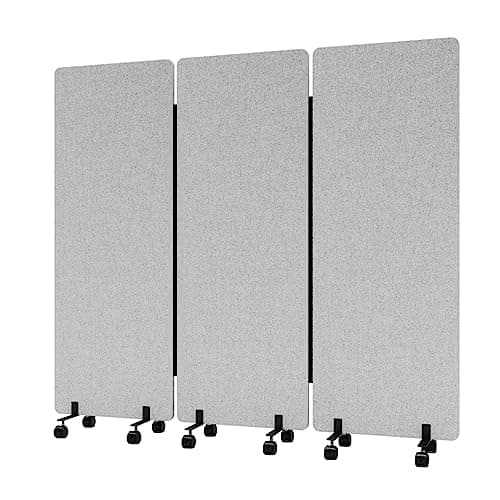
VIVO Freestanding Mobile Privacy Panel, 72 x 66 in (PP-3-T072G-M)The same three-panel VIVO system on lockable wheels, 55.2 lb. Fifty dollars for casters, which is worth it if the room has two jobs.
YASRKML 3-Panel Soundproof Room Divider, Portable AcousticFlame-retardant PET with a fabric wrap, 12 self-locking wheels and a reinforced metal base, at about 60 dollars less than the KERRAM.
MAYOLIAH Single Panel Rolling Privacy Screen, 71 x 75 inOne 71 by 75 in panel on four lockable wheels at 9 lb, with no panel seams. Forty-four dollars, and the tallest screen here.
VAMFUTRE Single Panel Screen on Braked Casters, 6 x 6 ftThirty-six dollars for a 6 by 6 ft panel on caster wheels with individual locking brakes and a reinforced metal frame.
Ranked on mobility hardware rather than absorption, which is why this order differs from our acoustic partition page. Prices are live.
01/KERRAM
3-Panel Foldable Office Partition with Wheels
Best acoustic partition
8.2/ 10
Names its core material as 100% high-density polyester fiber, states a 1.13 in panel thickness, folds flat, and runs on 10 self-locking casters.
Names its core material as 100% high-density polyester fiber, states a 1.13 in panel thickness, folds flat, and runs on 10 self-locking casters.
Published specification
Overall size
71 in wide x 66 in high
KERRAM published specification
Panel thickness
1.13 in
KERRAM published specification
Core
100% high-density polyester fiber, fabric outer
KERRAM published specification
Frame
Aluminum
KERRAM published specification
Casters
10 self-locking swivel casters
KERRAM published specification
Assembly
3 to 5 minutes; casters only, no panel assembly
KERRAM published specification
Absorption
Not published as a figure. The core material and thickness are published, the NRC is not
Absence confirmed against the published specification
What the specs are good for
States a panel thickness AND a core material, which together are the two facts that decide whether a partition does anything acoustically
1.13 in of high-density polyester is a genuine absorber, unlike fabric on a steel frame
Folds completely flat for storage, which no other acoustic partition here does
Aluminum frame keeps the weight down without the flex of a thin steel tube
Ten self-locking casters and a 3 to 5 minute setup
What they are not
No NRC or absorption coefficient published, so the thickness and material are the only evidence
380 dollars for 32 sq ft of partition
Only 20 units showed in stock at the time of writing, so availability is thin
Skip this if
Skip this if you need the partition to block sound rather than absorb it. 1.13 in of polyester fiber reduces reflections and speech spill; it is not a wall and it will not stop a conversation being audible on the other side.
Who it is for. Someone in a shared room who needs the calls to stop bouncing and the partition to disappear into a cupboard at weekends.
Freestanding Mobile Privacy Panel, 72 x 66 in (PP-3-T072G-M)
Best partition that moves daily
7.8/ 10
The same three-panel VIVO system on lockable wheels, 55.2 lb. Fifty dollars for casters, which is worth it if the room has two jobs.
The same three-panel VIVO system on lockable wheels, 55.2 lb. Fifty dollars for casters, which is worth it if the room has two jobs.
Published specification
Overall size
72.4 in wide x 66 in high
VIVO published specification
Panel size
23.8 in wide x 66 in high, 3 panels
VIVO published specification
Weight
55.2 lb
Listing published specification
Model
PP-3-T072G-M
VIVO published specification
Casters
Feet with wheels, all lockable
VIVO published specification
Absorption
Not published
Absence confirmed against the published specification
What the specs are good for
All casters lock, which is what separates a mobile partition from a partition that drifts
3.8 lb heavier than the static version, so the wheels did not come at the cost of mass
Same zip-link flexibility: one panel or three
Moving it is a ten-second job, which means it will actually get moved rather than left up
What they are not
No published absorption figure, same as the static model
450 dollars, the most expensive partition on this page
Wheels raise the panel slightly, opening a floor gap that a static base does not have
Skip this if
Skip this if the partition is going to live in one place. You are paying 50 dollars and a floor gap for mobility you will not use. Buy the static PP-3-T072G instead.
Who it is for. A dining room that becomes an office at 9 and a dining room again at 6.
Flame-retardant PET with a fabric wrap, 12 self-locking wheels and a reinforced metal base, at about 60 dollars less than the KERRAM.
Flame-retardant PET with a fabric wrap, 12 self-locking wheels and a reinforced metal base, at about 60 dollars less than the KERRAM.
Published specification
Overall size
72 in wide x 66 in high maximum
YASRKML published specification
Panel size
24 in wide x 66 in high, 3 panels
YASRKML published specification
Core
Flame-retardant PET with fabric wrapping
YASRKML published specification
Casters
12 self-lockable universal wheels with brakes
YASRKML published specification
Base
Reinforced rust-proof metal
YASRKML published specification
Surface
Tackable
YASRKML published specification
Absorption
Manufacturer states it "absorbs at least 85% of noise". No NRC, no frequency range, no standard
YASRKML published specification
What the specs are good for
Flame-retardant PET core named explicitly, which puts it in the acoustic tier rather than the visual-screen tier
Twelve braked casters on a reinforced metal base: the most caster-and-base hardware of any partition here
Zip-linked and usable as one, two or three panels
Tackable surface, so it doubles as pinboard
What they are not
The "85% of noise" figure is a marketing sentence, not a measurement. No NRC, no frequency band, no test standard
Does not publish a panel thickness, which is the single most useful number for an absorber
Only 13 units in stock at the time of writing
Skip this if
Skip this if you want to compare absorbers on thickness, because YASRKML does not publish one. The KERRAM at 1.13 in tells you what you are buying; this tells you a percentage with nothing behind it.
Who it is for. Someone who wants a PET-cored partition on good casters and will accept less spec data to save 60 dollars.
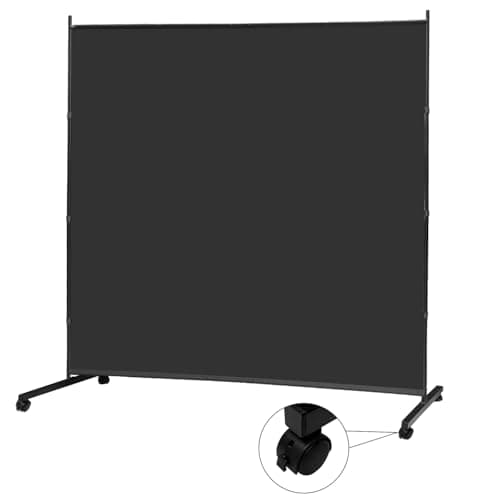
Thirty-six dollars for a 6 by 6 ft panel on caster wheels with individual locking brakes and a reinforced metal frame.
Thirty-six dollars for a 6 by 6 ft panel on caster wheels with individual locking brakes and a reinforced metal frame.
Published specification
Overall size
72 x 72 in
Listing published specification
Casters
Integrated, with individual locking brakes
VAMFUTRE published specification
Frame
Reinforced metal
VAMFUTRE published specification
Assembly
No hinge or multi-section assembly
VAMFUTRE published specification
Weight
Not published
Absence confirmed against the published specification
Acoustic material
None, and none claimed
Absence confirmed against the published specification
What the specs are good for
Individual locking brakes on a 36-dollar screen
Single panel, so no inter-panel gaps
Nothing to assemble beyond unfolding and placing it
Square 6 by 6 ft format suits a corner desk exactly
What they are not
Does not publish a weight, which is the number that tells you whether it will stay upright
No acoustic material
A single-panel screen on wheels has no zigzag to stabilize it, so it depends entirely on the base
Skip this if
Skip this if you need to know what you are getting. The weight is the critical spec for a freestanding screen and VAMFUTRE does not publish it, which is why it is scored below the MAYOLIAH despite being otherwise comparable.
Who it is for. A tight budget, a still room and a corner that needs covering today.
The cheap end of this category, and what it does not publish
Searching for a mobile acoustic partition turns up listings well below the two PET-cored products on this page - wheeled three-panel dividers described as soundproof in the low hundreds, and folding screens on lockable casters under a hundred. We checked a batch of them against the Creators API on 2026-10-12: the prices and the stock are real.
They are not picks here for one reason. The cheapest of them do not publish a brand name, a panel thickness or a core material - several do not publish a manufacturer at all - and on a product sold on its acoustic performance, that is the entire specification missing. We are not going to tell you a partition absorbs anything on the strength of the word soundproof in a title.
If the budget is the constraint, the honest route is to stop paying for absorption you cannot verify and buy coverage instead: a sub-fifty-dollar single rolling panel does the sightline job completely, and the money saved buys wall panels that do publish an NRC. That trade is worked through properly on room divider vs acoustic partition.
If none of these is right
Drop the wheels. If the partition is going to live in one place, a static base is cheaper, more stable and has no floor gap. Best office partitions ranks the fixed-base systems, and best room dividers for a home office covers the category as a whole.
Treat the walls instead. A partition is an absorber on a stand, and a stand is the expensive part. If you can put material on the wall you get more square feet per dollar and lose no floor space at all: best acoustic panels for a home office.
Treat the desk instead. If the problem is one workstation rather than a room, a desk screen takes no floor space and costs a fraction of any partition here. See best desk privacy panels.
Accept that you need an enclosure. If the requirement is that calls cannot be overheard, no partition on wheels at any price delivers that. Office pods and phone booths is the honest next step, with what their published ratings do and do not mean.
FAQ
Questions people ask about this
Do room dividers on wheels stay in place?+
The heavy ones do. Weight is what holds a wheeled partition still once the brakes are set, and it is the specification most sellers in this category omit. The VIVO publishes 55.2 lb across three panels; the MAYOLIAH publishes 9 lb across a larger panel area, which is just under seven times less mass per square foot. In a still room both are fine. In a room with a vent, a ceiling fan or a door that slams, the light one will move.
What does self-locking mean on a caster?+
A self-locking caster engages when weight settles onto it, rather than needing a brake pressed by hand on each wheel. None of the five listings here defines its mechanism or states a holding force, so the phrasing is the only evidence available. If other people in the house will move the partition, the self-locking description is the safer bet, because nobody has to remember to set ten brakes.
Can a room divider on wheels block sound?+
No, and the wheels make it slightly worse. Blocking sound needs mass and an airtight seal, and a partition has neither - it does not reach the ceiling or the floor, and casters lift it further off the floor, opening a gap exactly where sound passes under a barrier. A PET or polyester-cored partition does absorb reflections and reduces speech spill, which makes a shared room calmer. That is a different job from blocking.
Is a mobile partition worth the extra money over a static one?+
Only if the room has two jobs. VIVO sells the same three-panel system both ways, and the mobile version costs about fifty dollars more - the cleanest answer available, since nothing else changes between them. If the partition will stand in one corner indefinitely, that premium buys you a floor gap and nothing else.
How much floor space does a rolling divider need?+
More than the panel suggests, because wheeled bases are wider than feet. The MAYOLIAH publishes a 20 in base depth, and the multi-panel partitions need depth for the zigzag that stabilizes them as well as clearance to swing the end panels. Measure base depth before width: in a small room it is the dimension that rules products out.
Sources
Where these numbers came from
We have not handled any of these products. Every figure on this page is either the manufacturer's own published specification, named as such, or our arithmetic from those figures, shown so you can check it. Prices come from Amazon through our price layer and carry the date they were verified.
Amazon product listings, retrieved 2026-10-03
Published specifications, dimensions, materials and manufacturer claims were read from each product's own listing data. Prices and availability refresh daily and carry their verification date on the page.
The full published method, and an explicit statement of what a specs-only approach cannot tell you.
ASTM C423 — Standard Test Method for Sound Absorption and Sound Absorption Coefficients by the Reverberation Room Method
The governing test method behind any NRC figure. We name it where a manufacturer publishes an NRC so you know what the number is a result of. We have not performed this test and we do not restate anyone's NRC as our own measurement.