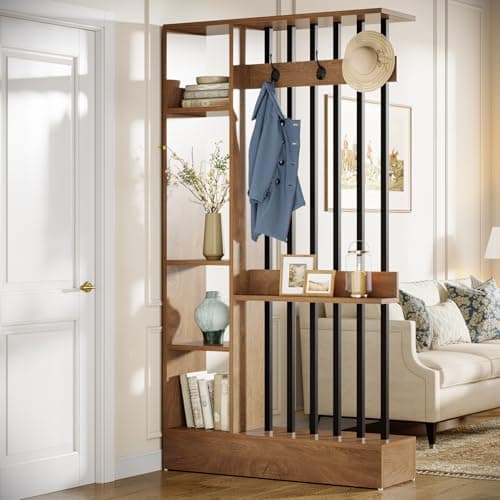
Every unit here ships an anti-tip kit that bolts it to a wall. A divider stands in the middle of the room. Start there.
SMBy Scooter M.Published October 23, 2026Prices verified November 22, 2026
The short answer
Buy the Tribesigns 70.9 in divider bookcase. It is the only unit here designed as a room divider first rather than as a bookcase that might serve as one: 39.4 in wide at eye height, open shelves with vertical metal bars between them, coat hooks, 68.3 lb of mass in the base, and an anti-tip device in the box. If you need to screen a standing person rather than a seated one, buy the SAHISTCT at 79.5 in - it is the tallest here and the only one with semi-transparent infill panels and a closed cabinet, so part of its area blocks a sightline whether or not you load the shelves. And if what you actually want is privacy rather than storage, do not buy either: a 60-dollar folding screen hides more, takes a sixth of the floor, and folds flat when you want the room back.
The thing every one of these ships, and none of them can use
Read the stability line on all five listings and a pattern appears that nobody selling them mentions.
Published anti-tip provision
Product
Height
What the listing says about tipping
Tribesigns
70.9 in
"An anti-tip device for added safety", plus a wide base
SILKYDRY
75 in
"2 anti-tipping kits that secure the book shelf against the wall"
DIYART (per unit)
62.6 in
"A dedicated anti-tip kit to anchor the shelf to the wall"
GIANTEX
39.5 in
"2 anti-toppling kits to secure it to the wall"
SAHISTCT
79.5 in
Nothing. No anti-tip provision is mentioned at all
Each row quotes that listing's own published text. We have not handled any of these units.
Four of the five ship hardware whose entire function is to bolt the unit to a wall. The fifth, which is the tallest, ships nothing. And the reason you are on this page is that you want to stand the thing in the middle of a room, where there is no wall to bolt it to.
This is not a manufacturing oversight. These are bookcases, and a bookcase against a wall with its anti-tip strap fitted is a safe object. Used as a divider, the one safety device it came with is unavailable, and the only things left holding it up are its own base width and the mass at the bottom of it. That reframes which specifications matter.
What is actually holding a mid-room divider up
Base depth is the lever arm resisting a push: GIANTEX 8.5 in, SILKYDRY 9.0 in, DIYART 9.3 in, SAHISTCT 9.5 in, Tribesigns 11.8 in
Empty weight, and crucially how much of it sits low: Tribesigns 68.3 lb, SILKYDRY 52.5 lb, GIANTEX 30 lb, SAHISTCT 85 lb, DIYART 85 lb for two units (about 42 lb each)
Height-to-depth ratio - the higher this is, the less of a push it takes: SAHISTCT 79.5 / 9.5 = 8.4, SILKYDRY 75 / 9.0 = 8.3, DIYART 62.6 / 9.3 = 6.7, Tribesigns 70.9 / 11.8 = 6.0, GIANTEX 39.5 / 8.5 = 4.6
A folding screen, for comparison: three 24 in panels opened to a zigzag give a footprint 20 to 30 in deep, so its ratio is nearer 2.5
Our arithmetic from each listing's published dimensions. A ratio is a comparison between these products, not a safety rating - no maker publishes a tipping force and we have measured nothing. The point of the sum is that a folding screen is inherently stable because it is its own tripod, and a shelf unit is not.
An open shelf blocks nothing until you fill it
The second thing worth being blunt about. A folding fabric screen is opaque the moment it is out of the box. An open bookcase is a frame with holes in it, and the privacy it provides is whatever you put on the shelves.
That cuts both ways and it is the honest reason to buy one. If what you want is a room that reads as two zones with light still crossing between them, open shelving is better than a screen: it marks the boundary without making the far half of the room dark. If what you want is to not be seen on a video call, it is the wrong product and no amount of books fixes the gaps.
What actually blocks the view, by unit
Product
Height
Blocks a seated person
Blocks a standing person
Opaque area with empty shelves
SAHISTCT
79.5 in
Yes
Yes
Partial - semi-transparent infill panels plus a closed cabinet
SILKYDRY
75 in
Yes
Mostly
None - but the staggered S profile breaks a diagonal line of sight
Tribesigns
70.9 in
Yes
Mostly
None - vertical metal bars give visual density, not cover
DIYART pair
62.6 in
Yes
No
None - staggered profile only
GIANTEX
39.5 in
No
No
None
Heights are published figures; the view columns are our judgment from the published height and construction against ordinary seated and standing eye heights. Nothing here was photographed or measured by us.
The SAHISTCT is the only unit in the category we found with any opaque area of its own, and that is most of why it ranks second despite publishing no anti-tip hardware. If the sightline is the point, that matters more than a shelf rating.
The floor cost, which is the real trade
This hub's standing rule is that a divider's honest cost is measured in floor area, not in dollars, and these are the deepest products in the category by a wide margin.
Floor depth against the alternatives
Folding fabric screen, flat against a wall: about 1 to 2 in
Clamp-on desk privacy panel: 0 in - it hangs off the desk you already own
Freestanding acoustic partition on feet: about 10 to 14 in including the feet
Storage divider: 8.5 to 11.8 in of permanently occupied floor, the full width of the unit
Tribesigns, the widest and deepest: 39.4 x 11.8 in = about 3.2 sq ft of floor, permanently
Our arithmetic from published dimensions. The difference from a partition is not the depth - it is that a partition's depth is two narrow feet and a storage divider's is a solid rectangle you cannot stand anything else in.
Three square feet sounds like nothing until you remember it is three square feet in the middle of a room rather than against its edge, which is the most valuable floor in any small home office. The case for paying it is that the unit is doing two jobs: if it replaces a bookcase you would otherwise have had against a wall, the net floor cost is close to zero and you have gained a partition for free. If you would not have bought a bookcase anyway, you are paying three square feet for a partition that does not partition very well. That is the decision, and it is a genuinely close one.
One published load rating in the whole category
Of the five units here, exactly one states what a shelf is rated to hold: SILKYDRY, at 44 lb per shelf. Tribesigns, SAHISTCT and GIANTEX publish nothing, and DIYART offers "engineered to hold heavy loads without sagging", which is an adjective rather than a figure.
That matters here for the same reason it matters across this site's storage hub: paper is far heavier than shelving expects. This site's standing arithmetic is that a letter-size banker's box of paper is about 30 lb, which works out at roughly 1.5 lb per linear inch of upright files.
What a shelf of files weighs, against the one published rating
SILKYDRY shelf, 31.5 in wide, allow about 28 in of usable width
28 in x 1.5 lb per in = about 42 lb of files on one shelf
SILKYDRY published rating: 44 lb per shelf
Margin: about 2 lb
One banker's box, for comparison: about 30 lb - so one box per shelf is fine, two is over the rating
Our arithmetic using the paper-weight figure documented across this site. The shelf rating is SILKYDRY's published figure; the usable-width allowance is ours.
So the one product that tells you its limit turns out to be roughly at its limit with a single shelf of files. We think that is the useful finding rather than a mark against SILKYDRY - it published a number, the number is honest, and the arithmetic says a storage divider is a books-and-decor product rather than an archive product. The four units that publish nothing are presumably in the same territory and will not say so.
The same five metrics as the rest of this hub - coverage, acoustic performance, stability, mobility and documentation - with two notes specific to this format. Every unit here scores 1 for acoustics, because not one contains any absorbing material and we are not going to pretend a bookcase is acoustic treatment. And stability is scored against mid-room use, so a unit whose only published anti-tip provision requires a wall is marked accordingly. Full rubric on how we pick.
#
Product
Best for
Score
Price
01
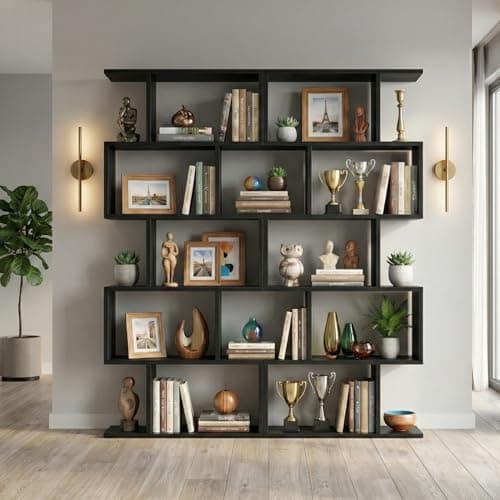
Tribesigns Freestanding Room Divider Bookcase with Coat Hooks, 70.9 inThe only unit here designed as a room divider first: 39.4 in of width at eye height, open shelves, coat hooks and a published anti-tip device.
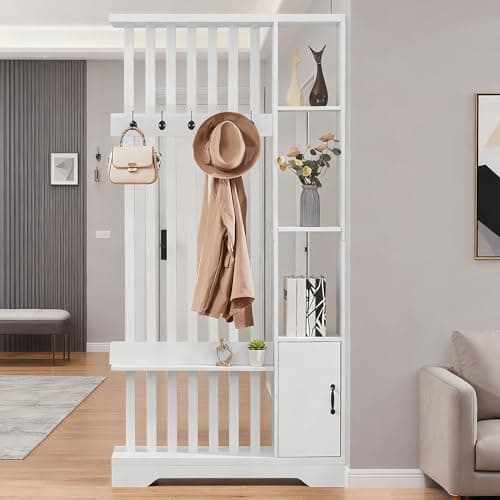
SAHISTCT Room Divider with Storage Cabinet and Coat Rack, 79.5 inThe tallest divider in this set at 79.5 in, and the only one with a closed cabinet and semi-transparent panels rather than open shelf alone.
DIYART 5-Tier S-Shaped Bookcase Room Divider, Set of 2, 62.6 inTwo units in one box giving about 55 in of combined width, which is the cheapest way here to cover a real opening.
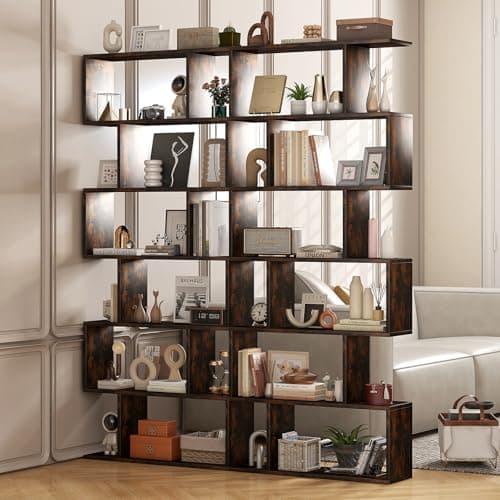
SILKYDRY 6-Tier S-Shaped Bookcase Room Divider, 75 in75 in tall on a 9 in footprint, and the only divider in this format that publishes what a shelf is rated to hold.
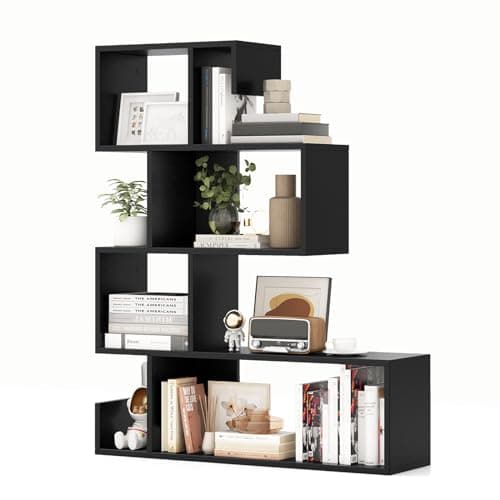
GIANTEX 5-Tier S-Shaped Bookcase, 39.5 inThirty-nine inches tall for about fifty dollars: not a privacy divider by any reading, but a genuine desk-height room break.
Ranked on the five divider metrics, with stability doing more work than usual because a shelf unit used as a divider cannot be anchored. Dimensions and weights are each listing's published figures; prices on the buy rows are live.
01/Tribesigns
Freestanding Room Divider Bookcase with Coat Hooks, 70.9 in
Best storage divider
6.4/ 10
The only unit here designed as a room divider first: 39.4 in of width at eye height, open shelves, coat hooks and a published anti-tip device.
The only unit here designed as a room divider first: 39.4 in of width at eye height, open shelves, coat hooks and a published anti-tip device.
Published specification
Dimensions
39.4 in wide x 11.8 in deep x 70.9 in high
Tribesigns published specification
Weight
68.3 lb
Listing published specification
Structure
Engineered wood with reinforced vertical metal bars
Tribesigns published specification
Storage
Open shelves plus integrated coat hooks
Tribesigns published specification
Stability
Wide base, and an anti-tip device included
Tribesigns published specification
Load rating
Not published
Absence confirmed against the published specification
Absorbing core
None - this is furniture, not acoustic treatment
Our reading of the published specification
What the specs are good for
70.9 in tall, which is the height that actually interrupts a standing sightline rather than just a seated one
39.4 in of width per unit, so one unit covers a desk recess without needing a second
Vertical metal bars between the shelves give it some visual density even where there is nothing on the shelf
68.3 lb is heavy for this format, and on a freestanding divider weight at the base is the stability spec
Coat hooks earn their place: a divider is usually where a room's boundary is, which is where coats end up
What they are not
11.8 in deep, so it takes four to six times the floor a folding screen takes
Publishes no shelf or total load rating, and paper is the heaviest thing a home office owns
Open shelving blocks nothing until you fill it, and what you fill it with becomes the privacy
"Only 19 left in stock" at the time we checked, so availability on this one is thinner than the rest
No absorbing material anywhere in it, so it does nothing measurable for noise
Skip this if
Skip this if the divider has to fold away, or if the reason you are dividing the room is a phone call rather than a sightline. This is a piece of furniture that stays where you put it and has no acoustic function at all.
Who it is for. Someone zoning a room permanently who wants the dividing object to also hold the books, files and coats that currently have nowhere to go.
Room Divider with Storage Cabinet and Coat Rack, 79.5 in
Best for actual privacy
6.0/ 10
The tallest divider in this set at 79.5 in, and the only one with a closed cabinet and semi-transparent panels rather than open shelf alone.
The tallest divider in this set at 79.5 in, and the only one with a closed cabinet and semi-transparent panels rather than open shelf alone.
Published specification
Dimensions
39.4 in wide x 9.5 in deep x 79.5 in high
SAHISTCT published specification
Weight
85 lb
Listing published specification
Structure
Wood with reinforced metal steel pipes
SAHISTCT published specification
Storage
Closed storage cabinet, display shelves and an integrated coat rack
SAHISTCT published specification
Infill
Semi-transparent panels
SAHISTCT published specification
Load rating
Not published
Absence confirmed against the published specification
Anti-tip
Not mentioned in the published specification
Absence confirmed against the published specification
What the specs are good for
79.5 in is the only height here that covers a standing adult, which is what matters if the room is shared while you are on a call
The semi-transparent panels mean part of its area blocks a sightline whether or not you load the shelves - no other unit here can say that
A closed cabinet is the only lockable-looking storage in the format, and the obvious place for the files you do not want on display
9.5 in deep, so it is the second-narrowest footprint in the set despite being the tallest
85 lb, the heaviest here, and on a freestanding object that is the stability figure
What they are not
No anti-tip hardware is mentioned at all, and at 79.5 in tall that absence is the specification
No load rating for the cabinet or the shelves
Described as a "floor to ceiling wall divider" in one line and as freestanding in another, and the listing does not resolve which it is
The most expensive unit in the set, and some of that price is the coat rack and the finish rather than the partition
No absorbing material, so no acoustic function
Skip this if
Skip this if there are children or pets in the room. It is 85 lb and 79.5 in tall, it publishes no anti-tip device, and nothing in this format should be that tall without one.
Who it is for. Someone who needs the divider to genuinely screen a standing person and wants closed storage rather than a display shelf.
5-Tier S-Shaped Bookcase Room Divider, Set of 2, 62.6 in
Best width per dollar
5.9/ 10
Two units in one box giving about 55 in of combined width, which is the cheapest way here to cover a real opening.
Two units in one box giving about 55 in of combined width, which is the cheapest way here to cover a real opening.
Published specification
Dimensions
27.5 in wide x 9.3 in deep x 62.6 in high per unit
DIYART published specification
Combined width
About 55 in with both units side by side
Our arithmetic from the published per-unit width
Pack
2 units
Listing published specification
Weight
85 lb for the pair
Listing published specification
Material
CARB Phase 2 compliant wood, low-VOC finish
DIYART published specification
Anti-tip
A dedicated anti-tip kit per unit, to anchor each to a wall
DIYART published specification
Load rating
Not published; stated only as engineered to hold heavy loads without sagging
Absence confirmed against the published specification
What the specs are good for
About 55 in of combined width for less than either single purpose-built divider costs - by a wide margin the most width per dollar here
Two separate units means you can split the room in an L, or put one each side of a desk, which no single unit can do
CARB Phase 2 and a named low-VOC finish is the only air-quality claim in the set, and it is a reasonable thing to want next to a desk
9.3 in deep per unit keeps the floor cost close to the narrowest here
What they are not
62.6 in is the shortest of the tall units - it screens a seated person and not a standing one
"Engineered to hold heavy loads without sagging" is an adjective, not a load rating, and no figure is published
Two units means two assemblies and a visible seam down the middle of your partition
Each unit's anti-tip kit anchors to a wall, so mid-room both kits are unusable
No absorbing material, so no acoustic function
Skip this if
Skip this if the point of the divider is to screen you while you stand up on a call. At 62.6 in it clears a seated head and not a standing one, and the 75 to 79.5 in units on this page are the ones that do that job.
Who it is for. Someone covering a wide opening on a budget, or dividing two edges of a room rather than one.
75 in tall on a 9 in footprint, and the only divider in this format that publishes what a shelf is rated to hold.
75 in tall on a 9 in footprint, and the only divider in this format that publishes what a shelf is rated to hold.
Published specification
Dimensions
31.5 in wide x 9 in deep x 75 in high
SILKYDRY published specification
Weight
52.5 lb
Listing published specification
Shelf load
44 lb per shelf
SILKYDRY published specification
Shelf height
13 in per shelf
SILKYDRY published specification
Material
E0 grade particle board with melamine veneer
SILKYDRY published specification
Anti-tip
2 anti-tipping kits, which secure the unit against a wall
SILKYDRY published specification
What the specs are good for
44 lb per shelf is the only published load figure in this entire format, and it is the figure that decides whether files can go on it
Publishes the shelf height too (13 in), so you can check a binder fits before buying
9 in deep is the smallest footprint here - the narrowest floor cost of any storage divider we found
75 in tall, second only to the SAHISTCT
The staggered S profile means adjacent shelves face opposite ways, which blocks more of a diagonal sightline than a flat open shelf does
What they are not
31.5 in wide, so covering a desk recess takes two of them and two prices
52.5 lb is the lightest of the tall units here, and light plus 75 in is the wrong combination for a free-standing object
Its own anti-tip kits are designed to anchor it to a wall, which is not available mid-room
Particle board with a melamine veneer is the least durable construction in the set
No absorbing material, so no acoustic function
Skip this if
Skip this if you need one object to cover the gap. At 31.5 in wide it is a half-width divider, and two of them cost more than either purpose-built 39.4 in unit on this page.
Who it is for. Someone dividing a narrow gap - the end of a desk run, an alcove - who wants a published load figure before putting files on a shelf.
Thirty-nine inches tall for about fifty dollars: not a privacy divider by any reading, but a genuine desk-height room break.
Thirty-nine inches tall for about fifty dollars: not a privacy divider by any reading, but a genuine desk-height room break.
Published specification
Dimensions
31.5 in wide x 8.5 in deep x 39.5 in high
GIANTEX published specification
Weight
30 lb
Listing published specification
Material
Thick engineered wood
GIANTEX published specification
Anti-tip
2 anti-toppling kits, which secure it to a wall
GIANTEX published specification
Load rating
Not published
Absence confirmed against the published specification
What the specs are good for
The least expensive entry into the format by a wide margin
8.5 in deep is the smallest footprint of anything on this page
At 39.5 in and 30 lb it is the only unit here that one person can reposition without emptying it first
Desk-height, so it defines a zone without darkening the room or blocking a window
What they are not
39.5 in tall screens nothing above a desktop - it is a boundary marker, not a privacy product
No load rating published
30 lb and five tiers of open shelf is the easiest unit here to overload top-heavy
Its anti-toppling kits anchor to a wall, which a mid-room divider does not have
No absorbing material, so no acoustic function
Skip this if
Skip this if anyone needs to be screened from view. At desk height it marks a zone and does not hide a person, a screen or a mess, which is what most people buying a divider actually want.
Who it is for. Someone who wants the floor plan to read as two zones rather than one, and who is storing rather than hiding.
Three alternatives, because one of them is usually better
A folding screen. Opaque immediately, 1 to 2 in of floor when flat against a wall, folds away when the room has one job again, and a fraction of the price. If privacy is the reason you are reading this, buy one of these instead: the best room dividers for a home office has the ranking.
A cored acoustic partition. If the problem is a phone call rather than a sightline, nothing on this page helps at all and a partition with an absorbing core is the product that does. The best acoustic room dividers separates the ones with a real core from the ones that are fabric on a frame - and room divider vs acoustic partition is the decision itself.
A bookcase against a wall, plus a screen. The unbundled version of this product, and frequently the better buy: a proper shelving unit with a published load rating, anchored where its anti-tip strap works, plus a folding screen for the middle of the room. You usually get more storage, more privacy and more safety for the same money, at the cost of owning two objects instead of one. Office shelving ideas covers the shelving half.
What none of these do
They do nothing for noise. No absorbing core, no mass, no seal. A bookcase full of books has a mild diffusing effect on a hard room and that is not the same as absorption. Do room dividers block sound? explains why almost nothing in this category does.
They do not fold, and they do not move loaded. Every unit here is assembled in place and emptied before it is repositioned. If the room needs to change shape in the evening, this is the wrong product and the best room dividers on wheels is the right one.
They do not publish a tipping force, and most do not publish a load. One shelf rating across five products, no total loads, no stability figure from anybody. We have ranked these on dimensions, weight and what the listings admit, and that is the ceiling of what this category documents about itself.
FAQ
Questions people ask about this
Can you use a bookshelf as a room divider?+
Yes, and several are sold specifically for it, but two things change when you do. First, the anti-tip kit that four of the five units here ship is designed to anchor the unit to a wall, and in the middle of a room there is no wall - so base depth, weight and how low you load it become the only stability you have. Second, an open shelf blocks nothing until you fill it, so the privacy you get is whatever you put on the shelves.
How tall should a room divider with shelves be?+
About 70 in and up if anyone needs to be screened while standing, and 79.5 in in this set is the only height that genuinely covers a standing adult. Around 62 in screens a seated person and not a standing one. Below about 45 in you have a zone marker rather than a divider - useful for making a room read as two spaces, useless for privacy.
How much floor space does a storage divider take?+
Between 8.5 and 11.8 in of depth across the full width of the unit, which for the widest here is about 3.2 sq ft of permanently occupied floor. A folding screen against a wall takes 1 to 2 in. The case for paying the difference is that the divider is also your bookcase - if it replaces shelving you would have bought anyway, the net cost is close to nothing.
Are room dividers with shelves safe without anchoring them to a wall?+
No manufacturer here publishes a tipping force, so nobody can answer that with a number. What the published figures do say is that these units are 4.6 to 8.4 times taller than they are deep, and that four of the five ship anti-tip hardware intended for a wall. If you use one mid-room, load the bottom shelves heavily and keep weight off anything above waist height, pick the deepest base you can, and do not use one at all in a room with small children.
Can you put files on a room divider with shelves?+
Lightly. Only one unit here publishes a shelf rating - 44 lb on the SILKYDRY - and by our arithmetic a 28 in run of upright files is about 42 lb, so a single shelf of paper is already at the published limit. One banker's box per shelf is fine, two is over. If filing is the real job, a shelving unit that publishes both per-shelf and total loads, or a file cabinet, is the right product.
Room divider with storage, or a screen plus a bookcase?+
The screen plus the bookcase, more often than not. You get a shelving unit with a published load rating anchored where its anti-tip strap actually works, plus a partition that is opaque from the first day and folds away. The combined product wins when floor space is so tight that one object has to do both jobs, or when you want the boundary to still let light through.
Do room dividers with shelves help with noise?+
Not meaningfully. None of these contains any absorbing material, and a full bookcase scatters sound rather than absorbing it. If the reason for dividing the room is a call, you want a partition with a published core material instead - that is a different product and a different page.
Sources
Where these numbers came from
We have not handled any of these products. Every figure on this page is either the manufacturer's own published specification, named as such, or our arithmetic from those figures, shown so you can check it. Prices come from Amazon through our price layer and carry the date they were verified.
Amazon product listings, retrieved 2026-10-03
Published specifications, dimensions, materials and manufacturer claims were read from each product's own listing data. Prices and availability refresh daily and carry their verification date on the page.
The full published method, and an explicit statement of what a specs-only approach cannot tell you.
Our arithmetic: the weight of office paper
A standard letter-size banker's box holds about 2,500 sheets; 2,500 sheets of 20 lb bond weighs about 25 lb, so a full box is roughly 30 lb including the box. That works out at about 1.5 lb per linear inch of upright files. Every shelf-load and cabinet-load comparison on this site uses those figures and shows the sum.